Because of Me?

Because of Me?

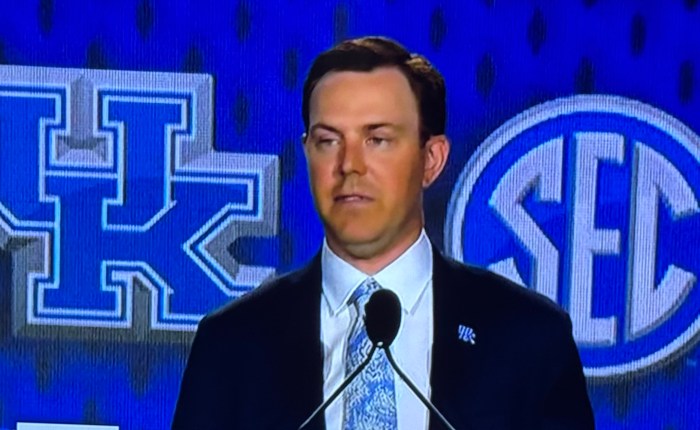
When Will Stein was asked at SEC Media Days why Kentucky football will succeed now after years of inconsistency, his answer wasn’t long.

“Because of me.”

That’s certainly one way to grab a headline.

My first reaction? I actually laughed.

My second reaction? I’m still not sure what to think.

On one hand, I appreciate confidence. You don’t become an SEC head coach by doubting yourself. If you don’t believe you’re the right person for the job, why should anyone else? Fans have spent years begging for coaches with swagger, vision, and the ability to convince recruits that Kentucky can compete with anyone.

Will Stein clearly believes all of that.

In today’s college football landscape, maybe he almost has to.

Coaches aren’t just coaches anymore. They’re CEOs, fundraisers, recruiters, salesmen, and motivational speakers rolled into one. Every microphone is another recruiting pitch. Every quote is designed for social media. Every appearance is another chance to create momentum.

Perhaps “Because of me” wasn’t really directed at reporters.

Perhaps it was directed at every high school recruit listening.

Still…

There is a fine line between confidence and arrogance.

Stein has already made comments suggesting that everyone wants to play for Will Stein. Now comes, “Because of me.”

At some point, the words begin to pile up.

And eventually, they demand results.

The Bible offers a timeless warning: “Pride goes before destruction, a haughty spirit before a fall.”

Those words weren’t written for football coaches, but they apply remarkably well. The higher you build yourself up publicly, the farther you have to fall if things don’t work out.

That’s what gives me pause.

Kentucky football doesn’t have the luxury of making bold proclamations without consequences. This isn’t Alabama. It isn’t Georgia. It isn’t Ohio State.

National audiences are already skeptical of Kentucky football. Many expect the Wildcats to finish somewhere in the middle or bottom of the SEC. Every confident sound bite becomes another receipt waiting to be pulled out if the season starts 2-3 or 3-4.

The internet never forgets. Neither do opposing fan bases. If Kentucky wins, Stein will look like a genius. If Kentucky struggles, those same quotes will be replayed endlessly. The memes practically write themselves.

That’s the risk.

Personally, I’ve always preferred coaches who let their teams do the talking.

Nick Saban rarely made games about himself. Mark Stoops built Kentucky largely by embracing an underdog mentality. Even Mark Pope, as energetic as he is, usually redirects praise toward his players, the program, or Big Blue Nation. Most coaches instinctively redirect the credit away from themselves.

Stein’s approach feels different.

More personal.

More confrontational.

More “watch me.”

Maybe that’s exactly what Kentucky needs.

Maybe the program has spent too many years trying to prove it belongs instead of acting like it already does. Confidence can be contagious. Players often reflect the personality of their coach. If Stein genuinely believes Kentucky is about to become something special, perhaps that belief spreads throughout the locker room.

I’d love nothing more than to look back in December and say his confidence was completely justified.

In fact, Kentucky fans should hope that’s exactly what happens.

Because if Stein backs up every word with victories, nobody will care how bold his quotes sounded in July.

Winning has a remarkable way of turning arrogance into leadership.

But until then, I’m reserving judgment.

Confidence is essential.

Cockiness is entertaining.

Results are everything.

One thing is certain: Will Stein has ensured that people are paying attention.

Now comes the hard part.

Living up to “Because of me.”

Dr. John Huang is a retired orthodontist, military veteran, and award-winning author. Currently serving as a columnist for Nolan Group Media, he invites readers to follow him on social media @KYHuangs. Explore his latest, Whining for Posterity, and all his books at Amazon.
The House Always Wins

The House Always Wins

What good is it for someone to gain the whole world, yet forfeit their soul?

Remember when the worst thing to happen in a basketball game was Perry Stevenson goaltending a free throw or Christian Laettner stomping on someone’s chest? Those were simpler times. Now we’ve got Chauncey Billups and Terry Rozier being investigated for sports gambling.

Welp, shame on us. We got what we asked for.

When we opened the floodgates to legalized sports betting, we were told it would be harmless fun—a way to “enhance fan engagement.” The marketing geniuses promised us responsible wagering, clean oversight, and a little extra tax revenue for our schools. What we actually got was a nation of addicts-in-training, daily fantasy junkies, and people screaming at their phones during the fourth quarter of a meaningless midweek NBA game because they needed one more rebound to hit the over.

And yes, I get it. Gambling itself isn’t inherently evil. It’s not like betting on Kentucky to cover the spread automatically condemns your soul to perdition. But let’s not pretend we didn’t invite the devil in when we started normalizing this stuff as if it were just another harmless hobby.

I know because I’m wired that way myself. I’ve got an addictive personality. Always have. I still remember the euphoric rush of winning my first NCAA tournament bracket—strutting around like Einstein in sneakers because I had correctly predicted some 11-seed Cinderella run to the Sweet 16. Then came fantasy football. Oh, the sweet taste of victory on Monday night! I’d sit there with one player left in the lineup, calculating yards and touchdowns like a Wall Street trader watching his stock portfolio. When my guy scored, I’d practically levitate off the couch.

You see, that’s the problem. It’s never enough. You always want a little more action, a little bigger hit of adrenaline, the proverbial dopamine rush. For people like me, that’s a slippery slope. One day you’re betting a friendly five bucks with your buddies; the next day you’re mortgaging the house because the Bengals can’t possibly blow another lead.

The truth is, gambling can ruin lives. It destroys families, wrecks bank accounts, and turns decent people into liars and thieves. It feeds on desperation and ego—the belief that you can beat the odds, that you’re smarter than the system or your neighbor down the street, that this next parlay will finally get you even. Spoiler alert: the house always wins.

And when that “house” happens to be tied to the integrity of our sports, that’s when things really go south. If you can’t watch a game without wondering whether the ref’s call was clean, or whether the player missed that shot on purpose, what are we even cheering for? The beauty of sports has always been its purity—hard work, skill, competition. Gambling muddies that. It injects suspicion where there should instead be joy.

Money, of course, is the root of it all. It always is. Money draws in the riff raff, the hustlers, and the shadowy figures waiting in the alleys of every major sports scandal. Organized crime didn’t just disappear when we legalized betting; it just put on a nicer suit and opened an app. The lure of easy cash will always attract those looking to exploit the system—and sadly, some of those people will have locker room access.

When I was growing up, sports were an escape from the mess of the world—a pure and noble pursuit of excellence. Now they’re just another line item in somebody’s betting portfolio. Every pitch, every possession, every field goal attempt is a potential profit or loss. Even the broadcasters can’t resist dropping the over/under like it’s part of the game itself.

And while we’re pointing fingers, let’s not forget the sports radio guys who spend half their shows preaching about “responsible gambling” while the other half reading ad copy for the very apps causing the mess. Spare me the sanctimony. You can’t sermonize about integrity one minute and then tell me to “hammer the over” with a promo code the next.

I’m not naïve. I know you can’t unring the bell. Gambling is here to stay. The toothpaste is out of the tube, and no amount of moral handwringing is going to put it back. But we can at least be honest about what it’s doing to us. For every “responsible gamer” out there treating it like entertainment, there are dozens more suckers sinking deeper into the quicksand.

I suppose it’s fine if you know your limits—if you can place a small wager and walk away without checking your phone every five minutes. But for most people, those limits blur over time. The lines between fun and fixation disappear, and before long, you’re chasing losses like Calipari after Covid.

So yeah, when I hear about Chauncey Billups and Terry Rozier getting tangled in the gambling web, I’m not shocked—I’m sad. Sad for them, sad for the sport, sad for the fans who still believe in fair play. Because the more this stuff spreads, the more we risk losing what made us fall in love with sports in the first place.

I’m not preaching here. Like I said, I’m as susceptible as anyone. If gambling apps had been around when I was younger, I might have been one of those guys refreshing DraftKings under the table during Sunday service. (I’m joking… mostly.) But maybe that’s why I’m so wary of it now. I know how easy it is to get hooked, how quickly something innocent can become destructive.

So as these investigations unfold, I’ll be watching—not for the point spreads or the odds, but for the soul of the game itself. Because if we keep going down this road, if we keep letting money and manipulation call the shots, one day we might wake up and realize the thrill is gone. The joy’s been replaced by suspicion, and the purity of the game by the price of the bet.

And when that happens, it won’t matter who wins or loses. The house will have already won.

Dr. John Huang is a retired orthodontist, military veteran, and award-winning author. Currently serving as a columnist for Nolan Group Media, he invites readers to follow him on social media @KYHuangs. Explore his latest, “Whining For Posterity,” and all his books at https://www.Amazon.com/stores/Dr.-John-Huang/author/B092RKJBRD