Cancel the Season

Cancel the Season

DISCLAIMER: This column is satire. Anyone taking it literally should immediately cancel the season.

(LEXINGTON, KY.) – For those of us who love the Wildcats, it was fun while it lasted.

For eight glorious days, Kentucky basketball had everything. There was plenty of momentum, optimism, talent, and depth. Mark Pope had assembled a loaded roster, complete with Final Four expectations and perhaps even another national championship banner dangling somewhere off in the distance.

Then Mark Mitchell ruined everything.

He went back to Missouri.

Missouri.

I haven’t felt this betrayed since Rick Pitino put on a Louisville tie. Okay, that might be a slight exaggeration—just a little embellishment on my part.

Just over a week ago, Mitchell was coming to Kentucky, and suddenly everything surrounding Mark Pope’s third season seemed to fall perfectly into place. Malachi Moreno was back. Milan Momcilovic was here. The roster was loaded. Pope was cooking. J. Batt was fighting the SEC. Greg Sankey was getting dragged into courtrooms.

Big Blue Nation had rediscovered its swagger.

And Mark Mitchell—the two-time All-SEC forward who averaged 18.3 points last season—was going to be the final piece.

Not merely a piece.

The piece.

At least that’s what we convinced ourselves because that’s what Kentucky fans do better than anybody.

Give us one five-star recruit, one transfer portal commitment, or one grainy summer practice video showing somebody hitting three consecutive jump shots, and we’ll have the championship parade route mapped out before dinner.

Mitchell was considerably more substantial than that. He gave Kentucky another proven scorer at the four position, another experienced body, and another legitimate SEC star. His commitment didn’t merely improve Kentucky’s roster. It changed the way we looked at the season.

Kentucky wasn’t merely going to be good anymore. Kentucky was going to be scary. Maybe even national championship scary.

Then Monday arrived, and we all heard the news. “Mark Mitchell is returning to Missouri.”

Excuse me?

I thought we had a deal. I thought the paperwork was signed. I thought the courts had spoken. I thought Greg Sankey had been defeated. I thought J. Batt had stormed Birmingham, planted a UK flag in the SEC offices, and returned to Lexington carrying Mitchell over his shoulder.

Apparently not.

Instead, Mitchell is returning to the same school he was supposedly leaving, and Kentucky is once again holding an empty roster spot and wondering what the heck just happened.

This is unacceptable. Someone must be blamed.

Mitchell? Sankey? The SEC presidents? The NCAA? The transfer portal? The judicial system? Mark Pope? Pope Leo? Missouri?

YES! Let’s blame Missouri.

It’s easier.

Missouri joined the SEC in 2012 and I’ve never completely understood why. They’re somewhere out there west of St. Louis, occasionally beating Kentucky in something and otherwise minding their own business.

Now they’ve stolen OUR power forward.

I move we revoke their conference membership—effective immediately.

And please don’t bother responding with any rational explanations. I know Mitchell’s situation became tangled in an absurd web of NCAA eligibility rules, court rulings, and SEC transfer restrictions. Returning to Missouri apparently provides him a cleaner path toward actually playing basketball this season.

That’s fine, but I don’t want rationality right now.

I WANT OUTRAGE!

Because eight days ago, Kentucky basketball had momentum. Real momentum.

Now?

Season over.

Don’t even play it. Cancel Big Blue Madness. Board up Rupp Arena. Tell the pep band to stay home. Return all season tickets. Turn the Craft Center into pickleball courts.

Aargh, Kentucky basketball has lost Mark Mitchell.

How can we possibly go on?

Of course, we will.

That’s the funniest part of this entire ridiculous episode. Kentucky had a really good basketball team before Mark Mitchell committed. Kentucky had a really good basketball team while Mark Mitchell was committed. And Kentucky still has a really good basketball team now that Mark Mitchell apparently has decided he’d rather spend another winter in Columbia, Missouri.

The Wildcats still have Moreno, Momcilovic, Zoom Diallo, Alex Wilkins, and Kam Williams. They still have plenty of talent. They still have legitimate reasons to believe this season could become something special.

But that’s tomorrow’s perspective.

Today, we mourn.

Eight unforgettable days.

August 22, 2026 — August 31, 2026.

Mark Mitchell’s Kentucky career.

Zero games.

Zero points.

Zero rebounds.

Zero turnovers.

And somehow, one of the most exhausting Wildcats I’ve ever covered.

Rest in peace.

We barely knew ya.

Dr. John Huang is a retired orthodontist, military veteran, and award-winning author. He currently serves as a columnist for Nolan Group Media and invites readers to follow him on social media @KYHuangs. His latest book is Whining for Posterity, available on Amazon.

A Face Full of Cake

A Face Full of Cake

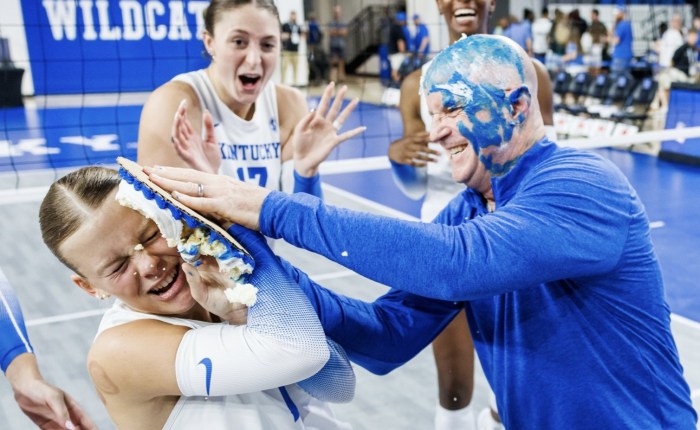
Craig Skinner and Trinity Ward square off in an epic cake battle celebrating Skinner’s 500th career victory (Photo Credit UK Athletics/Kentucky Volleyball).

(LEXINGTON, Ky.) — Craig Skinner won his 500th volleyball match Saturday night, which apparently earned him the traditional reward reserved for legendary coaches everywhere.

A face full of cake.

Kentucky swept South Florida at Historic Memorial Coliseum, setting off a postgame celebration that included video tributes, family congratulations, and Trinity Ward being entrusted with the cake.

Bad idea.

“I was like, ‘Do I get to throw it in his face?’” Ward said.

She did.

Skinner retaliated, Ward claimed she was “tapping out,” and everyone eventually survived long enough to discuss a considerably more impressive accomplishment.

Five hundred wins.

“The 500 thing is not on my radar,” Skinner said.

Maybe it should be. Five hundred victories don’t happen accidentally, particularly at a place where Skinner wasn’t exactly inheriting a volleyball dynasty when he arrived 22 years ago.

He left Nebraska as a career assistant coach without really knowing whether he could successfully run his own program. He and his wife, Megan, came to Kentucky figuring he would see what he could build and perhaps move along after three to five years.

“They’re at the bottom,” Skinner recalled thinking. “Let’s see what we can do.”

So much for the five-year plan.

Skinner stayed, and somewhere along the way Kentucky volleyball went from trying to become relevant to becoming one of the programs everybody else recognizes.

The Wildcats now compete for SEC and national championships, draw large crowds to Historic Memorial Coliseum and receive invitations to the kinds of events that would have sounded preposterous when Skinner arrived. They’ll play UCLA on Wednesday and then face Penn State next weekend at Wrigley Field.

Those aren’t the opportunities Skinner inherited.

They’re the opportunities he helped create.

The interesting part, however, is listening to him explain how.

After Kentucky swept Utah State on Friday night, Skinner talked about the difficult week of practice that followed an earlier loss to Pittsburgh. He thought his team had gotten a little too comfortable.

“Comfort is the enemy of great,” he said.

So practice became decidedly less comfortable.

Skinner doesn’t necessarily believe the old coaching cliché that you play exactly like you practice. Players make mistakes. Execution isn’t always perfect. Some practices are ugly.

What matters to him is the effort behind them.

“I think you play to the effort you give,” he said.

A night later, after victory No. 500 and another sweep—this time over South Florida—Skinner offered an additional glimpse into a philosophy that has served him pretty well for more than two decades.

“Coaches are teachers,” he said. “As soon as coaches lose sight of that, that’s typically when they go off the rails.”

His players seem to understand that part of him better than anybody.

When asked what makes Skinner effective as a teacher, they didn’t talk about sophisticated volleyball strategy or championship-level motivational speeches. They talked about patience. They talked about his willingness to explain something differently when a player doesn’t understand it the first time. They talked about his consistency and how he shows up for them the same way every day regardless of what might be happening in his own life.

They also revealed that he makes a mean risotto and can apparently perform a backflip off a diving board.

I didn’t see either of those accomplishments listed in his official UK bio.

But the number 500 wasn’t what made Skinner emotional Saturday night. Watching the video tributes from former players did.

He remembered what those players were like when they first arrived in Lexington and, more importantly, the people they had become by the time they left.

“That motivates me more than wins,” he said.

Don’t misunderstand him. Skinner likes winning just fine.

“Wins are great, and championships are great, and we all are striving to do that,” he said. “Don’t let people kid you when they say they’re not.”

He’s simply learned that the best way to accumulate victories isn’t necessarily to obsess over accumulating victories.

Teach players. Develop them. Demand effort. Get an entire group of people, as Skinner put it, “looking down the same tracks at the same time.”

Do that long enough and apparently the wins start piling up.

Five hundred of them, to be exact.

Saturday night was supposed to celebrate everything Craig Skinner has accomplished during his 22 years at Kentucky. Instead, it may have provided a pretty good explanation for how he accomplished it.

And when somebody tells you to take off your glasses for a team picture while Trinity Ward is standing nearby holding a cake, don’t fall for it.

Dr. John Huang is a retired orthodontist, military veteran, and award-winning author. He currently serves as a columnist for Nolan Group Media and invites readers to follow him on social media @KYHuangs. His latest book is Whining for Posterity, available on Amazon.

Welcome to the SEC, J. Batt. Greg Sankey Would Like a Word.

Welcome to the SEC, J. Batt. Greg Sankey Would Like a Word.

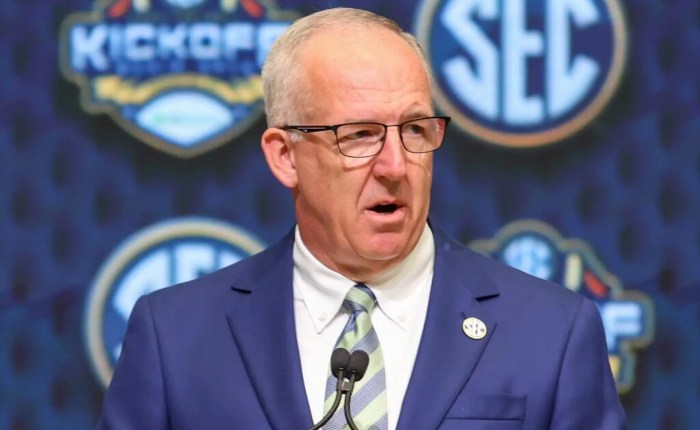
Greg Sankey, pictured at the SEC media day in July. Photo Credit: Jordan Godfree / Imagn Images

J. Batt has had a pretty good honeymoon.

Since arriving at Kentucky, the new athletics director has talked about listening to fans, improving their experience, and positioning the Wildcats to compete at the highest level. He has opened doors. Now we may find out whether he’s willing to kick one down.

Because Mark Mitchell’s eligibility has suddenly become about something much bigger than whether Kentucky adds another talented basketball player. It’s about power. And Greg Sankey and the SEC have plenty of it.

According to CBS Sports’ Matt Norlander, SEC presidents have reaffirmed conference rules that could prevent Mitchell from playing for Kentucky this season. Mitchell played at Missouri last year but didn’t enter the transfer portal during the spring window.

There’s a pretty good reason for that. He wasn’t eligible. Mitchell had exhausted his eligibility after four seasons of college basketball. There was no reason to enter the portal because, as far as everyone knew, there wasn’t another college season to play.

Then everything changed.

Mitchell and other players challenged the NCAA’s eligibility rules in court. A Jefferson County judge granted a temporary restraining order allowing Mitchell to pursue a fifth season. He entered the portal, committed to Kentucky, and suddenly Mark Pope had another experienced piece for a roster with championship aspirations.

Enter the SEC. According to Norlander, Mitchell is believed to fall under the SEC’s prohibition on intraconference transfers because he didn’t enter the portal during the designated window.

Rules are rules. Except when complying with them requires a time machine. How exactly was Mitchell supposed to enter the portal in April for a fifth season that didn’t exist? Unless Doc Brown and a DeLorean are somewhere in Kentucky’s NIL budget, I’m not sure how that was supposed to work.

That’s the question Kentucky should be asking forcefully.

The timing couldn’t be more interesting.

The SEC also just adopted severe penalties in a separate but related eligibility battle for schools that roster athletes who previously signed professional contracts or declared for professional drafts without properly withdrawing. Those penalties reportedly can include a half-season suspension for the head coach, massive financial penalties, and even the loss of conference voting privileges.

That’s not a slap on the wrist. That’s Sankey walking into the room carrying a sledgehammer.

There’s a reason for it.

The NCAA has spent years getting pummeled in court. Every time college sports’ governing bodies draw another line around amateurism, somebody seems to find a judge willing to erase it.

So the SEC is trying something different. Instead of punishing the player, punish the school. Make the consequences painful enough and nobody will dare test the rule.

That’s clever. Whether it survives a legal challenge is another matter. More immediately, we’ll see whether Kentucky is willing to push back.

This is where Batt comes in.

Batt’s early months have included plenty of popular decisions. Better concessions. More fan engagement. Open practices. Even an invitation for aging media members to risk orthopedic surgery playing basketball.

I’ve applauded all of it.

This, on the other hand, is different.

Kentucky isn’t fighting the NCAA from some distant outpost. It’s potentially challenging its own conference and arguably the most powerful commissioner in college athletics.

And Kentucky isn’t merely a victim of SEC governance, either. It’s a member. Its president sits at the same table as everybody else’s. The conference’s rules are ultimately the product of its own institutions.

That makes this situation complicated. It also makes it fascinating.

I’m not suggesting Kentucky should recklessly throw Mitchell onto the floor and dare Sankey to suspend Mark Pope.

There’s a difference between courage and stupidity.

But Kentucky should fight every reasonable fight for him.

Ask for the waiver. Challenge the interpretation. Support Mitchell’s legal efforts where appropriate. Make the SEC explain why a player should be punished for missing a deadline he had no conceivable reason to meet.

And if those avenues fail?

Then Batt has a decision to make.

Because there will be other Mark Mitchells. College athletics is changing too rapidly for there not to be. Courts will rule. Players will sue. Conferences will respond. Rules written six months earlier will collide with circumstances nobody anticipated.

Somebody eventually will discover exactly where the SEC’s authority ends. Kentucky doesn’t necessarily need to volunteer to be the guinea pig. LSU appears perfectly willing to handle that assignment. But Kentucky shouldn’t run from the laboratory, either.

Batt has spent his first few months telling Big Blue Nation that Kentucky intends to think bigger.

Good.

Here’s his chance.

Welcome to the SEC, J. Batt. Greg Sankey would like a word. Something tells me this meeting won’t be about concession prices.

Dr. John Huang is a retired orthodontist, military veteran, and award-winning author. He currently serves as a columnist for Nolan Group Media and invites readers to follow him on social media @KYHuangs. His latest book is Whining for Posterity, available on Amazon.

Because of Me?

Because of Me?

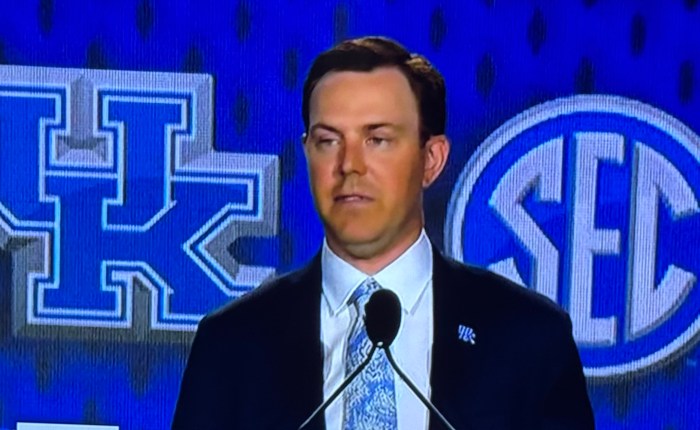
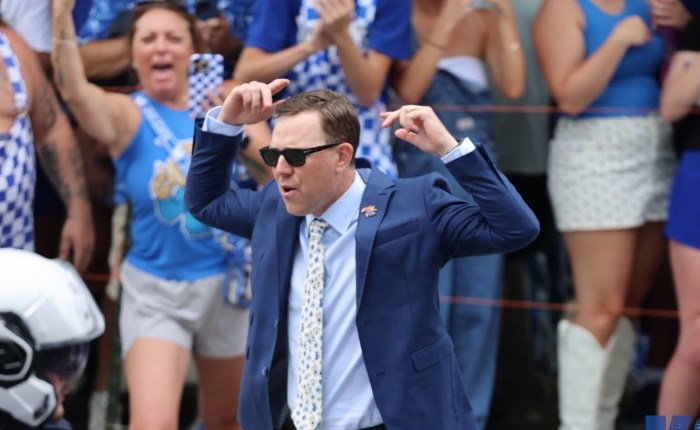
When Will Stein was asked at SEC Media Days why Kentucky football will succeed now after years of inconsistency, his answer wasn’t long.

“Because of me.”

That’s certainly one way to grab a headline.

My first reaction? I actually laughed.

My second reaction? I’m still not sure what to think.

On one hand, I appreciate confidence. You don’t become an SEC head coach by doubting yourself. If you don’t believe you’re the right person for the job, why should anyone else? Fans have spent years begging for coaches with swagger, vision, and the ability to convince recruits that Kentucky can compete with anyone.

Will Stein clearly believes all of that.

In today’s college football landscape, maybe he almost has to.

Coaches aren’t just coaches anymore. They’re CEOs, fundraisers, recruiters, salesmen, and motivational speakers rolled into one. Every microphone is another recruiting pitch. Every quote is designed for social media. Every appearance is another chance to create momentum.

Perhaps “Because of me” wasn’t really directed at reporters.

Perhaps it was directed at every high school recruit listening.

Still…

There is a fine line between confidence and arrogance.

Stein has already made comments suggesting that everyone wants to play for Will Stein. Now comes, “Because of me.”

At some point, the words begin to pile up.

And eventually, they demand results.

The Bible offers a timeless warning: “Pride goes before destruction, a haughty spirit before a fall.”

Those words weren’t written for football coaches, but they apply remarkably well. The higher you build yourself up publicly, the farther you have to fall if things don’t work out.

That’s what gives me pause.

Kentucky football doesn’t have the luxury of making bold proclamations without consequences. This isn’t Alabama. It isn’t Georgia. It isn’t Ohio State.

National audiences are already skeptical of Kentucky football. Many expect the Wildcats to finish somewhere in the middle or bottom of the SEC. Every confident sound bite becomes another receipt waiting to be pulled out if the season starts 2-3 or 3-4.

The internet never forgets. Neither do opposing fan bases. If Kentucky wins, Stein will look like a genius. If Kentucky struggles, those same quotes will be replayed endlessly. The memes practically write themselves.

That’s the risk.

Personally, I’ve always preferred coaches who let their teams do the talking.

Nick Saban rarely made games about himself. Mark Stoops built Kentucky largely by embracing an underdog mentality. Even Mark Pope, as energetic as he is, usually redirects praise toward his players, the program, or Big Blue Nation. Most coaches instinctively redirect the credit away from themselves.

Stein’s approach feels different.

More personal.

More confrontational.

More “watch me.”

Maybe that’s exactly what Kentucky needs.

Maybe the program has spent too many years trying to prove it belongs instead of acting like it already does. Confidence can be contagious. Players often reflect the personality of their coach. If Stein genuinely believes Kentucky is about to become something special, perhaps that belief spreads throughout the locker room.

I’d love nothing more than to look back in December and say his confidence was completely justified.

In fact, Kentucky fans should hope that’s exactly what happens.

Because if Stein backs up every word with victories, nobody will care how bold his quotes sounded in July.

Winning has a remarkable way of turning arrogance into leadership.

But until then, I’m reserving judgment.

Confidence is essential.

Cockiness is entertaining.

Results are everything.

One thing is certain: Will Stein has ensured that people are paying attention.

Now comes the hard part.

Living up to “Because of me.”

Dr. John Huang is a retired orthodontist, military veteran, and award-winning author. Currently serving as a columnist for Nolan Group Media, he invites readers to follow him on social media @KYHuangs. Explore his latest, Whining for Posterity, and all his books at Amazon.
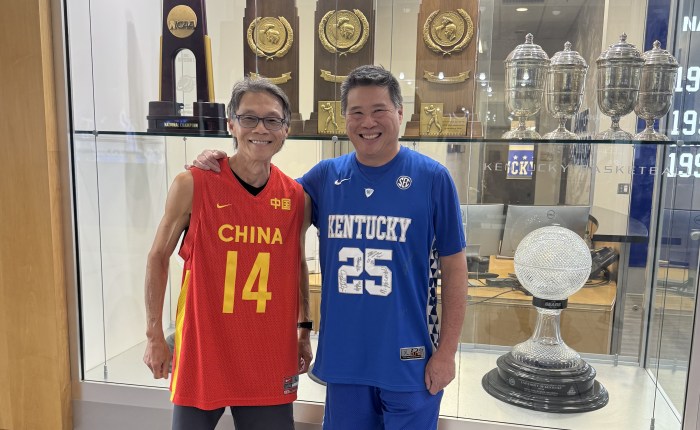
Why Kentucky Didn’t Want Another Mitch Barnhart

Why Kentucky Didn’t Want Another Mitch Barnhart

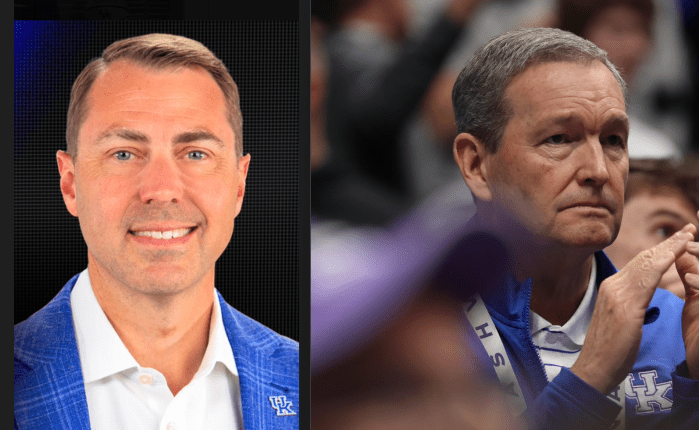
The easiest way to understand Kentucky’s hiring of J Batt is to stop thinking about Mitch Barnhart. In fact, the farther away you get from Mitch Barnhart, the closer you get to understanding why Kentucky made this hire.

That’s not criticism. It’s reality.

For twenty-three years, Mitch Barnhart was exactly what Kentucky needed. He was steady, measured, patient, and dependable—all necessary traits for the head honcho in charge.

If Mitch Barnhart were a vehicle, he would have been a Toyota Camry. He wasn’t flashy. He wasn’t loud. He wasn’t constantly reminding you how innovative he was. He simply started every morning and got you where you needed to go.

For more than two decades, that was a tremendous asset. The problem, however, isn’t that Barnhart changed. The problem is that college athletics did.

The world Mitch Barnhart mastered no longer exists.

When Barnhart arrived in Lexington, players couldn’t transfer freely. NIL wasn’t a thing. Revenue sharing wasn’t a thing. Athletic departments weren’t competing against professional franchises for attention. Nobody was discussing private equity investments in college sports. Most fans had never heard the words “collective” or “portal.”

Back then, an athletics director hired coaches, built facilities, balanced budgets, and tried not to make national headlines. Today? Today an athletics director needs to be part CEO, part fundraiser, part lawyer, part economist, part politician, and part crisis manager. Somewhere along the way, college athletics stopped being a department and became an industry.

That’s why Kentucky’s hiring of J Batt feels so significant.

Kentucky wasn’t looking for the next Mitch Barnhart.

Kentucky was looking for Mitch Barnhart’s opposite.

Again, that’s not an insult. It’s a recognition that the job description has fundamentally changed.

Barnhart represented stability. Mitch Barnhart ran Kentucky athletics the way your favorite small-town banker used to run a bank. He knew people. He remembered names. He understood that relationships mattered. You got the sense he could walk through a student-athlete dining hall and recognize half the room.

J Batt inherits a world where the athletics director is less small-town banker and more hedge fund manager. The challenge isn’t remembering everyone’s name. The challenge is making sure the balance sheet survives long enough for there to be a team wearing the jersey.

Barnhart spent years carefully building Kentucky athletics.

J Batt arrives at a time when the entire structure of college sports seems to change on a monthly basis.

One man was built for certainty.

The other was hired for chaos.

And make no mistake—chaos is exactly what college athletics has become. Schools are paying players. Players are changing schools. Conferences are expanding. Conferences are disappearing. Lawsuits are flying. Revenue-sharing models are being rewritten. Television contracts are driving decisions that would have seemed absurd a decade ago.

The sport isn’t evolving. It’s mutating. Which is why I find Kentucky’s hire so fascinating. The university didn’t simply replace an athletics director. It acknowledged reality.

For years, Kentucky’s greatest advantages were tradition, facilities, fan support, and resources. Those things still matter. But they no longer guarantee anything. Today, success depends on navigating a constantly shifting landscape where the rules seem to change faster than the scoreboards.

The modern athletics director isn’t simply protecting an institution. He’s repositioning it. That’s a different skill set. It’s also a different personality.

Mitch Barnhart always felt like a caretaker.

J Batt feels more like a venture capitalist.

One was entrusted with preserving what Kentucky had built.

The other is being asked to figure out what Kentucky must become.

Those are very different assignments. And that’s why this hire feels bigger than many fans realize.

Most people will judge J Batt by wins and losses. That’s understandable. Fans should care about wins and losses. But his biggest challenge may have nothing to do with scoreboards. His challenge is ensuring Kentucky remains Kentucky while college athletics transforms into something none of us fully recognize.

That’s not easy. In some ways, it’s impossible. Because the truth is that the college sports many of us grew up loving are already gone.

The amateur model is gone.

The old recruiting model is gone.

The old roster-building model is gone.

The old business model is gone.

What’s replacing them remains a work in progress.

Which brings us back to J Batt. Kentucky didn’t hire him because Mitch Barnhart failed. Kentucky hired him because the world Mitch Barnhart mastered disappeared.

The next decade won’t be about protecting the past. It will be about surviving the future.

And that may be the most important hire Kentucky has made in years.

Dr. John Huang is a retired orthodontist, military veteran, and award-winning author. He currently serves as a columnist for Nolan Group Media and invites readers to follow him on social media @KYHuangs. His latest book is Whining for Posterity, available on Amazon.

Seven Million Dollars? Have We Completely Lost Our Minds?

Seven Million Dollars? Have We Completely Lost Our Minds?

Milan Momcilovic/ photo courtesy Jacob Rice/ Iowa State Daily

I have a confession to make. When I first heard the reported figure Kentucky allegedly paid Milan Momcilovic to come to Lexington, I assumed somebody had misplaced a decimal point.

Seven million dollars? Are you kidding me?

I immediately began searching for clarification. Surely they meant seven hundred thousand. Maybe 1.7 million. Perhaps even 2.7 million. After all, NIL has changed everything. But seven million dollars for one college basketball player? That number sounds less like a recruiting budget and more like something you would pay to acquire a small Caribbean island.

Before anyone accuses me of criticizing Momcilovic, let me make something perfectly clear. This isn’t about him.

I wanted more than anything for Kentucky to land him.

I think he’s exactly the kind of player Mark Pope needed. Kentucky lacked consistent perimeter shooting last season. Momcilovic is one of the best shooters in college basketball and immediately makes the Wildcats better in so many different ways. Not only will he score, but he’ll automatically spread the floor, allow his teammates to create, and open up the lanes for a bunch of easy baskets. If Coach Mark Pope wanted him, I wanted him. That’s not the issue.

The issue is the number.

Maybe I’m showing my age, but I grew up in an era when Kentucky fans debated whether a coach was worth a million-dollar contract. I can still remember when coaching salaries themselves seemed outrageous. Today, we’re discussing the possibility of paying a college basketball player seven times that amount.

Think about the names that have passed through Lexington.

Dan Issel.

Jack Givens.

Kyle Macy.

Jamal Mashburn.

Anthony Davis.

John Wall.

Shai Gilgeous-Alexander.

None of them made anything remotely approaching seven million dollars while wearing Kentucky blue. Heck, Coach Adolph Rupp most likely didn’t make seven million dollars in his entire forty-year career.

Yet here we are.

What fascinates me isn’t necessarily the amount itself. What fascinates me is how quickly we’ve become numb to numbers that would have seemed absurd only a few years ago. If somebody had predicted ten years ago that Kentucky fans would be casually discussing whether a player was worth seven million dollars, we would have laughed them out of the room. That’s a lot of twenty-dollar handshakes.

Today the reaction is often, “Well, that’s just what it costs.”

Maybe that’s true.

In fact, that’s the uncomfortable part of this conversation. If Kentucky wants to compete for championships, perhaps this really is what it costs. Perhaps the market has spoken. Perhaps this is simply the new reality of major college athletics.

If that’s the case, then we should at least be honest about what we’ve become.

For years the argument was that players deserved compensation. I didn’t always agree. I felt the free tuition and associated amenities were more than a fair tradeoff.

But I’ve since relented a bit. Universities, television networks, apparel companies, and coaches were making fortunes while the players generated much of the product. I’ll admit the old system wasn’t fair.

But somewhere along the way, college athletics stopped evolving and started mutating.

Today we have free agency, bidding wars, contract negotiations, agents, revenue sharing, NIL collectives, and transfer portals. The jerseys still say Kentucky across the front, but increasingly the sport resembles professional basketball with pep bands and mascots.

I don’t blame the players.

In fact, if someone offered me seven million dollars when I was nineteen years old, I would have sprinted toward the nearest signature line before they could change their minds.

The players didn’t create this marketplace. The adults did. The schools did. The boosters did. The television networks did. And yes, the fans did.

For years, fans demanded that their schools spare no expense. We demanded elite recruits. We demanded Final Fours. We demanded championships. We demanded that our programs do whatever it took to stay ahead of the competition.

Well, apparently somebody listened.

Now we’re seeing what “whatever it takes” actually looks like.

Of course, all of this leads to the obvious question.

Is any college basketball player worth seven million dollars?

My answer is simple.

No.

Nobody is worth seven million dollars. Not John Wall. Not Anthony Davis. Not Cooper Flagg. Not anybody.

Unless…they win Number Nine.

That’s the standard at Kentucky.

At seven million dollars, we’re no longer talking about potential. We’re no longer discussing upside, projections, or recruiting rankings. We’re discussing results only. We’re discussing banners. We’re discussing championships.

Fair or unfair, a number that large creates expectations that are equally large.

If Kentucky wins a national championship, nobody will care what Momcilovic cost. Fans will call it a bargain. They’ll call it money well spent. They’ll celebrate the investment the same way businesses celebrate a successful acquisition.

But if Kentucky falls short, that number won’t disappear. It will hover over every loss, every missed shot, every disappointing March exit. That’s simply the reality of attaching professional-level money to college-level expectations.

Perhaps that’s what bothers me most.

The old connection between fans and players was built largely around shared identity. Players came to Kentucky because they wanted to be Wildcats. Fans embraced them because they represented Kentucky. Today, many players come because Kentucky assembled the most competitive financial package.

Again, I don’t blame them. Most of us would do exactly the same thing. But let’s not pretend the relationship hasn’t changed.

Maybe that’s progress. Maybe it’s inevitable. Maybe it’s even fair. I honestly don’t know.

But every once in a while, I hear a number like seven million dollars and find myself wondering whether we’ve mistaken evolution for absurdity.

And then I remind myself of one final truth.

If Banner Number Nine is hanging in Rupp Arena next April, nobody will remember the price.

Until then, however, I reserve the right to stare at that reported number and wonder whether college basketball has finally lost its mind.

Dr. John Huang is a retired orthodontist, military veteran, and award-winning author. He currently serves as a columnist for Nolan Group Media and invites readers to follow him on social media @KYHuangs. His latest book is Whining for Posterity, available on Amazon.

NIL, APR, and Other Fairy Tales

NIL, APR, and Other Fairy Tales

The University of Kentucky Athletic Department proudly announced this week that UK student-athletes achieved a combined 3.471 GPA this spring, marking the 28th straight semester above a 3.0.

Twenty-eight straight semesters. That’s a mark of unparalleled consistency.

The release was filled with impressive numbers. Four hundred fifty-nine athletes above a 3.0. One hundred thirty-six with perfect 4.0 GPAs. Volleyball leading the way with a staggering 3.865 GPA. Men’s basketball posting a sparkling 3.59. Football climbing above a 3.0. Eight teams earning perfect APR scores.

And honestly, those accomplishments deserve recognition. A lot of these athletes work incredibly hard balancing travel, practices, media obligations, workouts, NIL appearances, social media branding, and actual coursework. The academic support staffs deserve medals for somehow keeping all the trains running on time in an environment that increasingly resembles free agency with mascots.

Still, forgive me if I chuckled while reading the release.

Because while UK is celebrating APR scores and graduation rates, the rest of college athletics now operates like a bizarre hybrid of the NFL, Wall Street, and reality television. Revenue sharing has arrived with a vengeance. NIL collectives function like salary-cap departments. Boosters debate roster construction with the intensity of Fortune 500 executives discussing quarterly earnings. Coaches talk openly about roster retention costs while fans stalk transfer portal announcements like day traders watching stock tickers.

Yet every spring, universities still release these glowing academic reports with the warm sincerity of a church bulletin.

“At Kentucky, the educational mission remains central,” Mitch Barnhart said in the release.

And I actually believe he believes that. I do.

But the contrast is impossible to ignore.

One minute, fans are screaming online about the desperate need for a seven-foot rim protector who can defend ball screens and shoot 38 percent from three. The next minute, the university puts out an APR graphic like educational outcomes are all that matter.

That’s what makes modern college athletics such magnificent theater.

We’ve created a world where a freshman quarterback can earn more money before his sophomore year than several university professors combined, yet schools still expect us to become emotionally moved over cumulative GPA announcements.

Again, this isn’t anti-education. Quite the opposite. I still genuinely love universities. My family funds scholarships. I spent decades in healthcare and education-related environments. I’m one of the few media people who asks academically related questions and questions APR outcomes. I believe academics matter deeply.

Which is precisely why this whole charade fascinates me so much.

The NCAA still unveils APR scores every year with all the drama of sacred scripture being lowered from the mountaintop. The Academic Progress Rate remains one of those phrases that sounds incredibly important while simultaneously causing most fans’ eyes to glaze over instantly.

We all understand that the average fan is far more concerned about whether Kentucky has enough NIL money to keep a backup guard from transferring to Arkansas next Tuesday.

At this point, “student-athlete” feels less like a meaningful description and more like a nostalgic phrase from another era. Like “video rental store” or “collect call.”

I especially enjoyed seeing men’s basketball post a 3.59 GPA. A 3.59 at Kentucky, no less. That’s genuinely impressive considering half the fan base spent the offseason demanding more “dudes” and another year of eligibility for Otega Oweh.

The real heroes in all this may honestly be the academic counselors. Somewhere inside the Joe Craft Center, an exhausted advisor is probably trying to have a serious discussion about long-term educational development with a teenager whose NIL valuation already exceeds the salary of multiple associate professors combined. The fact those conversations happen with straight faces is one of the true miracles of modern college athletics.

And maybe that’s why these academic numbers feel so strange now. Not fake. Not meaningless. Just disconnected from what college sports has become.

A 3.471 GPA in the NIL and revenue-sharing era simply does not carry the same context it once did. Not with online coursework, massive institutional support systems, and billions of dollars floating around the enterprise. College athletics has evolved into a professional entertainment business carefully wrapped inside educational branding, and everybody involved knows it.

The schools know it.

The coaches know it.

The players know it.

The fans absolutely know it.

We just keep pretending otherwise because “student-athlete” sounds far more wholesome than “young entertainment employee with a Maserati and a meal plan.”

So yes, congratulations to UK Athletics. The accomplishments are real, and the work behind them deserves praise.

But every time I read one of these glowing academic press releases, I still can’t help but picture some wealthy booster proudly nodding at the 3.471 GPA announcement while simultaneously texting a collective representative:

“Wonderful. Now how much for that five-star offensive tackle?”

Dr. John Huang is a retired orthodontist, military veteran, and award-winning author. He currently serves as a columnist for Nolan Group Media and invites readers to follow him on social media @KYHuangs. His latest book is Whining for Posterity, available on Amazon.

The Best Will Stein Interview Yet?

The Best Will Stein Interview Yet?

There was a time, years ago, when I somehow found myself as editor of the Just The Cats website. When the radio show took a temporary hiatus, the website went totally defunct—but man—I sure do miss those days.

I also miss working with Michael Bennett.

Even back then, Michael had a gift. Not necessarily for subtlety—but for making every conversation somehow come alive by circling back to Michael Bennett. If there were a tornado warning in Louisville, Michael would somehow mention he once interviewed a meteorologist at a charity golf scramble while standing near a buffet line at Valhalla.

So hearing Michael interview new Kentucky football coach Will Stein this morning on “Just the Cats” felt strangely comforting. It was football talk mixed with a humble brag TED Talk. Part sports radio interview. Part “This Is Your Life: Michael Bennett Edition.”

In other words, it was “radio gold.”

Within the first two minutes, Michael had already managed to mention:

  • Churchill Downs Turf Club access
  • meeting Stein outside a men’s restroom
  • horse ownership
  • heading to the Preakness
  • Mark Stoops being his friend
  • Vince Marrow being one of his closest friends
  • his lifelong sales background
  • volunteering his phone number for NIL fundraising duty

Honestly, it was magnificent.

To Stein’s credit, he handled it beautifully.

The poor guy probably thought he was doing a simple radio appearance and instead wandered into a verbal obstacle course where every answer eventually led back to Michael either:
A) knowing somebody important,
B) owning something expensive,
or
C) losing 50 pounds.

Still, beneath the accidental comedy, Stein said several things Kentucky fans should pay attention to.

Leave it to Michael Bennett to conduct the perfect Will Stein interview.

First, the recruiting momentum is real.

Stein downplayed the recent run of four-star commitments as merely “old school recruiting,” but the details mattered. He emphasized repeated contact, multiple campus visits, relationship building, and consistent communication with not just players, but parents, trainers, coaches, and agents.

That sounds simple. It isn’t. Just ask Mark Pope.

Kentucky football has often recruited like a program trying to convince players not to leave. Stein is recruiting like a program expecting elite talent to arrive. There’s a difference in tone there. Fans can feel it already.

And yes, part of that energy comes directly from Stein himself. The man sounds like a first-time head coach fueled by energy drinks and Navy SEAL motivational videos.

At one point, discussing preseason predictions that Kentucky could finish near the bottom of the SEC, Stein casually unveiled his team motto:

“F everybody but us.”

That’ll play in Lexington—especially after the last couple seasons where Kentucky football often felt emotionally exhausted before kickoff even started.

Stein’s confidence may ultimately prove justified or delusional. Nobody knows yet. But what’s undeniable is that the temperature around the program has changed dramatically in just a few months.

And unlike some coaches who manufacture swagger like a corporate branding exercise, Stein’s personality feels natural. Maybe borderline unhinged at times—but authentic.

That authenticity came through repeatedly thanks to Michael’s prompting.

When Michael asked how he approaches recruits, Stein didn’t launch into analytics jargon or culture buzzwords. He talked about relationships. About genuinely caring about players before selling them on football.

“It’s not slimy, weird, or scammy,” Stein said.

Considering modern recruiting often resembles international hostage negotiations conducted through collectives and Instagram graphics, that line probably resonated with fans.

Stein also revealed something else Kentucky desperately needed: obsession.

Not fake coach-speak obsession. Actual obsession.

When asked which game he’s most excited about, he didn’t bite on Tennessee, Alabama, Louisville, or revenge narratives.

“Youngstown State, September 5th.”

That answer sounds boring until you realize he means it.

Stein approaches football like a man who still wakes up angry about a missed block in eighth-grade Pop Warner. Kentucky fans have spent years begging for someone to inject life back into the program. Well, careful what you wish for. They may have hired a caffeinated football lunatic.

The most revealing moment, though, came when Stein discussed mindset.

“There’s never been a game I’ve gone into thinking we’re gonna get our asses beat,” he said. “If that’s your mentality, you’re a loser.”

Again—not polished. Not PR-approved. Probably not ideal for SEC Media Days.

But Kentucky fans are starving for somebody who sounds like they actually expect to matter nationally.

For years, Kentucky football’s identity was built around toughness and overachievement. Somewhere along the way, that edge dulled. The program started feeling like it was constantly explaining why it couldn’t compete instead of plotting how it could.

Stein doesn’t sound interested in explanations.

Now, does that guarantee wins? Of course not.

This is still the SEC. The schedule is brutal. And eventually the honeymoon phase ends. Stein himself even called it “the honeymoon buffet,” which may have been the perfect phrase considering Michael Bennett spent half the interview discussing food, cakes, Turf Club seating, and rich people.

But right now, Kentucky football feels alive again.

And honestly, maybe that’s enough for May.

And finally, Michael Bennett deserves some sort of broadcasting lifetime achievement award for successfully turning a Will Stein interview into:

  • a Derby recap,
  • a weight-loss testimony,
  • a horse ownership update,
  • a family therapy session,
  • and an NIL fundraiser.

All while reminding us he once met the Kentucky football coach outside a bathroom.

Honestly, elite broadcasting range.

Just like the good ol’ days.

Dr. John Huang is a retired orthodontist, military veteran, and award-winning author. He currently serves as a columnist for Nolan Group Media and invites readers to follow him on social media @KYHuangs. His latest book is Whining for Posterity, available on Amazon.

Please , Sir, I Want Some More!

Please , Sir, I Want Some More!

If 68 teams are good, then more must be better, right?

That seems to be the guiding philosophy behind the latest push to expand the NCAA Division I Men’s Basketball Tournament. Because when something works beautifully, the natural instinct—apparently—is to stretch it and squeeze it. We’re like Oliver Twist, always pleading for more porridge.

Why stop at 68? Let’s go full buffet line. Ninety-six. One hundred twenty-eight. Let’s invite your neighbor’s rec league champion and the entire KSR bowling team while we’re at it.

Sadly, this is where we are.

The inevitable expansion isn’t really about competitive balance—despite what analysts like Seth Greenberg will tell you between commercial breaks. It makes for a great soundbite. It just doesn’t happen to be true.

Honestly, the choice isn’t about inclusion. It’s not even about giving that plucky mid-major a better shot at glory. This is about money—cold, hard, TV-contract, inventory-filling money.

And yes, before someone sends me a strongly worded email with 17 bullet points and a KenPom chart, I understand the arguments. More access, more Cinderella stories, more games, more reason to retain coaches, more content for media.

More.

That word should make you nervous. Because in college athletics, “more” rarely means better. It usually means diluted, bloated, and harder to care about.

Sixty-eight teams already felt like we were pushing the limits. We’ve got First Four games that feel like play-in games to the play-in games. We’re asking fans to invest emotionally in teams that, in many cases, barely proved they belonged in the field to begin with.

And now the solution is to… add more?

At some point, you don’t have a tournament. You have participation trophies with a TV schedule.

The beauty of Selection Sunday has always been its tension—the idea that you earned your shot through the grind of a long season. Expand the field, and you cheapen that accomplishment. Why even play the regular season?

And let’s not pretend this is being driven by some noble mission to “grow the game.” The game is doing just fine. The arenas are packed. The ratings are strong. The brackets—those glorious, chaotic brackets—are already a national obsession.

This is about squeezing more out of something that’s already near perfect.

It’s the classic mistake: taking a great product and over-engineering it in the name of revenue. Like adding extra endings to a movie that didn’t need one. Or turning a tight 90-minute thriller into a bloated three-hour director’s cut because you can.

The NCAA sees inventory. Networks see programming. Advertisers see eyeballs.

Fans? We get a longer, messier tournament that asks for more of our time while giving us less of what made it special.

And here’s the irony: expanding the field doesn’t really help the teams it claims to help.

Those fringe teams? They’re still long shots. They’re still walking into a buzzsaw against better, deeper, more talented programs. The difference now is we’re pretending their inclusion is meaningful when it’s mostly symbolic.

Congratulations. You made it. Here’s your one shining moment.

Now please exit quietly after your 20-point loss. You shouldn’t have been here anyway.

Meanwhile, the top seeds get an even easier path. More mismatches. More tune-up games disguised as tournament contests. The rich get richer, and the rest get a slightly nicer seat at the table before being asked to leave.

That’s not equity. That’s optics.

And let’s talk about the fan experience for a second. The bracket—arguably the greatest interactive element in all of sports—is already a delicate, maddening puzzle. It’s what pulls in casual fans, office pools, and that one friend who hasn’t watched a game all year but suddenly becomes a bracketologist.

Now we’re going to complicate it further?

More teams means more variables, more confusion, and frankly, less fun. There’s a tipping point where complexity stops being engaging and starts being exhausting.

We’re flirting with that line.

Look, I’m not naïve. College sports has been on this trajectory for years. Conference realignment, NIL deals, transfer portal chaos—it’s all part of the same ecosystem. The business side has been winning for a long time.

But this one feels different because it messes with something that didn’t need fixing.

March Madness wasn’t broken.

It was one of the few things in sports that felt universally loved, reliably unpredictable, and beautifully simple at its core: win or go home.

Now it’s starting to feel like: win… or maybe you still get in.

And maybe that’s not just a tournament problem.

But hey, what do I know?

I’ve never won a bracket.

Now it’ll be even harder.

Dr. John Huang is a retired orthodontist, military veteran, and award-winning author. He currently serves as a columnist for Nolan Group Media and invites readers to follow him on social media @KYHuangs. His latest book is Whining for Posterity, available on Amazon.