When Words Wound

When Words Wound

“The words of the reckless pierce like swords,
but the tongue of the wise brings healing.”

Proverbs 12:18

I was raised to believe that the presidency matters. Not necessarily the man occupying it at any given moment, but the office itself. It is bigger than personality, bigger than party, and often bigger even than policy. The presidency is one of the few remaining civic institutions that still carries moral weight—at least, it should. When the president speaks, the country listens. When the president stumbles, the consequences echo far beyond a 24-hour news cycle.

That conviction shapes how I view politics, and it shaped my reaction this week to the brutal deaths of filmmaker Rob Reiner and his wife. A double homicide is the kind of tragedy that should still our arguments, even briefly. Death has a way of reminding us that before we are voters or ideologues, we are human beings.

And yet, almost immediately, words were spoken that did not heal.

President Donald Trump’s public response to the Reiner tragedy did not center on condolences or restraint. Instead, it reframed the deaths through a political lens—speculating about psychological torment and ideological obsession, and implying, without evidence, that political animus somehow mattered in the moment of loss. Whatever one thinks of Rob Reiner’s politics—and he was outspoken and combative—this was not a moment for diagnosis or deflection. It was a moment for dignity.

Proverbs would call such speech reckless.

I want to be clear about my posture. I did not put Donald Trump in office. As a naturalized citizen, I cannot run for president myself, which perhaps gives me an added reverence for the institution. I love this country. I respect the presidency deeply. I appreciate secure borders. I admit—somewhat selfishly—that I like seeing a strong stock market. I even admire, at times, the president’s willingness to speak plainly rather than hide behind political correctness.

Respecting the office, however, does not require blind loyalty to the occupant. In fact, true respect for the presidency demands moral accountability.

Scripture does not evaluate leaders only by what they accomplish. It weighs how they speak.

The issue here is not policy. It is posture.

As a writer, author, and frequent radio guest, I’m very mindful of the difference between speaking one’s mind and wielding one’s tongue like a weapon. Proverbs warns that reckless words pierce. They cut deeper than intended. They leave wounds long after the speaker has moved on. When such words come from the presidency, they do more than wound individuals—they shape the moral atmosphere of the nation.

This is the tension many thoughtful citizens feel. We want candor without cruelty. Honesty without hatred. Conviction without contempt. These are not incompatible virtues, but they require wisdom—and wisdom is precisely what Proverbs elevates above raw power.

“The tongue of the wise brings healing.”

Healing does not mean agreement. It does not mean pretending differences don’t matter. It does not even mean withholding criticism. It means recognizing when a moment calls for restraint rather than rhetoric. It means knowing that grief is not a platform and death is not a talking point.

Rob Reiner was a fierce critic of Donald Trump. He was relentless, provocative, and unapologetic. But even fierce opponents deserve dignity in death. If “hate the sin, love the sinner” is more than a slogan, it must apply most clearly when someone can no longer answer back.

We live in a culture that rewards outrage and mistakes humility for weakness. Social media trains us to respond instantly, not wisely. But presidents are not influencers. They are stewards—not only of power, but of language. The words spoken from that office carry disproportionate weight. They can calm a nation or inflame it. They can heal or they can pierce.

And swords, Scripture reminds us, always cut deeper than expected.

Donald Trump has often cast himself as a defender of those who feel unheard. That role carries moral gravity. It also carries responsibility. One cannot champion dignity for some while dismissing it for others, especially in moments of irreversible loss.

This is not about hating Donald Trump. It is not about loving him either. It is about loving the presidency enough to say: this mattered. Words mattered. The moment mattered. The office mattered.

A nation can survive bad policies. It can recover from flawed leadership. What it cannot tolerate is the erosion of empathy from the highest office in the land.

Proverbs 12:18 leaves us with a choice. We can pierce, or we can heal. We can speak quickly, or we can speak wisely. We can cheapen the presidency—or we can honor it by demanding better from those who hold it.

I still believe the office means something.

That is precisely why this moment did too.

Dr. John Huang is a retired orthodontist, military veteran, and award-winning author. Currently serving as a columnist for Nolan Group Media, he invites readers to follow him on social media @KYHuangs. Explore his latest, “Whining For Posterity,” and all his books at https://www.Amazon.com/stores/Dr.-John-Huang/author/B092RKJBRD

When the Empire Crumbled in Nashville

When the Empire Crumbled in Nashville

Photo credit: KY INSIDER/Tristan Pharis

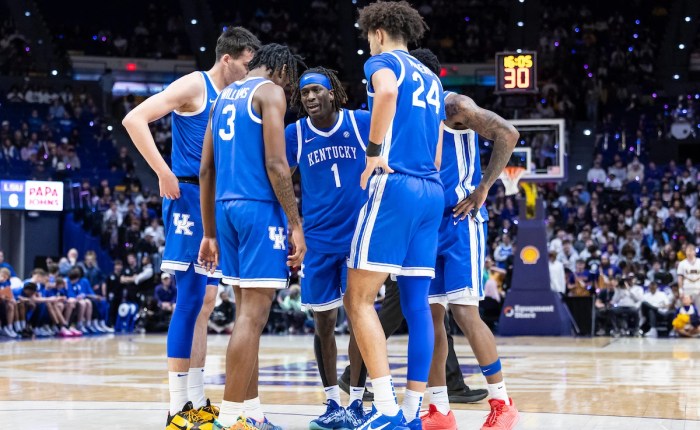
(NASHVILLE, Tn.) – Nobody died. Let’s be clear about that from the start. But walking out of Bridgestone Arena on that bleak December night, it sure felt like some small—but vital—part of me kicked the bucket. If grief truly comes in stages, Big Blue Nation skipped denial and bargaining entirely and hurtled straight into anger and depression. A 35-point blowout loss to Gonzaga will do that to you.

Thirty-five. Five touchdowns. A deficit so large you half-expected Diego Pavia to pad his Heisman stats by tossing one more.

The Cats shot 26% from the field—a number so pitiful you’d think they were tossing up prayer requests rather than basketballs. Meanwhile, Graham Ike—just one man, mind you—had more two-point field goals than the entire Kentucky roster. Let that sink in. One guy outscoring a blue-blood program in its own chosen sport. And not just any sport—the sport. The one woven into our DNA, passed down from grandparents to grandbabies like that sacred cloth Mark Pope keeps referencing.

This wasn’t just a loss. It was the fiber unraveling on holy ground—the third-most lopsided defeat in the shot clock era. We’ve known pain before. Saint Peter’s. Oakland. That 41-point thrashing from Vanderbilt—Vanderbilt!—that still wakes some of us with night sweats. Gardner Webb. Robert Morris in the NIT. Middle Tennessee State, if you really want to dig around in old wounds. But this… this seemed different. This was more visceral. This was more publicly humiliating. This was a blue mist turning into a funeral fog over Lower Broadway.

The boos rained down like I’ve never heard—sharp, heavy, and honest. Those weren’t spur-of-the-moment grumbles. Those were boos pulled from deep in the diaphragm—boos with ancestry.

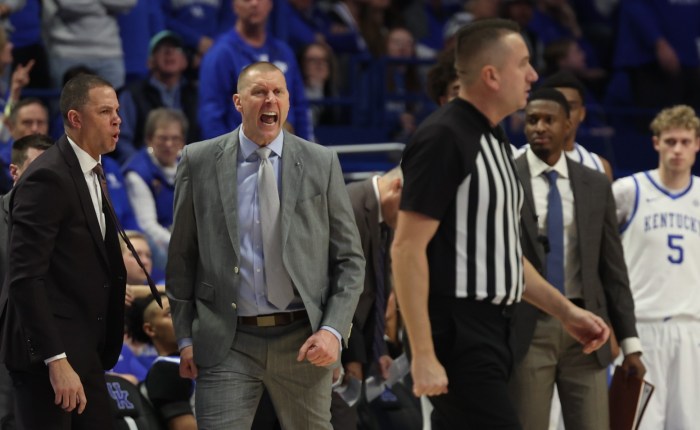
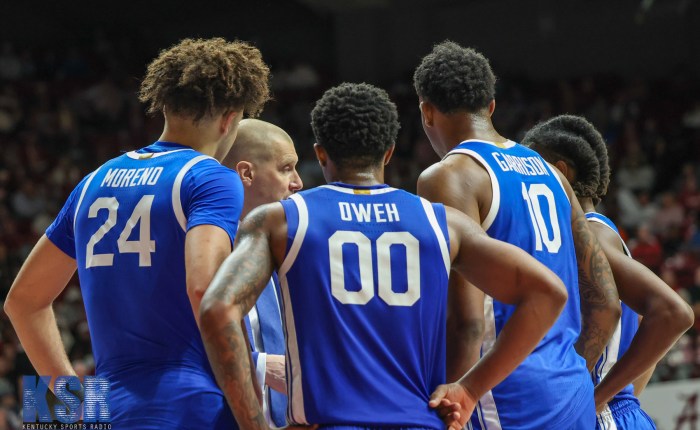
And in the middle of it all stood Mark Pope. Clueless. Clutching his arms. Pacing. Staring. Hoping. Praying. Whatever offensive scheme existed remained locked in the bus. The defense was optional. The effort was zero. And the $22-million payroll—which should buy you at least a handful of competent dribbles—played like a group of guys who accidentally wandered in from the YMCA while looking for hot chicken.

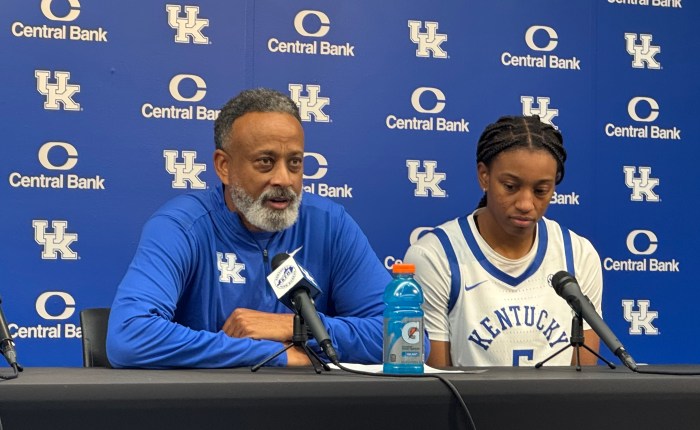
Afterward, Pope sat there and took it. “All the boos we heard tonight were incredibly well deserved—mostly for me,” he acknowledged.

And credit where due—he’s right. BBN isn’t booing because we hate. BBN boos because we care too much. Because this program is stitched into our emotional circuitry. Because watching it flounder like this feels like watching a beloved family business collapse under the weight of mismanagement and market forces we don’t fully understand.

Because NIL—this new world we were forced into—feels like it’s quietly cannibalizing the very soul of Kentucky basketball.

Where do we go from here? That’s the question echoing from Lexington to London to Pikeville to Paducah. This program means so much—too much, maybe—and to see it decimated, hollowed out, and sold to the highest bidder leaves a taste in the mouth not unlike despair.

We’ve now lost six straight to AP Top 25 opponents. Six. That’s not a skid. That’s a full-blown car crash. Indiana comes calling next Saturday, carrying history and smugness in equal measure. I guarantee the Hoosiers are smelling fear the way sharks smell blood.

Pope keeps telling us he’s going to fix it. He says it every game, every press conference, every painful in-between: “We’ll fix it.”

But those words—once hopeful, once rousing—are starting to fall on ears that have gone numb from overuse. We’ve become the fanbase that cries wolf, except the wolves actually show up and chew our legs off every other week.

Nobody died. But something inside us sure felt like it did. The Empire may have crumbled in Nashville, but unlike the Romans, we don’t have the luxury of blaming the Visigoths. This collapse came from within—bad shots, bad schemes, bad chemistry, bad body language, bad vibes. The kind of decay you can’t just patch with a rah-rah press conference, a well-placed promise, or even a savior named Jayden Quaintance.

And here’s the uncomfortable truth that stings most of all—the one we don’t want to say out loud but feel gnawing at us anyway: we don’t know if this gets better. We don’t know if the fixes Pope keeps preaching about are real or wishful incantations. We don’t know if a program built on NIL money and one-year mercenaries can rediscover heart, pride, or purpose. We don’t know if next Saturday against Indiana is the first step back… or one more step into the void.

We don’t know. That’s the scary part.

Because for all our bluster and bravado, Big Blue Nation likes certainty. We like legacy. We like stability. We like knowing that no matter the chaos swirling through college hoops, Kentucky Basketball stands firm—unshakable, undeniable, eternal.

But standing outside Bridgestone Arena after that 35-point humiliation, looking into the hollow faces of fellow fans who traveled hundreds of miles for a beatdown they’ll never forget, it was impossible not to feel the ground shifting under our feet.

Maybe we rise from this. Maybe we don’t. Maybe this is rock bottom. Or maybe—we whisper it, barely audible—it’s a sign of something even more ominous.

Nobody died. But something has changed. And until this team proves otherwise, we’re left clinging to hope with one hand… and bracing for the worst with the other.

This article was originally written for distribution through Nolan Group Media publications.


Dr. John Huangis a retired orthodontist, military veteran, and award-winning author. Currently serving as a columnist for Nolan Group Media, he invites readers to follow him on social media @KYHuangs. Explore his latest, Whining For Posterity, and all his books at Amazon.

To Hell with the Standard (Champions Classic Edition)

To Hell with the Standard (Champions Classic Edition)

(LEXINGTON, KY.) – Mark Pope keeps telling us Kentucky didn’t “meet the standard,” but after that Michigan State demolition in the Champions Classic, I’m starting to think we’re comparing this team to the wrong standard entirely. Championship Number Nine? At this point, I’d settle for “don’t get pantsed on national television before halftime.”

You see, “the standard” sounds great when you’re at a booster dinner or a preseason pep rally. But when the Cats get embarrassed again in Madison Square Garden—when the defense leaks worse than a cheap umbrella and the chemistry looks like oil and vinegar—then the standard becomes a cruel, suffocating weight.

And surely you caught Pope’s postgame presser… ugh. The man looked like someone had just put his dog down. Depressed. Drained. Eyes sunken like he’d been up all night gathering data, crunching analytics, and questioning all his life decisions. This isn’t the buoyant, always-positive, program-resurrecting Pope we hoped for—this is a man preparing for a root canal without anesthesia.

Pope said his players weren’t ready for Louisville because of some “out-of-character” incident before the game. Well, what was the excuse against Michigan State? Nothing—nothing—about that latest performance looked in character for a team supposedly training every day under the ghostly shadow of the standard. At this point, the standard has morphed into a meaningless punchline.

And can we talk about the $22 million elephant in the room?
That’s right—this roster is collectively pulling in twenty-two million American dollars to play basketball. That’s not chump change.

And what are we getting for that hefty investment?

Poop. Absolute, unmitigated poop.

Defense? Poop.
Shot selection? Poop.
Effort? Poop.
Guys playing for an NBA audition instead of the name on the front of the jersey? Extra-strength poop with glitter.

Okay—I’ve vented enough. Let’s take a deep breath (maybe two) and accept the painful truth: Mark Pope inherited a proud tradition, but also a monster. Every coach who takes the Kentucky job eventually realizes the same terrifying thing—this fan base is passionately crazy. Anything less than a Final Four is failure. Anything short of cutting down the nets is unacceptable. That’s the gospel of Big Blue Nation.

But here’s the irony—we demand perfection from kids who can’t legally rent a car. We scream “UNACCEPTABLE!” into the Twitter void while eating buffalo wings in our recliners. We call for Pope’s head in November, then brag about our loyalty in March.

We’ve worshiped at the altar of the standard so long that we’ve forgotten why we fell in love with Kentucky basketball in the first place. It wasn’t just the championships—it was the magic. The tradition. The roar inside Rupp when some kid from Pikeville or Paducah drills a three. The way the team makes us feel like part of something larger than ourselves.

You can’t measure that with analytics. You can’t hang it from the rafters either. It’s a pulse. A heartbeat. And right now, that heartbeat’s faint—not because of the losses, but because we’ve forgotten how to simply enjoy the game.

So here’s my radical suggestion: to hell with the standard—for now.

Let’s stop counting banners and start counting moments. Let’s cheer the hustle play, the smart pass, the kid who dives on the floor when the game’s already out of reach. Let’s celebrate the little victories—the ones that don’t make SportsCenter but make us proud nonetheless.

Sure, this team may not be destined for the ninth championship banner. They may fumble away a few more games. The defense may still make you want to throw a shoe at your TV. But they’re our team. And if we can’t love them when they’re flawed and broken, we don’t deserve to love them when they’re flying high.

The sky isn’t really falling. It just feels that way because we’ve been staring upward too long, waiting for the next banner to drop.

Let’s stop pretending this is a title run and just… watch basketball. Enjoy the wild, maddening, forehead-smacking circus it becomes. Appreciate Pope trying to hold the universe together with bailing wire while the players try to remember how to guard a ball screen.

Because if you don’t laugh, you’ll cry. And if you don’t ditch the standard, you’ll be the one feeling the root canal.

Championship Nine isn’t walking through that door.
But maybe joy can.
If we let it.

And if this $22-million roster ever decides to stop playing like poop, well… we’ll call that manna from heaven.

This article was originally written for distribution through Nolan Group Media publications.

Dr. John Huang is a retired orthodontist, military veteran, and award-winning author. Currently serving as a columnist for Nolan Group Media, he invites readers to follow him on social media @KYHuangs. Explore his latest, “Whining For Posterity,” and all his books at https://www.Amazon.com/stores/Dr.-John-Huang/author/B092RKJBRD

Top of Form

Bottom of Form

Fifty Years After Unspeakable Tragedy, Thundering Herd Charges On

Fifty Years After Unspeakable Tragedy, Thundering Herd Charges On

It’s now November 14, 2025–fifty-five years since that unspeakable tragedy. Randy Maynard and Mike Hamrick have moved on to new positions, but their love for Marshall University remains unshakably steadfast.

(LEXINGTON, Ky. November 14, 2020) – The Covid-19 pandemic has turned our sporting world upside down. As die-hard fans, we’re all sick and tired of this invisible pathogen messing with the games we love. Even as mandatory masks, routine testing, and socially distanced stadiums have become the norm, everyone should be quick to realize that it’s not the first time a harbinger of evil has punched us squarely in the face.

Certainly, the events after 9/11 made us all feel vulnerable. Terrorist attacks, assassination attempts, and political upheaval can cripple a nation with fear. Likewise, natural disasters—such as Hurricane Katrina or the 1989 San Francisco earthquake—can scramble our game-day priorities. Even something as surreal as the O.J. Simpson saga can easily invade, disrupt, and destroy our collective sports psyches more than we care to admit.

Having lived through all of the above, one of the most impressionable off-the-field sports tragedies of my generation occurred nearly fifty years ago—just a short two-hour drive from Lexington—directly east on I-64. Seminal moments such as these can shatter you to the core—forcing you to think about your mortality, your purpose, and the sanctity of life on earth.

Pastor Randy Maynard, Marshall University Class of ‘79, and one of the most passionate Thundering Herd supporters around, still speaks about that fateful day with a quiver in his voice.

“We wanted everyone to be OK,” Maynard painfully recalled. “But it turned out not to be the case.”

November 14, 1970—Horror

On November 14, 1970, Southern Airways Flight 932, a McDonnell Douglas DC-9 chartered by Marshall University, crashed a mile short of the runway at Tri-State Airport in Kenova, West Virginia. On board was the Thundering Herd football team, including 36 players, five coaches, 19 administrative and staff personnel, 10 prominent boosters, and a flight crew of five. The entourage was returning home from Kinston, North Carolina, after a 17 – 14 homecoming loss to the East Carolina Pirates.

Pilot Frank Abbott had never flown into Tri-State Airport. It was a rainy and foggy evening when the plane approached the runway. According to the National Transportation Safety Board, the airport did not have any equipment that would warn incoming pilots about low-altitude dangers.

With an estimated 300 feet of cloud cover, Abbott misjudged the plane’s altitude. The jet clipped the top of some trees, then hit a hillside, cartwheeled and exploded into flames.

All on board were instantly killed. Six bodies were charred beyond recognition and could never be positively identified.

“Ten feet higher and the plane would have made it,” NSTB chairman John D. Reed said at the time. “That’s all it needed.”

The accident remains the worst sports-related air tragedy in U.S. history.

Maynard, who grew up in Kenova, West Virginia, was a 17-year-old high school senior when he heard about the crash while attending a United Methodist Youth Fellowship event in Huntington. He received a call from his father telling him the Marshall plane had crashed—and that it looked to be an awfully bad accident. Immediately, Maynard and his best friend, Randy Adkins, began to pray, not knowing at the time that everybody on board had already perished.

“When the report came out at midnight that there were no survivors, I was overcome with emotion,” Maynard recounted. “There was an almost unbearable sense of grief and sadness.”

Mike Hamrick was thirteen when he heard the news. He and some buddies had just returned from an afternoon movie. They were in a local restaurant eating quarter hotdogs, drinking ten-cent cokes, and playing the pinball machines when an alert flashed across the television set.

“I can remember it like it was yesterday,” Hamrick said. “I looked up at the TV and it scrolled across the bottom that there had been a plane crash. I didn’t think much about it at first, but then when I found out [the crash] involved the Marshall University football team, I went, ‘OH NO!’”

Upon returning home, Hamrick heard his father sobbing on the telephone. His dad was the local football coach at Herbert Hoover High School in Clendenin, West Virginia. He had just received the official news that several people he knew—including one of his former assistant coaches—had perished in the crash.

“It was the only time I’ve seen my dad cry,” Hamrick recalled.

Almost everybody in Huntington knew somebody on that plane. Several of the players who died were married, some were engaged, and one was a soon-to-be parent. In an unbelievably cruel twist of fate, his child was born on the very same day he was buried. Unfathomably, several young people in the community lost both sets of parents. Those escaping heartbreak were stricken with a sense of survivor’s guilt—left wondering why they were spared while so many of their friends, colleagues, and loved ones were so indiscriminately taken away.

Mary Jane Tolley, wife of head coach Rick Tolley, usually traveled on these road trips. On this particular occasion, she was advised to stay home in order to care for her ailing German shepherd. Her life was spared, but in one fell swoop, the world around her was permanently shattered. She lost not only her husband, but 25 good friends in that one ghastly moment.

The Marshall cheerleaders were allotted a limited number of seats on the flight. They decided that since not all of them could go, then none of them would go. They all bypassed the flight, but they were haunted for years by the nightmares that followed.

Time would do little in soothing their wounds.

November 14, 2000—Catharsis

To understand the long-lasting impact the tragedy had on those in the Marshall community, let’s fast forward to the year 2000—a full thirty years after the fateful crash. Now a proud Marshall alumnus, Randy Maynard ironically found himself pastoring a church just outside of Greenville, North Carolina—the site of East Carolina University, the same school Marshall played just hours before the horrifying air disaster. He decides to write an article about the 30-year anniversary of the Marshall plane crash for the Greenville Daily Reflector newspaper.

“It was cathartic for me,” Maynard answered, when I asked him why he felt compelled to write about an event that happened three decades earlier. “I needed to put down on paper events surrounding the crash and about what had transpired. I actually felt like that God had placed me in Greenville, North Carolina, because of my connection to the tragedy. I know that may sound crazy to a lot of people, but I truly felt that. There were two members in my congregation that played in that game against Marshall, and I was able to somehow minister to them.”

What many don’t realize is how many people from East Carolina were similarly affected by the tragedy. Sadness and sorrow of that magnitude cannot easily be contained. Maynard sensed that pain of that intensity had already spread well outside the Marshall family and would not necessarily dissipate with time. Even today, he hears story after story from opposing players, coaches, and fans who witnessed that game telling him how stunned they were upon hearing the news of the crash and how they still struggle to reconcile the horrible events of that day.

As Maynard continued to do research for his article, he’s introduced to Mike Hamrick, who just serendipitously happens to be the East Carolina Pirates’ athletics director at the time. Like Maynard, Hamrick was also a fellow Herd alumnus by then, so the two naturally hit it off by talking about anything and everything related to their mutual college experience. Hamrick had played linebacker for the Herd from ’76 through ’79, and was recruited by Coach Jack Lengyel—only five short years after the resurrection of the program—at a time when many questioned whether Marshall should have even been fielding a football team.

Leading up to the plane crash, Marshall had not had a winning season since 1963. At one point, they went 27 consecutive games without a victory. Some well-intentioned boosters and alumni subsequently broke NCAA rules in trying to secure some additional victories. In 1969, the school was placed on probation for more than 140 recruiting violations and kicked out of the Mid-American Conference. With the daunting prospect of starting from scratch after the crash—and the specter of probation still hanging over their heads—it’s understandable why some in the Marshall family wanted to stop playing football altogether.

“If Marshall had stopped playing football, it would have meant those in the plane crash would have died in vain,” Hamrick told Maynard in the 2000 newspaper story. “Even though we did not have much success at Marshall, each time we stepped on the field we knew we were playing for those that had their lives tragically shortened. Playing at Marshall taught me so much about not ever quitting. In the grand scheme of things, what we accomplished while I was at Marshall set the stage for the success the program is enjoying now.”

Of course, that success began with Jack Lengyel, portrayed by Matthew McConaughey in the 2006 Hollywood production We Are Marshall. Hired on in 1971 as the coach to literally and figuratively rebuild a football program from the ashes, Lengyel took four holdovers (who fortuitously didn’t make the trip to Greenville), some walk-ons, some ex-service men, some transfers, and a team of freshman (granted a special NCAA exemption to play that year)…and miraculously molded them into a serviceable unit.

To the amazement of many, Lengyel’s “Young Thundering Herd” won its second game of the 1971 season, beating Xavier 15 – 13 on the game’s last play. As expected, the team that year also suffered some lopsided defeats, but it did manage to rack up another improbable 12 – 10  win against a Don Nehlen-coached Bowling Green team later in the campaign.

There were some extremely rocky seasons for Marshall during that first decade of rebuilding, but by the mid-1980s, the Herd was on a roll. From 1986 through 2004, Marshall never had a losing season. During that period, they also moved successfully from Division I-AA to I-A. The school had the best record of any Division I football team of the 1990s, amassing a total of 114 victories, including two Motor City Bowl postseason wins, in that span. Randy Moss, Chad Pennington, Byron Leftwich, and Bobby Pruett—just a few of the Marshall greats responsible for such an improbable resurrection.

By 1999, the team finished undefeated at 13 – 0 and was ranked 10th in the country at the end of the season by both the Associated Press and the ESPN/USA Today coaches polls. Maynard swears he’ll go to his grave believing Marshall could have beaten Florida State, the eventual national champion, if only they had been given a chance to play that year.

November 14, 2020—Remembrance

Another 20 years go by, and the pain remains palpable.

As Marshall prepares to commemorate the 50-year anniversary of the tragedy, I caught up with both Randy Maynard and Mike Hamrick to talk about their thoughts on the significance of what happened back in 1970. In hindsight, what are the lessons they’ve gleaned?

“Marshall Football is the greatest comeback story in the history of college athletics,” Hamrick told me proudly. “Your whole team—coaches, administrators, top boosters—are wiped out, and you came back and started having the success that we started having in the 80s and 90s and clear up to today. I don’t believe there’s another story like it.”

Hamrick, believe it or not, is now in his 12th season as Marshall’s athletics director. He returned home in 2009—thirty years after his playing days ended. His football alma mater enters the game on Saturday undefeated at 7 – 0, inching toward a top-10 ranking, and with one of the top-rated defenses in the country. With emotions running at a fever pitch, poor Middle Tennessee (or Alabama for that matter) surely doesn’t stand a chance.

If you’re part of the Marshall family, every November 14th is emotional. This year will be no different. Hamrick’s voice will crack as usual when he gives his speech at the Memorial Fountain ceremony on the morning before the game. He’ll shed tears again when 75 roses are laid by the fountain by family members in memory of their lost loved ones.

Four East Carolina football players who played in the game just hours before the tragedy are also planning to make the trip up to Huntington to pay their respects. They wanted to come—on their own accord, with no prompting—to lay wreaths by the fountain.

Lucianne Kautz will be the featured speaker. She’s one of the cheerleaders who elected to skip the ill-fated flight. Her father, Charles Kautz, was the athletics director who lost his life in the crash, so you can bet she’ll have an exceptionally poignant message to share.

Michael W. Smith, the three-time Grammy winner, contemporary Christian musician, and Kenova, West Virginia native, will be flying up from Nashville to participate in the fountain ceremony and to sing the national anthem. “Mike” (as he’s called back in Kenova) remembers that a little over a month after his 13th birthday, his dad took him to the crash site, and he described how witnessing the smoldering flames impacted him deeply. Mike briefly attended Marshall.

In addition to all that, the University will also be adding something extra special this year. The thirty-nine players who died in 1970 never received their college degrees. On Friday, each student who perished will be honored with a posthumous degree in their program of study. How special will that be?

Seldom does a day go by that Hamrick doesn’t think about the many lives cut short by the crash. The players who perished were youngsters who never had the opportunity to live out their dreams. Those young men wore the same uniform and played for the same school that Hamrick did.

“Every time we get on an airplane and fly with that Marshall football team, I promise you, it goes through my mind what happened 50 years ago,” Hamrick confessed. “I always bow my head and say a quick prayer. If you’re a Marshall person and you know anything about November 14, 1970—which every Marshall person does—that tragedy is forever on your mind.”

“It’s our W-H-Y,” Hamrick continued. “It’s why we’re here. It’s why we do things. It’s the fabric that made this university. Unfortunately, it was a tragedy. But Marshall has embraced it, and for the simple reason to honor those and to never forget those who we lost.”

Because of that W-H-Y, the 63-year-old Hamrick never takes anything for granted anymore. He enjoys every day on the job, he appreciates his coaches more, and he cares more about his players now more than ever. He wants all of them to have a great college experience.

“Most of all,” Hamrick surmised. “What happened on November 14, 1970, helps me put everything into proper perspective.”  

Every year, the Marshall football coaches lead the team from the stadium, and they’ll go on a little run up to Spring Hill Cemetery where the six players who could not be positively identified are buried in a common grave. The coaches will then speak to the players about why the setting is so significant, why they need to remember it, and why it means so much to the community and to the family members of those who died.

You remember the scene in the movie where McConaughey/Lengyel makes his impassioned pregame speech.

“Six players, six teammates, six sons of Marshall,” he explains. “This is our past, gentlemen. This is where we have been. This is how we got here. This is who we are—today.”

Today, Randy Maynard serves as a Pastoral Care Coordinator at Centenary United Methodist Church in Lexington—one of the largest Methodist congregations in the region. He’s quick to proclaim that what transpired fifty years earlier on a fog-shrouded hillside just a mile from his home directly affected his calling into the pastorate. On that day, God placed in his heart an empathy for those who have lost people near and dear to them.

“I for sure think that God would want us to be involved in the lives of those who have lost loved ones,” Maynard solemnly reflected. “To be there for support—not necessarily with words—but to let folks know that you care, that you’ll be there for them, and that you’ll want to support them any way that you can…and especially that you’ll be praying for them.”

Maynard, who together with his wife Cindy, named one of their children “Marshall” in memory of the 75 crash victims who perished, still thinks frequently about hearing the bad news a half century earlier. Even as a man of deep faith, he still occasionally wonders about the suffering we all must endure as spiritual beings living in this earthly world.

“The plane crash made a lasting impression on me,” he said. “It serves as a vivid reminder that no one is guaranteed another minute on this earth. Hence, we are to do all we can to be in constant service and to be in close communion with our risen Savior, ready to meet him when we leave this earthly home.”

For both the preacher and the athletics director, home—for the time being—is Marshall University. They’ll be cheering like crazy this Saturday for the Thundering Herd. Two close friends sharing a 50-year memory, an unbreakable bond, and a love for a university…that arose out of an unspeakable tragedy.

“I think Marshall’s just a special place,” Maynard reiterated. “You have to be part of it to really understand it. What happened on November 14, 1970, created a deep-seated love between the University and the community that couldn’t be fabricated otherwise. It’s hard for outsiders to look at Marshall and to have the depth of passion that those who have been there have.”

In other words, “We are Marshall!”

On November 14, 2020, so too will be the rest of the sporting world.

Dr. John Huang is a retired orthodontist, military veteran, and award-winning author. Currently serving as a columnist for Nolan Group Media, he invites readers to follow him on social media @KYHuangs. Explore his latest, “Whining For Posterity,” and all his books at https://www.Amazon.com/stores/Dr.-John-Huang/author/B092RKJBRD

Battle at the Yum: Brotherly Love, Bluegrass Style

Battle at the Yum: Brotherly Love, Bluegrass Style

(LEXINGTON, Ky.) – I’ve been to a lot of games at the KFC Yum! Center over the years, and one constant remains: somebody always spills beer on me. Maybe it’s the cramped seats, maybe it’s divine retribution for my unapologetic “L’s down,” or just that smug smirk when Kentucky pulls off that inevitable upset. But whatever the reason, it’s always the same warm, yeasty baptism by Yuengling. Welcome to the Kentucky–Louisville rivalry, friends—where good manners and mutual sportsmanship go to die.

When Kentucky invades the Yum on Tuesday night, it won’t just be another non-conference matchup—it’ll be a civil war disguised as basketball. Don’t let the early date on the calendar fool you. Sure, the game won’t decide an SEC or ACC title, and yes, both programs are still figuring out rotations, chemistry, and playing through injuries. But if you think this one doesn’t matter, try telling that to the guy in the bird suit mugging for the cameras behind Kentucky’s bench.

Here’s the scary part. The Wildcats might not know what they’re walking into. Mark Pope’s shiny new roster—brimming with transfers, freshmen, and enthusiasm—hasn’t yet been immersed in the unholy water of this rivalry. You can study film all you want, but no amount of game tape or analytics prepares you for 22,000 red-clad fanatics who hate everything about you down to the shade of your underwear. This isn’t just basketball—it’s bragging rights and cultural warfare.

To the Louisville faithful, Kentucky is the privileged older brother, always hogging the spotlight, driving the fancy car, and bragging about his NBA friends. The Cardinals, meanwhile, are the petulant little sibling—scrappy, defiant, and perpetually insecure. They’ll do anything to get big brother’s attention, even if it means tossing a drink in his face or keying his Ferrari.

Speaking of Ferraris, Pope’s team is still learning to shift gears smoothly. We’ve seen flashes of brilliance—fast breaks that hum, defense that smothers, and a jaw-dropping Collin Chandler dunk—but also some of the sputtering you’d expect from a group still breaking in the new parts. Louisville, on the other hand, is in the midst of its own identity crisis under coach Pat Kelsey. Kelsey’s energy borders on cartoonish—think Red Bull-fueled pep rally meets evangelical tent revival. He and Pope are oddly similar in their intensity, their positivity, and their charming—but goofy—awkwardness.

If it weren’t for their height difference, these two might actually be long-lost twins separated at birth. Both are relentlessly upbeat. Both quote leadership manuals like scripture. And both probably wear out their assistants with midnight text chains about “culture” and “accountability.” The difference? Pope has the keys to the big blue mansion, while Kelsey’s still trying to get the plumbing fixed in the old red house down the street.

Then there’s last year’s dustup—when Pope put Kelsey in a friendly “headlock” during a midgame scrum. Add in the rumored “verbal altercation” outside a top recruit’s home, and you’ve got another colorful chapter in UK-UL lore. It’s all fun and games—until it’s not.

Expect some fireworks on Tuesday. Louisville will treat this like their Super Bowl, their one shining moment to prove they’re not entirely irrelevant. Kentucky, meanwhile, would like nothing more than to quiet the rowdy red masses and head back down I-64 with the smug satisfaction that only a rivalry win provides.

This particular game might not have the national stakes of years past. Remember, it’s happening way too early. Both teams are still under construction—a mix of promise and potential waiting for the right foundation. But pride, not perfection, will define the night. The winner gets the city for a year; the loser gets excuses.

And let’s be honest—Kentucky fans need this one. After the ups and downs of recent seasons, after the heartbreaks and early exits, Big Blue Nation wants tangible proof that Pope’s vision is more than just those “beautiful” slogans he’s been preaching since his arrival in Lexington. A win at the Yum would do wonders for morale, momentum, and those all-important selection committee resumes down the road.

Remember also that rivalries are less about rankings and more about respect—or, in this case, disrespect. You don’t beat Louisville for seeding; you beat Louisville because you can’t stand them.

So yes, I’ll make the trip again. I’ll brave the hecklers, dodge the popcorn, and pray the beer showers are light this year. Because there’s nothing quite like Kentucky versus Louisville—the noise, the tension, the mutual loathing wrapped in a shared love for basketball. It’s messy, it’s emotional, and it’s absolutely glorious.

This article was originally written for distribution through Nolan Group Media publications.

Dr. John Huang is a retired orthodontist, military veteran, and award-winning author. Currently serving as a columnist for Nolan Group Media, he invites readers to follow him on social media @KYHuangs. Explore his latest, “Whining For Posterity,” and all his books at https://www.Amazon.com/stores/Dr.-John-Huang/author/B092RKJBRD

In Stoops We Trust (Whether You Like It or Not)

In Stoops We Trust (Whether You Like It or Not)

(LEXINGTON, Ky.) – Funny how one Saturday can change the entire temperature of the Bluegrass. Just a week ago, half of Big Blue Nation was ready to pack Mark Stoops’ bags for him. With Kentucky’s huge 38-7 victory over Florida on Saturday night, the path to bowl eligibility now becomes a whole lot clearer. Suddenly, the same folks who wanted Stoops’ head on a platter are out shopping for “In Stoops We Trust” T-shirts.

That’s life in the SEC—one minute you’re an overpaid underachiever, the next you’re the savior of the Commonwealth. But whether you were cheering Stoops before Florida or rediscovering your faith afterward, one thing remains constant: the man deserves to stay. Not because of one big win, but because of the foundation he’s built and the culture he’s created.

Let’s face it, the honeymoon was long over before tonight. The flowers had wilted, the champagne went flat, and the marriage between Mark Stoops and Big Blue Nation felt more like a 25-year-old couch—no longer comfortable, visibly soiled, and sagging in all the wrong places.

Everywhere you turned, folks were hollering for divorce. Social media was ablaze with “Fire Stoops” hashtags. Radio hosts were frothing at the mouth and ready to kick him to the curb and swipe right on someone—anyone—new.

Well, not anymore, my friend. Before we stick that “For Sale” sign in Stoops’ front yard, let’s take a deep breath, pour ourselves a glass of Kentucky bourbon, and think this through with a little perspective—and a dash of sanity.

For one, let’s talk dollars and sense. That buyout? Thirty-seven. Million. Dollars. That’s not a typo. That’s not Monopoly money. That kind of cash could fund an entire NIL war chest and keep Cutter Boley grinning for the next couple of years.

And let’s not forget history. Mark Stoops is the winningest coach in Kentucky football history. Think about that. More wins than Bear Bryant during his Kentucky days. More wins than Fran Curci, Jerry Claiborne, or Rich Brooks combined (well, close enough for rhetorical effect). Sure, some of those wins came against glorified high schools disguised as non-conference opponents, but they still count in the record book—and on the paycheck.

People forget how bleak it was before Stoops. Joker Phillips limped out the door with the fanbase howling. The program was a punchline, a perennial cellar dweller where bowl games were as rare as John Calipari NCAA wins post Covid. Stoops changed that. He brought stability. He brought hope. He brought swagger. And yes, he even brought us a ten-win season—twice! That’s not stale; that’s historic.

Now, I get it. Things felt stagnant the past couple of years. The offense sputtered forever, the defense gave up too many big plays, and the postgame pressers all sounded like reruns of Groundhog Day. Stoops kept saying, “We’ll clean it up; get back to work.” But it started feeling like the same spilled milk being mopped up year after year.

But let me ask the question that haunts every program stuck in the “fire him” cycle: Who you gonna get that’s better?

Seriously. Who?

Nick Saban’s busy counting his retirement checks. Kirby Smart’s not walking through that door. Urban Meyer? Please—he couldn’t even handle Jacksonville. And as much as people want to throw out names like Jon Sumrall or Will Stein, let’s pump the brakes. Sumrall’s a fine coach, but running Tulane isn’t the same as running an SEC program with boosters, egos, and ESPN cameras breathing down your neck. And Will Stein? He’s got promise, sure—but he’s barely had time to unpack at Oregon. Handing him the keys to Kentucky football right now would be like giving a 16-year-old your trusted Mercedes and hoping for the best.

Coaching transitions are messy. You could just as easily end up with the next hot coordinator who flames out in two seasons, leaving us all longing for the good ol’ days when Stoops at least got us to the Music City Bowl.

And here’s something people overlook: his players still believe in him. They play hard. They don’t quit. Even when the scoreboard turns ugly, they fight to the end. That’s not nothing. That’s culture—culture that Mark Stoops built brick by brick. You can’t fake that, and you certainly can’t buy it with NIL money. Remember when Kentucky teams used to fold faster than a lawn chair at a tailgate? Not anymore. This group—his group—competes, cares, and represents the program with pride. They don’t flinch. That’s his real legacy.

What Stoops provides—whether fans admit it or not—is stability. And in the volatile world of college football, stability is the rarest commodity. It’s not sexy. It’s not flashy. But it’s the bedrock on which long-term success is built. Programs like Iowa, Wisconsin, and Kansas State built entire identities on stability. They don’t panic after a bad season. They reload, recalibrate, and keep grinding.

And that’s what Stoops does best. He grinds. He builds men, not just football players. He develops two-star recruits into NFL draft picks. He preaches accountability, loyalty, and hard work. Those aren’t buzzwords; they’re virtues—spiritual ones, even.

Maybe that’s what this whole debate boils down to. We’ve lost our patience in a world of instant gratification. We want quick fixes, shiny new toys, and miracle seasons. But life—like faith—isn’t about the quick fix. It’s about perseverance through the dry spells. It’s about trust.

The Bible says in Galatians 6:9, “Let us not grow weary in doing good, for in due season we will reap, if we do not give up.” That’s not just good theology—it’s good football philosophy. Stoops has been sowing seeds in rocky soil for over a decade. He’s weathered storms, endured heartbreaks, and still kept this program relevant. That’s not a man you throw away. That’s a man you stand by.

So before you call the moving truck, Big Blue Nation, remember: the grass isn’t always bluer on the other side. Sometimes, the real victory is learning to bloom where you’re planted.

And if you don’t like that spiritual analogy, fine—think of it this way: $37 million buys a lot of forgiveness.

This article was originally written for distribution through Nolan Group Media publications.

Dr. John Huang is a retired orthodontist, military veteran, and award-winning author. Currently serving as a columnist for Nolan Group Media, he invites readers to follow him on social media @KYHuangs. Explore his latest, “Whining For Posterity,” and all his books at https://www.Amazon.com/stores/Dr.-John-Huang/author/B092RKJBRD

The House Always Wins

The House Always Wins

What good is it for someone to gain the whole world, yet forfeit their soul?

Remember when the worst thing to happen in a basketball game was Perry Stevenson goaltending a free throw or Christian Laettner stomping on someone’s chest? Those were simpler times. Now we’ve got Chauncey Billups and Terry Rozier being investigated for sports gambling.

Welp, shame on us. We got what we asked for.

When we opened the floodgates to legalized sports betting, we were told it would be harmless fun—a way to “enhance fan engagement.” The marketing geniuses promised us responsible wagering, clean oversight, and a little extra tax revenue for our schools. What we actually got was a nation of addicts-in-training, daily fantasy junkies, and people screaming at their phones during the fourth quarter of a meaningless midweek NBA game because they needed one more rebound to hit the over.

And yes, I get it. Gambling itself isn’t inherently evil. It’s not like betting on Kentucky to cover the spread automatically condemns your soul to perdition. But let’s not pretend we didn’t invite the devil in when we started normalizing this stuff as if it were just another harmless hobby.

I know because I’m wired that way myself. I’ve got an addictive personality. Always have. I still remember the euphoric rush of winning my first NCAA tournament bracket—strutting around like Einstein in sneakers because I had correctly predicted some 11-seed Cinderella run to the Sweet 16. Then came fantasy football. Oh, the sweet taste of victory on Monday night! I’d sit there with one player left in the lineup, calculating yards and touchdowns like a Wall Street trader watching his stock portfolio. When my guy scored, I’d practically levitate off the couch.

You see, that’s the problem. It’s never enough. You always want a little more action, a little bigger hit of adrenaline, the proverbial dopamine rush. For people like me, that’s a slippery slope. One day you’re betting a friendly five bucks with your buddies; the next day you’re mortgaging the house because the Bengals can’t possibly blow another lead.

The truth is, gambling can ruin lives. It destroys families, wrecks bank accounts, and turns decent people into liars and thieves. It feeds on desperation and ego—the belief that you can beat the odds, that you’re smarter than the system or your neighbor down the street, that this next parlay will finally get you even. Spoiler alert: the house always wins.

And when that “house” happens to be tied to the integrity of our sports, that’s when things really go south. If you can’t watch a game without wondering whether the ref’s call was clean, or whether the player missed that shot on purpose, what are we even cheering for? The beauty of sports has always been its purity—hard work, skill, competition. Gambling muddies that. It injects suspicion where there should instead be joy.

Money, of course, is the root of it all. It always is. Money draws in the riff raff, the hustlers, and the shadowy figures waiting in the alleys of every major sports scandal. Organized crime didn’t just disappear when we legalized betting; it just put on a nicer suit and opened an app. The lure of easy cash will always attract those looking to exploit the system—and sadly, some of those people will have locker room access.

When I was growing up, sports were an escape from the mess of the world—a pure and noble pursuit of excellence. Now they’re just another line item in somebody’s betting portfolio. Every pitch, every possession, every field goal attempt is a potential profit or loss. Even the broadcasters can’t resist dropping the over/under like it’s part of the game itself.

And while we’re pointing fingers, let’s not forget the sports radio guys who spend half their shows preaching about “responsible gambling” while the other half reading ad copy for the very apps causing the mess. Spare me the sanctimony. You can’t sermonize about integrity one minute and then tell me to “hammer the over” with a promo code the next.

I’m not naïve. I know you can’t unring the bell. Gambling is here to stay. The toothpaste is out of the tube, and no amount of moral handwringing is going to put it back. But we can at least be honest about what it’s doing to us. For every “responsible gamer” out there treating it like entertainment, there are dozens more suckers sinking deeper into the quicksand.

I suppose it’s fine if you know your limits—if you can place a small wager and walk away without checking your phone every five minutes. But for most people, those limits blur over time. The lines between fun and fixation disappear, and before long, you’re chasing losses like Calipari after Covid.

So yeah, when I hear about Chauncey Billups and Terry Rozier getting tangled in the gambling web, I’m not shocked—I’m sad. Sad for them, sad for the sport, sad for the fans who still believe in fair play. Because the more this stuff spreads, the more we risk losing what made us fall in love with sports in the first place.

I’m not preaching here. Like I said, I’m as susceptible as anyone. If gambling apps had been around when I was younger, I might have been one of those guys refreshing DraftKings under the table during Sunday service. (I’m joking… mostly.) But maybe that’s why I’m so wary of it now. I know how easy it is to get hooked, how quickly something innocent can become destructive.

So as these investigations unfold, I’ll be watching—not for the point spreads or the odds, but for the soul of the game itself. Because if we keep going down this road, if we keep letting money and manipulation call the shots, one day we might wake up and realize the thrill is gone. The joy’s been replaced by suspicion, and the purity of the game by the price of the bet.

And when that happens, it won’t matter who wins or loses. The house will have already won.

Dr. John Huang is a retired orthodontist, military veteran, and award-winning author. Currently serving as a columnist for Nolan Group Media, he invites readers to follow him on social media @KYHuangs. Explore his latest, “Whining For Posterity,” and all his books at https://www.Amazon.com/stores/Dr.-John-Huang/author/B092RKJBRD

Mark Pope’s Ferrari: Kentucky Basketball’s Drive for a Championship

Mark Pope’s Ferrari: Kentucky Basketball’s Drive for a Championship

(LEXINGTON, Ky.) – When Mark Pope stood before the assembled media the other day and said, “We got a great Ferrari and we can’t wait to take it for a spin,” I thought he was referring to the team’s on-court performance. You know—sleek offensive design, turbocharged energy, cornering on a dime. What I didn’t realize was that the real Ferrari might be the one he’s been paying for—rumored to be worth about $22 million in NIL payouts.

Apparently, this isn’t your dad’s Kentucky basketball team, cobbled together with a few well-placed ten-dollar-handshakes. Nope, this is a shiny new model, custom-built with top-of-the-line NIL features, luxury international imports, and more horsepower than a herd of wild stallions. Pope, of course, is the guy behind the wheel—white-knuckled, grinning ear to ear, and just itching to mash the accelerator.

Unfortunately, he may have already dinged the fender.

Before Big Blue Nation could even buckle their seatbelts, the Ferrari hit a pothole during the Blue-White Scrimmage in Memorial Coliseum. Starting point guard Jaland Lowe, the Pitt transfer recruited specifically to pilot this high-powered offense, went down with a shoulder injury. It didn’t appear to be a fiery crash—but still—you never want to see your lead driver headed to the pit before the first lap.

And what a lap it was. The Blue-White game—usually a glorified layup line wrapped in applause—felt more like a demolition derby this year. Players were crashing the glass with impunity, fighting through screens like the bench was calling, and snarling like the game meant a trip to the Final Four.

I’ve covered a lot of Blue-White scrimmages in my day, but I’ve never seen one that intense. The pace was frenetic, the emotions were high, and the competition was fierce. Pope has these guys revved up like they’re chasing Banner No. 9, rehearsing for One Shining Moment before the first ball is even tipped.

And that’s the rub, isn’t it? The new head coach hasn’t just brought a fresh energy—he’s brought a fresh philosophy. Gone are the days of “these guys are young” or “trust the process.” Pope doesn’t do slow builds or cautious optimism. He’s out there saying, in essence, “We’re Kentucky. We play to win it all—every game, every drill, every scrimmage.”

That kind of bravado plays beautifully in October. It’s the stuff fans dream about while their football team self-destructs. But it’s also a lot to live up to over the grind of a five-month season.

Because as thrilling as it is to hear your coach talk about Ferraris, championship hunts, and competitive fire, there’s a fine line between confidence and burnout. The season’s an endurance race, not a drag strip. The question isn’t whether this team can go 200 mph—it’s whether they can stay on the track long enough to see the checkered flag.

Now, before you accuse me of pouring water on Pope’s premium fuel, let me be clear: I love the swagger. After years of seeing a fan base divided between believers and doubters, there’s something downright refreshing about having a head coach who plants his flag, goes for the jugular and says, “These guys want to win, always.” No hedging, no excuses, no talk about youth or rebuilding.

Pope’s message to his players—and to all of us—is unmistakable: Kentucky basketball doesn’t back down. Whether it’s an intra-squad scrimmage on the UK campus or a March showdown in Madison Square Garden, they’re going to play with everything they’ve got.

But maybe, just maybe, he could keep one hand on the brake for a bit.

Because here comes Purdue—No. 1 in the country, with the nation’s top point guard in Braden Smith—rolling into town Friday night for the first exhibition. On paper, it’s a game that doesn’t count. But try telling that to a fan base that treats October tune-ups like NCAA Tournament play-ins. Win by 20 and the hype train leaves the station at warp speed. Lose by 20 and the “Ferrari” gets called a lemon before Thanksgiving.

That’s just life in the Bluegrass, where basketball is religion and patience is in short supply. Pope knows that better than anyone—he lived it as a player, and now he’s living it as the man in charge.

So, should he tamp it back a bit? Probably not. This is who Mark Pope is—the mad scientist, analytics guru, relentless, and unafraid to dream big. He’s not the kind of guy to idle in neutral while everyone else takes the safe route.

Besides, Ferraris aren’t built for cautious Sunday drives. They’re built to turn heads, scorch the pavement, and leave the competition in the dust.

Still, if there’s one lesson to remember, it’s that championship seasons aren’t won in October—they’re tuned there. Let’s just hope by the time March rolls around, the paint isn’t scratched, the tires aren’t bald, and the driver hasn’t run out of gas.

Because as any Kentucky fan knows, it’s not about how loud the engine roars at the start. It’s about how fast—and how fearlessly—you finish.

—and the only finish line that matters this year runs through Indianapolis.

Dr. John Huang is a retired orthodontist, military veteran, and award-winning author. Currently serving as a columnist for Nolan Group Media, he invites readers to follow him on social media @KYHuangs. Explore his latest, “Whining For Posterity,” and all his books at https://www.Amazon.com/stores/Dr.-John-Huang/author/B092RKJBRD

Deny, Deflect, and Denounce

Deny, Deflect, and Denounce

If there’s one thing I’ve learned after jumping into this media gig, it’s that when a coach’s lips are moving, there’s at least a 50–50 chance he’s fibbing. I say that with affection. Lying is practically a job requirement in this business—right up there with headset-throwing, blaming officials, and shaming reporters.

After Kentucky’s 35–14 loss to Georgia, Mark Stoops was asked about Alan Cutler’s recent report that he’d talked to athletics director Mitch Barnhart about a buyout and was turned down. Stoops’ response was swift, combative, and—shall we say—dismissive.

“I hate to give anything like that legs,” he said, when asked directly about it by Jon Hale of the Herald-Leader. “There’s zero (truth). I told you last year, right? I mean you guys could write it and say what you want about me, but, I mean, I told you there’s zero chance I’m walking away. I mean, zero.”

“There’s no quit in me,” Stoops added. “That’s unequivocally, 100% false, and anybody says otherwise is lying. I don’t want to address that crap no more.”

Now that’s what I call a full-throated rebuttal. In media training circles, they call this the Triple D Defense: deny, deflect, and denounce. Deny the rumor. Deflect the question. Denounce the reporter. Bonus points if you do all three with a wry grin.

Let me say right up front—I like Mark Stoops. He lives down the street from me. In his twelve years at the helm, he’s pulled Kentucky Football out of the gutter—had two ten-win seasons and eight straight bowl appearances. The guy’s the all-time winningest coach in UK Football history for heaven’s sake. But let’s not confuse accomplishments with transparency.

Because coaches, bless their competitive little hearts, lie. They all do. It’s part of their DNA.

Nick Saban once swore up and down he wouldn’t be the next Alabama coach—until he was. Urban Meyer “retired for health reasons” more times than I’ve retired from sugar and carbs. John Calipari and Mitch Barnhart held their infamous TV lovefest, right up until the moving vans headed toward Fayetteville the very next month.

And here at home, I still remember Stoops looking me dead in the eye last November when I asked if there was any chance he was walking away. His answer? “Zero percent. Next question.”

There’s that magic word again—zero.

In football, zero is usually a bad number. It means you didn’t score. You didn’t convert. You didn’t cover. And when it comes to coaching truth-telling, “zero” has become the new “trust me.” It’s the perfect word—short, emphatic, and impossible to fact-check.

Here’s the thing—I’ve known Alan Cutler for a while now. The man’s a bulldog with a microphone. He’s not going to run with a story unless he’s confident in it. Alan Cutler doesn’t do clickbait. He does facts. After doing Cut to the Chase together, I know him better than anyone outside his family—and still bear scars from all the fact-checking he made me do for the book. And if Alan says there were conversations, I’m inclined to believe he had his ducks—and his sources—in a row.

Does that mean Stoops is lying? Maybe not in the dictionary sense. Maybe he’s simply… selectively remembering. Coaches are experts in creative truth management. It’s like when you ask them if a player’s hurt. “He’s day-to-day,” they say, which usually means “He’s got a broken leg.” Or when they claim “We’re not worried about rankings,” while secretly refreshing the AP poll between bites of postgame pizza.

They can’t help it—it’s part of the game. In a world where every word gets dissected on social media, sometimes the safest thing a coach can do is say absolutely nothing. And when “absolutely nothing” isn’t an option, they pick something that sounds emphatic. Like “zero.”

Still, I wish Stoops had taken a softer tack. Instead of calling the story “crap” and implying that people are lying, he could have said, “Alan’s a respected reporter, but I think he got some bad information.” That would’ve disarmed the room. Instead, he went on offense—helmet down, mouthpiece in, straight at the messenger.

But that’s Stoops. He’s a fighter. You don’t build Kentucky football from the ashes of 2–10 seasons without developing a thick skin and a quick temper. His intensity is what makes him stand out—and what sometimes gets him in trouble.

And maybe that’s the lesson here. In football, as in life, there’s always a little gray between truth and fiction. Coaches shade the truth not because they’re bad people, but because honesty doesn’t always fit neatly into a postgame soundbite. When the wolves are howling, “no comment” just doesn’t cut it.

So yes, Stoops denied, deflected, and denounced. But I’ll give him this—he did it with gusto. And if the team somehow turns it around and pulls off an upset or two, most fans will forgive a little fibbing. Winning, after all, is the ultimate lie detector.

As for me? I’ll keep believing Alan Cutler until proven otherwise. But I’ll also keep giving Mark Stoops the benefit of the doubt because he’s earned it. Coaches lie, reporters dig, fans overreact—it’s the great circle of sports life.

And if you ask Stoops whether any of this bothers him, I’m sure he’ll tell you—there’s zero percent chance.

Dr. John Huang is a retired orthodontist, military veteran, and award-winning author. Currently serving as a columnist for Nolan Group Media, he invites readers to follow him on social media @KYHuangs. Explore his latest, “Whining For Posterity,” and all his books at https://www.Amazon.com/stores/Dr.-John-Huang/author/B092RKJBRD