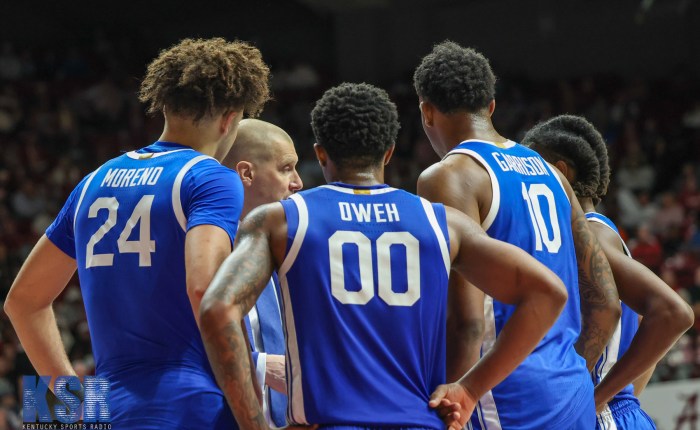
Mark Pope’s Ferrari: Kentucky Basketball’s Drive for a Championship

Mark Pope’s Ferrari: Kentucky Basketball’s Drive for a Championship

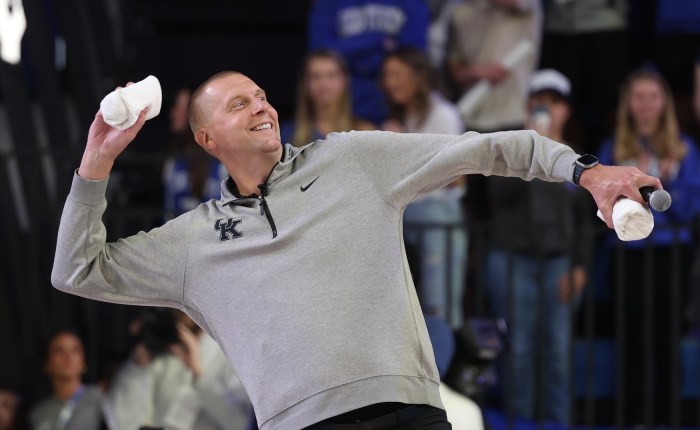
(LEXINGTON, Ky.) – When Mark Pope stood before the assembled media the other day and said, “We got a great Ferrari and we can’t wait to take it for a spin,” I thought he was referring to the team’s on-court performance. You know—sleek offensive design, turbocharged energy, cornering on a dime. What I didn’t realize was that the real Ferrari might be the one he’s been paying for—rumored to be worth about $22 million in NIL payouts.

Apparently, this isn’t your dad’s Kentucky basketball team, cobbled together with a few well-placed ten-dollar-handshakes. Nope, this is a shiny new model, custom-built with top-of-the-line NIL features, luxury international imports, and more horsepower than a herd of wild stallions. Pope, of course, is the guy behind the wheel—white-knuckled, grinning ear to ear, and just itching to mash the accelerator.

Unfortunately, he may have already dinged the fender.

Before Big Blue Nation could even buckle their seatbelts, the Ferrari hit a pothole during the Blue-White Scrimmage in Memorial Coliseum. Starting point guard Jaland Lowe, the Pitt transfer recruited specifically to pilot this high-powered offense, went down with a shoulder injury. It didn’t appear to be a fiery crash—but still—you never want to see your lead driver headed to the pit before the first lap.

And what a lap it was. The Blue-White game—usually a glorified layup line wrapped in applause—felt more like a demolition derby this year. Players were crashing the glass with impunity, fighting through screens like the bench was calling, and snarling like the game meant a trip to the Final Four.

I’ve covered a lot of Blue-White scrimmages in my day, but I’ve never seen one that intense. The pace was frenetic, the emotions were high, and the competition was fierce. Pope has these guys revved up like they’re chasing Banner No. 9, rehearsing for One Shining Moment before the first ball is even tipped.

And that’s the rub, isn’t it? The new head coach hasn’t just brought a fresh energy—he’s brought a fresh philosophy. Gone are the days of “these guys are young” or “trust the process.” Pope doesn’t do slow builds or cautious optimism. He’s out there saying, in essence, “We’re Kentucky. We play to win it all—every game, every drill, every scrimmage.”

That kind of bravado plays beautifully in October. It’s the stuff fans dream about while their football team self-destructs. But it’s also a lot to live up to over the grind of a five-month season.

Because as thrilling as it is to hear your coach talk about Ferraris, championship hunts, and competitive fire, there’s a fine line between confidence and burnout. The season’s an endurance race, not a drag strip. The question isn’t whether this team can go 200 mph—it’s whether they can stay on the track long enough to see the checkered flag.

Now, before you accuse me of pouring water on Pope’s premium fuel, let me be clear: I love the swagger. After years of seeing a fan base divided between believers and doubters, there’s something downright refreshing about having a head coach who plants his flag, goes for the jugular and says, “These guys want to win, always.” No hedging, no excuses, no talk about youth or rebuilding.

Pope’s message to his players—and to all of us—is unmistakable: Kentucky basketball doesn’t back down. Whether it’s an intra-squad scrimmage on the UK campus or a March showdown in Madison Square Garden, they’re going to play with everything they’ve got.

But maybe, just maybe, he could keep one hand on the brake for a bit.

Because here comes Purdue—No. 1 in the country, with the nation’s top point guard in Braden Smith—rolling into town Friday night for the first exhibition. On paper, it’s a game that doesn’t count. But try telling that to a fan base that treats October tune-ups like NCAA Tournament play-ins. Win by 20 and the hype train leaves the station at warp speed. Lose by 20 and the “Ferrari” gets called a lemon before Thanksgiving.

That’s just life in the Bluegrass, where basketball is religion and patience is in short supply. Pope knows that better than anyone—he lived it as a player, and now he’s living it as the man in charge.

So, should he tamp it back a bit? Probably not. This is who Mark Pope is—the mad scientist, analytics guru, relentless, and unafraid to dream big. He’s not the kind of guy to idle in neutral while everyone else takes the safe route.

Besides, Ferraris aren’t built for cautious Sunday drives. They’re built to turn heads, scorch the pavement, and leave the competition in the dust.

Still, if there’s one lesson to remember, it’s that championship seasons aren’t won in October—they’re tuned there. Let’s just hope by the time March rolls around, the paint isn’t scratched, the tires aren’t bald, and the driver hasn’t run out of gas.

Because as any Kentucky fan knows, it’s not about how loud the engine roars at the start. It’s about how fast—and how fearlessly—you finish.

—and the only finish line that matters this year runs through Indianapolis.

Dr. John Huang is a retired orthodontist, military veteran, and award-winning author. Currently serving as a columnist for Nolan Group Media, he invites readers to follow him on social media @KYHuangs. Explore his latest, “Whining For Posterity,” and all his books at https://www.Amazon.com/stores/Dr.-John-Huang/author/B092RKJBRD

“Name, Image, and Mayhem: Kentucky’s NIL Cliffhanger”

“Name, Image, and Mayhem: Kentucky’s NIL Cliffhanger”

I’ll be the first to admit—I’m confused. Especially when listening to University of Kentucky Athletics Director Mitch Barnhart talk circles around himself.

In his interview with Matt Jones of Kentucky Sports Radio earlier today, Barnhart assured all the loyal BBN listeners that, even within this new landscape of college athletics, not only will UK not be cutting any sports, but he’s confident the university will be able to fund any new upcoming revenue share amounts.

Those are shockingly bold statements. The obvious retort is: How does Mitch know?

Because just moments earlier while addressing the media, Barnhart refused to disclose any specifics about the revenue sharing amounts, citing the “uncertainty” and “fluidity” of the entire new world order.

“We’re in the first month of this thing,” Barnhart told a roomful of attentive scribes thirsting after his every word. “Literally the first month. For anybody to sit in front of a group and say, ‘I’ve got all the answers after four weeks,’ good for you, good for you. I mean, we’ve talked about a decade’s worth of change that has happened in the last six to ten months of college athletics.”

“The change that has occurred has been massive,” he continued. “We don’t even have a governance structure in place really, to be honest with you.”  

I always knew college athletics was a cutthroat business. That’s why I titled my debut novel Name, Image, and Murder. It was a fictional whodunit loosely based on the chaotic new world of NIL—the Wild Wild West of amateur sports gone pro. But I’m starting to think fiction might be safer than what’s actually brewing behind the scenes in Lexington.

You see, the same school that gave us Adolph Rupp, Dan Issel, Anthony Davis, and eight national championships is now poised at the crossroads of an athletic identity crisis. Do we leverage our exalted status as the greatest tradition in college basketball? Or do we bow before the almighty dollar in a noble attempt to keep all our boats floating? NIL has officially graduated from “name, image, and likeness” to “nobody is listening”—at least when it comes to making choices regarding long-term sustainability.

And now, with the recent House v. NCAA settlement ushering in the brave new world of revenue sharing, UK Athletics is walking a tightrope strung between Rupp Arena, Kroger Field, Memorial Coliseum, and Kentucky Proud Park.

On paper, the new rules sound reasonable. Schools can now pay players directly—up to $20.5 million a year in shared revenue. Kentucky has fully committed to this model, even creating a snazzy new LLC called Champions Blue. Sounds like a superhero franchise, right? Champions Blue! Defenders of BBN! As technically a nonprofit organization, I’m not sure what to make of it. Cynics might call it a financial shell game that makes Enron look like Little League bookkeeping.

Here’s the problem. Paying players is expensive. Kentucky projects a $31 million deficit next year, even after slashing perks, borrowing from the university, and shaking every couch cushion from Pikeville to Paducah. And with the bulk of revenue earmarked for men’s basketball and football, you can kiss some non-revenue sports goodbye faster than a 2-seed getting bounced by Saint Peter’s—regardless of what Mitch promises.

But wait, there’s more! Earlier reports citing multiple reliable sources claim UK is devoting 45% of its revenue-sharing budget directly to Mark Pope’s team. Even though Mark Stoops debunked that statement as “absolutely untrue,” many won’t believe him. This is, after all, a basketball school. Except when the football team has ten-win seasons. Or when the volleyball team is hoisting SEC banners. Or when someone on the rifle squad or track team wins Olympic gold. You know, the other student-athletes, who apparently don’t get to eat from the same buffet.

That’s where the danger lies. Not in the fairness of it all—college athletics has never been fair—but in the fragility of it.

What happens when Title IX lawyers come knocking, wondering why the women’s soccer team is using 1997 cleats while the men’s basketball team is taking private flights to Maui (yes, remember Maui)? What happens when boosters get bored with writing six-figure checks for backups who never leave the bench? What happens when ticket prices go up again to cover costs, and the average fan can’t afford to sit in the rafters without taking out a second mortgage?

What happens when your favorite in-state walk-on is replaced by a five-star diva who’s demanding an exorbitant NIL deal, a YouTube series, and three coveted parking spaces on campus?

This is not just a UK problem. This is an everywhere problem. But here in the Bluegrass, where we measure time in Final Fours and football tailgates, we feel the tremors more than most. It’s hard to build “La Familia” when everyone’s negotiating like La Cosa Nostra.

And don’t get me wrong—I’m not anti-athlete. I’m all for players getting their fair slice of the billion-dollar pie. But when the pie crust is crumbling and the recipe keeps changing, it’s hard to know whether we’re baking a dynasty or our athletics director is just blowing hot air.

Champions Blue may turn out to be a genius model. Or it may be a cautionary tale studied by future ADs with degrees in both sports management and disaster response. In either case, the margin for error is thinner than Mitch Barnhart’s top button.

As for me, I’m thinking about writing a sequel. Name, Image, and Mayhem: The NIL Strikes Back. It’ll feature a fictional blue-blood program that tried to buy its way to the top, only to realize it couldn’t afford loyalty, chemistry, or the next contract buyout. Spoiler alert: the villain isn’t the athlete, the booster, or the NCAA.

It’s the system. A system we all helped create. A system now careening down a one-way road where amateurism is dead, loyalty is negotiable, and tradition is mocked and poo-pooed.

So buckle up, BBN. The real madness isn’t in March anymore. It’s happening right now—behind closed doors, in budget meetings, where the stakes are higher than a last-second Aaron Harrison three-point bomb.

May God have mercy on us all.


Dr. John Huang is a retired orthodontist, military veteran, and award-winning author of Name, Image, and Murder. He serves as a reporter and columnist for Nolan Group Media. Follow him @KYHuangs on social media and find his books, including the soon-to-be-bestselling Whining for Posterity, here: https://www.Amazon.com/stores/Dr.-John-Huang/author/B092RKJBRD

Let Freedom Ring

Let Freedom Ring

I first penned this essay back in April of 2019. It still remains one of my favorite pieces. Happy Birthday, America!

Final Four? I don’t care. I guess I’m a sore loser. The minute Kentucky gets eliminated in the NCAA tournament, I just want to get as far away from basketball as possible. In 2017, right after UNC’s Luke Maye sent the Wildcats prematurely packing, I immediately started packing for my own trip to Turks and Caicos. When Kansas State upset the Big Blue a year later, I booked the first flight out for the Florida Gulf Coast. In 2019, unfortunately, I headed out early again—to someplace far away from Minneapolis, where I could put overtime losses to Bruce Pearl completely out of sight and out of mind.

You see, less than twenty-four hours after returning from the disappointment in Kansas City, I was stuffing my suitcase for Washington, DC. I’ve been there many times over the course of my lifetime, but never while the cherry blossoms were in full bloom. I was killing two birds with one stone on this trip—making my wife happy and NOT watching basketball during the first weekend in April.

Ah, the memories came flooding back. My first visit to our nation’s capital was with my mom and dad back in the mid-1960s. As newly minted, starry-eyed, first-generation immigrants from China, my parents wanted to show firsthand—to their number one son—the sights and symbols representing their personal pursuit of the American dream. Where better than Washington, DC, where founding fathers and freedom fighters named Washington, Jefferson, and Abraham Lincoln stood sentinel over democracy? Granted, I was only six years old at the time, but something deep down inside of me still resonated with this Land of Opportunity. Even back then, the inalienable rights of life, liberty, and the pursuit of happiness sounded pretty darned good to me.

I returned to DC again in the early 1980s, this time as a recent college graduate, indoctrinated with the liberal agenda and misguided cynicism flowing out of all university campuses. The city had a different vibe for me this time around. Thoughts of American imperialism, social injustice, and racial inequality sadly replaced the wide-eyed innocence of my earlier visit. With malice towards none; charity for all suddenly became a slogan that pipedreams were made of. Not going to happen in this America, I surmised at the time.

I returned to Washington again in the early 1990s, a thirty-something professional with a beautiful wife and one-year-old daughter in tow. Ten years in the military with a stint living overseas, and my thoughts on America had changed. The good ole’ USA was now all about capitalism—making a buck, keeping up with the Joneses, and paying off your mortgage. To me, DC represented all that was worth striving for—the money of the Federal Reserve, the power on Capitol Hill, and the status of the West Wing. I have a dream. It was a different dream than Dr. Martin Luther King had, but it was my dream, nonetheless.

And now, nearly three decades later, I’m back again—armed with a lifetime of experiences and a bucketload of supposedly new wisdom. It’s somewhat bittersweet. My mom has since passed, my daughter is all grown up, and I’ve been retired and put out to pasture. On a beautiful sunny weekday morning, I stroll leisurely along the National Mall, with plenty of time to ruminate about life’s regrets, growing old, and what America has meant to me.

Over a half a century as a naturalized American citizen gives me a perspective grounded mostly in gratitude. I’m grateful for many things—a fine education, access to health care, and languorous walks with my dog. But as I pause in front of all the different war memorials, I realize that the thing I’m mostly grateful for in America is freedom. Freedom to speak, write, gather, and worship as I choose. The United States of America still has its faults, but in terms of individual freedom, it remains the greatest nation on the face of the earth.

Walking up the steps of the Jefferson Memorial, I’m reminded that with freedom comes responsibility. Freedom isn’t free. Many have died fighting for it. “May we think of freedom, not as the right to do as we please, but as the opportunity to do what is right.” (author unknown)

Our Founding Fathers got it right in the beginning. “We hold these truths to be self-evident: that all men are created equal, that they are endowed by their Creator with certain inalienable rights, among these are life, liberty, and the pursuit of happiness…” May Washington, DC, remain forever a bastion of liberty and a beacon for democracy. Let freedom ring!

By the way, the cherry blossoms were beautiful in April. My wife is happy. Final Four? Who does Duke play again?

Dr. John Huang is a retired orthodontist, military veteran, and award-winning author. Currently serving as a columnist for Nolan Group Media, he invites readers to follow him on social media @KYHuangs. If you enjoy his writing, please check out his newest book, “Whining for Posterity,” available here: https://www.amazon.com/dp/B0FDLCGR1P

The Top Five Reasons NOT to Buy My Book

The Top Five Reasons NOT to Buy My Book

Let’s face it. We’re all inundated these days—with political propaganda, fast food coupons, and suspicious texts warning that your bank account’s been compromised. So when a washed-up orthodontist-turned-sportswriter announces his eighth book, your first instinct might be to mutter “bless his heart,” roll your eyes, and scroll on by.

But before you do, allow me—with all the humility I can muster—to present:

The Top Five Reasons NOT to Buy My New Book, Whining for Posterity: Life, Sports, and Other Things Worth Complaining About


Reason #5: You’ve Already Heard It All Before

Fair. At least the five people outside my immediate family who’ve read all my blogs, chuckled at my columns, and survived a few of my Facebook rants might think so. You know who you are.

You’re thinking, “I don’t need a bound compilation of recycled material cluttering up my coffee table.”

Touché. But this is the director’s cut. Whining for Posterity includes never-before-seen edits, timely updates, and slightly embarrassing bonus reflections by yours truly—organized into tidy little categories like “Life,” “Love,” “Politics,” “Religion,” “Travel,” and “Sports.”

Skip the spiritual stuff. Go straight to the football whining if that’s your thing. I won’t be offended.


Reason #4: You Don’t Like Complaining

Neither do I. That’s why I wrote a whole book about it.

Let me clarify: this isn’t just me griping about the Bengals’ play-calling or America’s healthcare system. It’s an honest, often humorous, occasionally heartfelt look at the little frustrations of life—and the big lessons hiding behind them.

Think of it as therapy, but with fewer co-pays and more Rick Pitino references.


Reason #3: You’re Holding Out for the Movie

Ah yes, the inevitable blockbuster. Picture it: Jackie Chan as me, Meryl Streep as my long-suffering editor, and John Calipari making a surprise cameo as himself.

Sadly, Hollywood hasn’t called. Yet.

So for now, your only option is to read the book. Don’t worry—it’s got plot twists, emotional payoffs, and enough laugh-out-loud moments to keep even the most distracted reader engaged. There’s something in it for everyone.

Best of all? It’s cheaper than a bucket of overpriced movie popcorn.


Reason #2: You Think I’m Just Trying to Make a Buck

Please. I’m a writer. If I wanted to make money, I’d still be straightening teeth.

Truth is, I’m donating all the proceeds from this book to charity. Not because I’m a saint—but because YOU are. Plus, I’d rather give the money away than explain to the IRS why I spent it all on road trips with the Wildcats.

So when you buy Whining for Posterity, you’re not just supporting me. You’re supporting a good cause—and giving yourself (or someone you’re regifting it to) a few laughs, a few tears, and maybe even a fresh perspective on this maddening miracle we call life.


Reason #1: You’d Rather Read John Grisham

Who wouldn’t? I’m no John Grisham.

But here’s the truth: Whining for Posterity isn’t a legal thriller. Nor is it just a collection of gripes and giggles. It’s a scrapbook of moments—some hilarious, some heartfelt—that remind us what really matters. Relationships. Family. Faith. Our dogs. The everyday absurdities that make life worth living.

At some point, we all start thinking about what we’re leaving behind. Not money or monuments, but memories, stories, and maybe a few lessons others can carry forward.

This book is my way of doing that. A little piece of my voice—whiny as it is—preserved for whoever wants to listen.

So no, you don’t have to read it. But if you do, I hope it makes you think a little more about your own legacy—the one you’re writing every day, whether you realize it or not.

Because whining, at its core, is just love in disguise. A love that refuses to let life pass by unnoticed.


So there you have it. Five completely legitimate, totally reasonable, utterly unconvincing reasons not to buy my book.

But if, despite all that, you feel compelled to grab a copy of Whining for Posterity, I won’t stop you. In fact, I’m thanking you now in advance. Flag me down and I’ll sign it for you—maybe even buy you lunch, or at the very least, offer a heartfelt “bless your heart.”

Whining for Posterity—available now on Amazon and wherever books silently judge you from your nightstand. Click here to purchase. https://www.amazon.com/dp/B0FDLCGR1P

#WhiningForPosterity
#BuyItAnyway
#ComplainingWithPurpose

It Still Means Something”: Why the Kentucky Brand Isn’t Just a Jersey

It Still Means Something”: Why the Kentucky Brand Isn’t Just a Jersey

Kentucky players celebrating the name on the front of the jersey after their big 106-100 win over the eventual national champion, Florida Gators, in Rupp Arena on January 4, 2025.

(LEXINGTON, Ky.) – In an era where players are more likely to follow Benjamins than banners, where “NIL” has replaced “MVP” in the recruiting wars, and where the transfer portal spins faster than my dog doing zoomies, one might wonder—Does the name on the front of the jersey still matter anymore?

At his recent media conference held earlier this week, Kentucky Basketball head coach Mark Pope answered that question with a resounding, heartfelt yes. And this wasn’t just your typical lukewarm head nod. No, this was the type of yes that gives you chills. The kind that makes you want to lace up your Nikes, high five your portly neighbor, and run through the proverbial brick wall.

“It matters,” Pope said. “There’s nowhere like this.”

He’s not wrong. Kentucky Basketball isn’t just a brand. It’s the program with the greatest tradition in the history of the game. It’s a baptism together with a rite of passage wrapped up in eight NCAA championship banners, 61 NCAA Tournament appearances, and the most all-time wins of anybody still playing. It’s Joe B. and Jamal. It’s Wah Wah and Wall. It’s five national championships in five different decades and a fanbase that will passionately defend the honor of Farmer, Pelphrey, Feldhaus, and Woods like they’re…well…Unforgettable.

But in this new wild west of college hoops—where loyalty is traded for luxury and bluebloods can be outbid by programs with booster billionaires—it’s fair to ask: Does Kentucky still hold sway with this new generation of coddled, roundball mercenaries raised on highlight reels and endorsement deals?

Pope thinks it does. Scratch that—he knows it does. And surprise, surprise—his answer isn’t only about tradition for tradition’s sake. It’s about transformation, character, work ethic, and servant leadership. About what happens when you willingly pour yourself into something bigger.

“If you come in here not understanding or appreciating that,” Pope warns, “I think your chances of success are not very high.”

That’s not gatekeeping. That’s the gospel according to the Pope.

Because this place is different. It asks more of you. More than just your wingspan or your vertical or your TikTok follower count. It demands your heart. Your humility. Your willingness to dive for loose balls, to play through bruises, to pass up a good shot for a great one. To give your teammate the limelight just because he’s your teammate. It demands that you surrender just a little piece of yourself—not to lose your identity, but to elevate it.

And that’s where the magic happens.

“When you learn that concept—of if I give a little bit of myself, it actually elevates myself—that’s what’s great about this beautiful, brilliant team sport of basketball,” Pope said. “The pathway to become immortal is very different than this world wants to teach us.”

Mic. Drop.

Yes, kids today are soft. There, I said it. Many may be distracted by the siren song of short-term riches. But Pope isn’t recruiting kids who just want a wheelbarrow full of cash. He’s recruiting young men who want to matter and make a difference. Who’ll leave legacy footprints in the bluegrass that echo through the rafters long after they’re gone. People like Issel, and Goose, and Macy, and Walker, and Davis.

Think about it: Where else can you become immortal at the ripe age of nineteen? Where else does a walk-on get a standing ovation just for checking in? Where else can you go from obscurity to legendary in a single March weekend? Where can you be known simply for sporting a unibrow, girls kissing your car bumper, or wearing jorts for heaven’s sake?

That’s not marketing fluff put together by the suits at JMI. That’s lived experience. That’s legacy. And it’s now being passed down from generation to generation.

“Our guys last season set a beautiful, brilliant standard of what it means to be a Kentucky Basketball player,” Pope said. “We’re leaning on them a lot… their video, their outtakes, their clips, their comments—just to help understand that.”

Because—as former coach John Calipari famously said on so many occasions—Kentucky isn’t for everyone. And that’s precisely the point.

You can go be a great basketball player at a lot of places. Pope knows that. Heck, he’s played and coached in a few of them. But being great here? That’s a different kind of great. That’s statue-worthy great. That’s raise-your-jersey-to-the-rafters great. That’s can’t-walk-through-Kroger-without-grandma-taking-a-selfie great.

So yes, the name on the back may earn you the check. But the name on the front? That’s what earns you the chapter in Kentucky lore.

Mark Pope gets it. He lived it. And now, he’s preaching it. Loudly. Passionately. With a blend of fire and sincerity that makes you believe Kentucky Basketball hasn’t lost its way after all. It’s just waiting for the right kind of player to find theirs.

Because for all the bells, whistles, dollar signs, and distractions of this modern basketball age, one truth remains: This place is different.

And if you can understand that?

You’re going to be crazy successful.

Or immortal.

That’s the gospel truth. Sign me up, Coach!

Dr. John Huang is a retired orthodontist, military veteran, and award-winning author. Currently serving as a columnist for Nolan Group Media, he invites readers to follow him on social media @KYHuangs. Explore his debut novel— “Name, Image, and Murder”—and all his books at https://www.Amazon.com/stores/Dr.-John-Huang/author/B092RKJBRD

This blog posting was first submitted as a column for Nolan Group Media publications.

Dear Duke Basketball

Dear Duke Basketball

We feel your pain. Really, we do.

After all, as die-hard Kentucky fans—we’ve been there. We’re all too familiar with having our national title hopes strewn like shattered glass across the Final Four floor. We’ve seen the movie several times before—the one where the best team, with the best players, and all the media hype in the world, suddenly and shockingly crumbles into a tragic heap of nightmarish disbelief.

So many times, we’ve also been anointed prematurely. Crowned before the coronation. Celebrated before the ceremony. And then left to watch—stunned and slack-jawed, humiliated and embarrassed—as the dream slipped away and the rest of the world rejoiced.

So yes, we feel for you, Duke fans.
But make no mistake—we’re also laughing at you this morning. At least just a little.

Because it couldn’t have happened to a more deserving program.

Oh, I know. That’s petty. That’s small. That’s un-Christian. “You’re living rent-free in our heads,” you say.

That may all be true.
But c’mon—this is Duke University we’re talking about.

Ever since Laettner hit the shot, you’ve been the villain in our college hoops drama. You stole our titles back in 2010 and 2015. You—with your haughty, self-righteous air of academic superiority—deserve exactly what you’re getting. Your smug alumni looking down from their elitist Gothic towers in Durham while we wallow in our fried chicken, cigarettes, and toothless grins.

And now this.

Comfortably up by 14 points with eight minutes to go, and you manage just one field goal the rest of the game—losing to Houston 70–67 in the national semifinals. The laughingstock. The punchline. The greatest Final Four choke of all time.

So what now?

You mope about. You avoid ESPN. You dread “One Shining Moment” and try to convince yourselves that next year will be your year.

(Spoiler: It won’t be.)

But take heart, for this too shall pass. Time, as they say, cures all wounds.

We know the feeling. The second-half shooting debacle versus Georgetown in 1984? We’re coping. The shot-clock violations versus Wisconsin in 2015? Scarred, but functional. Saint Peter’s and Jack Gohlke? Perplexed, but no longer in despair.

So join us, Duke. Come sit beside us on this broken, blue-blooded bench of cold-hearted misery. Let’s swap stories about what might have been. We’ll tell you about 2015 if you tell us about 2025.

You see, for all your Ivy League aspirations and smug superiority, you’re not so different from us after all. Blue bloods with blue uniforms. Blue tears. Blue language from angry fans. And now, an equally blue postseason résumé.

The only real difference?

We’ve got eight championship rings.
You still have only five.

Respectfully,
BBN

The Epic Return

The Epic Return

If Kentucky under Rick Pitino was Camelot—a kingdom of discipline, full-court pressure, and three-point barrages—then John Calipari’s Kentucky was Hollywood.

It was glitz, glamour, and one-and-done superstars walking the red carpet to the NBA. It was the biggest show in college basketball, headlined by a charismatic director who knew how to market his stars. There were blockbuster seasons (2010, 2012, 2015), shocking flops (Evansville, St. Peter’s, Oakland), and a script that, in the end, started feeling a little too familiar.

Like any Hollywood epic, it had its golden era, its sequels that didn’t quite measure up, and ultimately, an ending that unceremoniously flopped. But for over a decade, Big Blue Nation lived under the bright lights—forever in the hunt—hoping that every season could produce the next big championship hit.

Now, the cameras have moved on, the set has changed, and Calipari has left town. But on February 1, the former leading man returns to see if the audience still remembers his name.

Of course we remember. For 15 years, Coach Cal was the man in Lexington, patrolling the Kentucky sideline with designer suits, slicked-back hair, and a bottomless supply of “YOU PEOPLE ARE CRAZY” clichés. He promised the Big Blue Nation “we eat first,” and for a while, we did—four Final Fours, a national title, an undefeated regular season, and 25 NBA lottery picks will do that. But over time, the meals got smaller, the bill got bigger, and the chef started arguing with the waitstaff. When Mark Pope was handed the keys last April, many in the fan base felt relieved, a bit like ending a long-term relationship that had irreparably soured and gone stale.

But here’s the thing about breakups—closure is never real until you see them again.

So here comes Cal, rolling into town this weekend wearing red, looking like the guy who just bought a sports car after a midlife crisis. He won’t say it, but he’d love nothing more than to walk into Rupp, stick his hands in his pig-sooie pockets, and smugly strut out with a win.

The reception? Oh, it’s complicated.

If I were emperor of BBN, I would order a rousing standing ovation when Calipari is introduced. After all, the man deserves it. He’ll be in the rafters one day. The guy devoted 15 years of his life to the program, the university, and the community. Sure, he won a lot of ball games. But he also used his enormous platform to spearhead relief efforts wherever and whenever disasters hit, and people were hurting. On a personal level, he also wrote the foreword to two of my books. With the entire college basketball world looking on, how classy would it be if everyone stood and cheered.

There will be cheers because, let’s face it, he did bring home banner No. 8. There will also be boos, because 9, 10, and 11 never followed. Some fans will clap out of respect, others will heckle because they feel like the last four years were a hostage situation. And still others—perhaps the most honest among us—will feel an odd mix of nostalgia and irritation, like when you really enjoyed the movie but felt the ending royally sucked.

Tom Leach had a very insightful take when he appeared on the Round of Shots podcast earlier last week.

“He’ll get booed just like Rick did,” predicted the Voice of the Wildcats. “It’ll be a pretty strong chorus of boos I’d imagine. There’ll be some mixed emotions for Cal on that. If you’re in that situation and you’ve coached at Kentucky, you may be a little insulted if they didn’t boo you.”

With Calipari’s massive ego, that comment may just be spot on. So, let’s cheer at his intro. But as soon as the ball is tipped, we’ll boo until our heart’s content.

Whatever happens, one thing is for sure: February 1 is must-watch theater.

Because every Hollywood story gets a sequel—whether you want it or not.

Dr. John Huang is a retired orthodontist, military veteran, and award-winning author. Currently serving as a columnist for Nolan Group Media, he invites readers to follow him on social media @KYHuangs. Explore his debut novel— “Name, Image, and Murder”—and all his books at https://www.Amazon.com/stores/Dr.-John-Huang/author/B092RKJBRD

Back to the Future

Back to the Future

Mark Pope and Coach Rick Pitino enjoying the good times after Kentucky’s 1996 Championship run (David Perry/Lexington Herald-Leader staff file photo).

(LEXINGTON, Ky.) – The old has gone, the new has come.

In his farewell video to Big Blue Nation, John Calipari graciously acknowledged that the Kentucky basketball program needed a change at the top. Many of you agreed with him. Postseason wins had dwindled. Fan morale was at an all-time low. After the disappointing results from the last four years, Coach Cal’s snarky quips and swaggy braggadocio had turned a bit stale for anyone still gullible enough to listen. It was indeed time for a new voice.

Exit Boss Hogg. Enter Mark Pope.

News that the 51-year-old former Wildcat was taking over as the grand pooh-bah of college basketball’s Roman empire first leaked out late on Thursday night. With Billy Donovan still considered a viable candidate, the quick decision caught many by surprise. In fact, the mere mention of Pope as a serious choice generated more outrage initially than any debate on gun control, abortion, or unisex bathrooms.

Twelve hours later, however, the mood magically shifted. Although a few dissenters stood firm—and the “fire Mitch Barnhart” sentiments remained as ubiquitous as ever—the rest of Big Blue Nation began buying in and circling the wagons. After all, Mark Pope was one of us—a product of the glory years of the mid-90s, when the name on the front of the jersey instilled an overwhelming sense of pride, accomplishment, and honor to anyone heard cheering in the commonwealth. Plus, unlike Dan Hurley and Scott Drew, the man wanted to be here. He coveted the job.

In addition, Pope could coach. His teams at BYU played an exciting brand of basketball that spread the floor, shot threes with impunity, and actually ran in-bounds plays. On top of that, Pope was smart—a Rhodes Scholar candidate who completed three arduous years of medical school before chucking it all to pursue his coaching passion. Who in their right mind does that?

Ringing character endorsements provided the crowning coup de gras. Former teammates dubbed Pope as the ultimate leader with an infectious positivity that could move mountains. His former college coach—known for a few scandalous indiscretions of his own—attested on video to Pope’s moral integrity and grit.

Through it all, one important question loomed: Could Pope recruit? Time will soon tell. But given the blue-blooded resources now at his disposal, I’d say the chances are excellent. A just-announced $4 million injection into the Big Blue NIL fund certainly makes success more probable. He’ll need every penny, though. After John Calipari flew the coop, the cupboard for next year is frighteningly bare.

Putting all that aside, here’s what’s most astounding to me. Pope’s hiring is more than just a changing of the guard. His blink-of-an-eye ascension to the throne has resulted in something extraordinary. It’s miraculously galvanized the entire fan base in one unexpected fell swoop, giving every citizen of Big Blue Nation a lifesaving shot of adrenaline just when they needed it the most. By handing Mark Pope the keys to the kingdom, we’ve reconnected with our glorious past and recaptured everything that was once true, right, noble, pure, and admirable about the program we all knew and loved.

Okay—I’ll admit it—I’ve undoubtedly tasted the blue Kool-Aid. But here’s the thing. I’m not quite swallowing it just yet. 

Ultimately, Mark Pope will be judged on one thing only—national championships. Adolph Rupp garnered four of them before being forced into retirement in 1972. Since then, four of Rupp’s successors, Joe B. Hall, Rick Pitino, Tubby Smith, and John Calipari have added additional national titles to Kentucky’s trophy case.

Will Mark Pope be the fifth?

It’s a daunting question for a new hire right out of the gate—especially to one who hasn’t won a single NCAA tournament game. But it’s also not unfair to ask it under the circumstances. Because the bar is always set unreasonably high in the Bluegrass. Mind you, the program with the greatest tradition in the history of college basketball doesn’t hang banners for Sweet 16s or Elite Eights. You won’t find participation trophies for Final Fours.

Mark Pope knows all that. And yet, he’s still willing to forsake the comforts of Provo, Utah—where expectations are much more pedestrian—to plunge willy nilly into the soul-sapping vortex that awaits him back in Lexington.

“UK changed my life forever as a human being,” Pope said in his introductory statement. “The love and passion I have for this program, this University and the people of the Commonwealth goes to the depth of my soul.”

For that reason alone, all Kentucky fans need to rally behind him. I’m all in for now. And for the sake of the kingdom, you should be too.

Dr. John Huang is a retired orthodontist, military veteran, and award-winning author. This blog post was originally written as a sports column for Nolan Group Media publications. You can follow Dr. Huang on social media @KYHuangs and check out all his books at https://www.Amazon.com/stores/Dr.-John-Huang/author/B092RKJBRD

United We Stand, Divided We Fall

United We Stand, Divided We Fall

It’s high time for John Calipari to do the honorable thing (Dr. Michael Huang Photo).

(LEXINGTON, Ky.) – A house divided cannot stand.

Whether attributed to Abraham Lincoln or Jesus Christ, those are wise words—and Big Blue Nation should take heed.

After another demoralizing and embarrassing first-round flameout in this year’s NCAA tournament, the Roman Empire of college basketball finds itself hopelessly divided, poised on the precipice of a potential epic collapse.

In one corner are the staunch “Fire Calipari” proponents, claiming that the Hall of Fame coach has lost his fastball. The worst regular season in program history (9 – 16 in 2021), the worst postseason losses in program history (Saint Peters in 2022 and now Oakland in 2024), and one paltry NCAA tournament win in the last five years does not the Gold Standard make.

In the other corner are the loyal Coach Cal stalwarts. Despite the lack of recent postseason success, he’s still the best person for the job. Four Final Fours and a National Championship builds you a lot of equity. The man is still one of the best recruiters out there. Plus, look at all the charitable work he’s done for the community. Who’re you going to get that’s better?

So, we’re at a virtual impasse—hopelessly divided, right? A $33.3 million buyout of Calipari’s lifetime contract only adds to the existing quagmire. That’s not chump change, and the University of Kentucky—even if generous boosters come up with the goods—cannot afford to squander that amount of money just to cover up Mitch Barnhart’s horrific boo-boo.

How, then, do we unify and rally the fanbase? If Calipari stays on as coach, I’m afraid that simply wouldn’t be possible. From what I’ve gleaned in talking to fans and media alike, the atmosphere is just way too toxic. Expecting him to change his polarizing methods at this stage is simply wishful thinking on our part. Who’s coaching at Kentucky next year is a topic for another time. It just can’t be John Calipari.

The honorable thing would be for Calipari to graciously step down. When you’ve tarnished the empire’s reputation, it’s time to fall on your sword. But we know he’s way too proud and stubborn to do that. Plus, that wouldn’t be really fair to him. Both parties agreed to the financial terms in advance. Calipari loves money, and I doubt he’d settle for a penny less to just walk away.

Upon further review, perhaps the buyout isn’t as daunting as it first appears.

First of all, there’s an offset in the contract, meaning that if Calipari would get another coaching job somewhere else, his new salary would count toward the buyout. Even at 65 years old, I don’t think Coach Cal is ready to retire to his private island, watch Alaska shows, and play with his dogs all day long.

Secondly, we’re not talking about a lump sum payment. The buyout would be paid in monthly installments over the next five years. That’s certainly manageable in the university’s $6.8 billion mega budget.

The key, then, is to find a good compromise, one that allows both parties to save face and walk away feeling good. The university can’t be seen as pissing money away in an irresponsible fashion, while Calipari can’t lose out on the cash he thinks he was promised and deserves. In addition, any boosters paying Calipari to go away also expect and demand a good return on their investment.

What if the university or the boosters pay Calipari the full buyout amount and then Calipari agrees to donate a portion of it over to whatever charitable cause he wishes? That way, the university feels that money was actually put to good use—which it would be. Calipari gets what he’s owed, further enhances his charitable legacy, and rides off into whatever sunset he chooses under the good graces of a forever thankful UK fan base.

What distinguishes that UK fan base from all the other pretenders is our unbridled passion. What binds us together is our like-minded heritage and culture. We derive deep pleasure and satisfaction in having our identity tied in with the program—the program with the greatest tradition in the history of college basketball.

That tradition is slowly slipping away. It’s time for Mitch Barnhart and John Calipari to stop the bleeding. Lock yourselves in a room and either sing kumbaya or punch each other silly. But don’t come out until you’ve reached a tenable solution.

As die-hard Kentucky fans, the onus is on us also. Whatever Barnhart and Calipari decide, it’s important for Big Blue Nation to stick together, to circle the wagons, and to come back next year more passionate than ever.

“United we stand, divided we fall” is our state motto.

Now the legacy of our basketball empire depends on it also.

Dr. John Huang is a retired orthodontist, military veteran, and award-winning author. This blog post was originally written as a sports column for Nolan Group Media publications. You can follow Dr. Huang on social media @KYHuangs and check out all his books at https://www.Amazon.com/stores/Dr.-John-Huang/author/B092RKJBRD