The Seventy-Cent Ride from Hell

The Seventy-Cent Ride from Hell

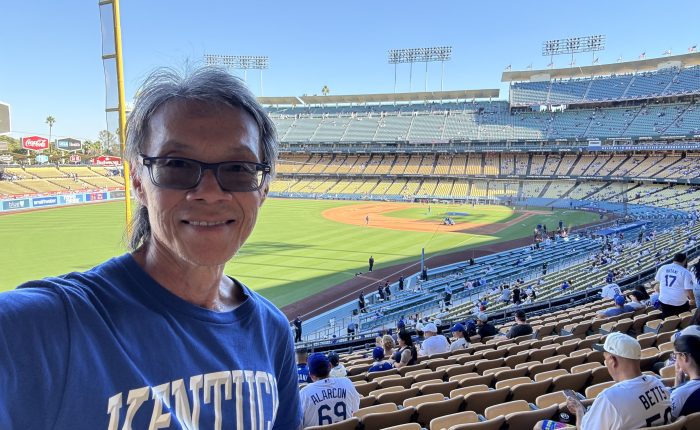
Me, at Game 2 of Braves/Dodgers NLDS. Still smiling. Hadn’t tried getting home yet.

There ought to be an age at which a man stops confusing being cheap with being resourceful. Apparently, sixty-seven isn’t it.

I’ve written before about my trips to Los Angeles. My daughter lives there, which makes every other reason for visiting the City of Angels secondary. You could put the World Series, the Olympics, and an all-you-can-eat dumpling festival on the same block, and being with Katie would still be the reason I come. The dumplings would simply help me stay longer.

Sunny Southern California has also become a getaway from the rigors of caregiving. I love my wife, but anybody who’s done it knows that loving somebody doesn’t make the responsibilities lighter. Sometimes you need a little distance to catch your breath. Flying back and forth from Lexington every couple of months, I’ve come to think of California as a second home, albeit one where I haven’t figured out how anybody affords the first one.

The weather, as you know, is usually glorious. You’ve got the beach, the mountains, and enough ethnic food to keep an adventurous eater looking for more. NFL Football comes on at 10 a.m. on Sundays. There are festivals, concerts, and sporting events practically every time you turn around. On this particular visit, the Braves and Dodgers were playing in the National League Division Series.

As a Reds fan, I don’t get many opportunities to watch postseason baseball. Usually by October, I’m available to rake leaves and carve pumpkins. So I figured I’d give this a try.

Ticketmaster—which by the way is still holding on to my postponed Barry Manilow tickets—was surprisingly cooperative. Plenty of good seats were available, which suggested that two consecutive World Series championships might have left Dodger fans a little jaded. Apparently, winning gets old. I’d be happy to conduct that experiment in Cincinnati.

Getting a ticket was easy. Getting myself to the stadium required considerably more imagination.

Armed with a senior citizen’s Metro pass, I intended to cross one of the most densely populated metropolitan areas in America for thirty-five cents. There was a subway connection to Union Station, followed by the free Dodger Stadium Express. On paper, it looked almost elegant.

Unfortunately, the paper neglected to mention the thirty-minute walk from my house to the Metro station in hundred-degree heat to begin the journey.

I could have called an Uber. Instead, I set off on foot, because somewhere in my overheated brain, spending money on transportation would have invalidated the entire expedition. By the time I reached the station, I had achieved the moisture content of a steamed dumpling.

Yes, Los Angeles has a subway. You might not know that from looking at the freeways. My trip to Union Station took about an hour, with only one transfer—also free, a detail I found disproportionately satisfying.

Riding public transportation can be humbling. The ride came with plenty of people watching. Some appeared to be without a home, others were elderly, and a few smelled as though they’d brought the dispensary along. For purposes of this discussion, elderly means older than me. I reserve the right to adjust that definition annually.

At Union Station, the Dodger Express folks offered free ice cream. The catch was that they wouldn’t let you take it on the bus. Offering a frozen dairy product to people right before boarding felt like a test somebody in a psychology department should have been supervising.

Eventually, I reached Dodger Stadium, where a hot dog and Coke cost me twenty-two dollars. Having crossed Los Angeles for thirty-five cents, I promptly surrendered my savings to a wiener. Somehow, this didn’t bother me nearly as much as paying for an Uber would have.

The game itself was terrific. On one side sat a rabid Braves fan, apparently determined to provide Atlanta with all the vocal support it wasn’t getting from the rest of the stadium. I admire passion, but there’s something to be said for occasionally checking whether the forty people glaring at you are enjoying your contribution.

On the other side, a couple appeared to be attempting to sample every concession Dodger Stadium offered. Every time I looked over, somebody was unwrapping something. Hey, where can I get that meal plan?

Atlanta won 3–2, but the outcome wasn’t settled until the end. Nobody left early, including me. I’d paid to see postseason baseball, and I intended to get every last out.

This was where my financial judgment began collecting interest.

Getting down from the upper deck involved shuffling through hot, stuffy corridors with thousands of other people who’d had the same excellent idea. There was nowhere to go except wherever the person in front of you went, which was generally six inches forward and then nowhere again. I had come to California to catch my breath. Now I was holding it as the stench and germs enveloped me.

Finally outside, I found the bus line back—and fortunately it appeared to be moving. That was encouraging until I realized it also kept going, snaking around the stadium as though we were touring the exterior. Fifteen minutes of loading later, I boarded a bus with standing room only.

Remember when people gave up their seats for the old guy? Well, I am now the old guy, and apparently that custom has been discontinued. Naturally, I wouldn’t have taken the seat had somebody offered. I’d have waved them off and insisted I was fine. But I would have appreciated the opportunity to lie.

I’ve spent enough years covering Kentucky games to understand postgame traffic. I wasn’t expecting our driver to part the Red Sea. Still, the word “Express” was beginning to feel like something the marketing department had slipped past legal.

Down the hills and around the turns we crawled, with me rocking back and forth among my fellow standees. Despite all my yoga, my balance ain’t that great. Apparently, holding a pose in a quiet room doesn’t fully prepare you for a downtown LA turn with a stranger’s elbow in your ribs. I clung to whatever was available and tried not to become somebody else’s problem. Luckily, the Dodger Dog stayed down.

Back at Union Station, we waited for trains. Then we waited on trains. The cars were packed, the intervals felt interminable, and even after boarding, we’d sit at a station long enough for me to wonder what in the hell we were waiting for.

By the time I finally reached my stop, it was pitch black. The condo was still 1.3 miles away.

An Uber would have made sense. My feet hurt, I was tired, and I had already demonstrated everything that needed demonstrating about the affordability of public transportation.

I walked anyway.

Somewhere along that last stretch, I thought about how often Katie must wonder whether her father has any sense. I come all this way to see her, then spend an evening sweating across the city to watch two teams I don’t even root for. Still, I’d checked off a bucket list item, experienced a little of Los Angeles beyond the beach, and acquired something to complain about. For a man who writes Huang’s Whinings, that’s a fairly productive evening.

When I finally got back to the condo, I took off my shoes and did the math one more time.

Seventy cents, for a six-hour round trip.

I’d tell you what my time was worth, but apparently we’ve established that already.

Dr. John Huang is a retired orthodontist, military veteran, and award-winning author. He currently serves as a columnist for Nolan Group Media and invites readers to follow him on social media @KYHuangs. His latest book is Whining for Posterity, available on Amazon.

If Baseball is Serious About Redemption, It’s Time to Crown Pete Rose as King

If Baseball is Serious About Redemption, It’s Time to Crown Pete Rose as King

(Sports Illustrated Photo)

Peter Edward Rose.

The Hit King.

The man who slid headfirst into first base because walking just wasn’t in his DNA.

News broke today that MLB Commissioner Rob Manfred removed Pete Rose and other deceased players from Major League Baseball’s permanently ineligible list. Manfred ruled that MLB’s punishment of banned individuals ends upon their deaths. The last I checked, Pete Rose remains six feet under—so by Manfred’s own decree, he’s finally eligible for Cooperstown.

Rose, one of my childhood heroes, collected 4,256 hits, won three batting titles, three World Series rings, and played every position but hot dog vendor. He was Charlie Hustle—baseball’s blue-collar avatar. The guy you wanted on your team in a bar fight or a bench-clearing brawl or at the plate with two out in the ninth with the winning runs on base. Unfortunately, he also bet on the ponies. And the Reds. And possibly on anything else, including whether the Riverfront Stadium concession stands would run out of nachos by the seventh inning.

Yes, Pete Rose gambled on baseball. And for that, he was banned for life. But he didn’t throw games. He didn’t tank innings. He didn’t call in a reliever from the bullpen with a suspicious limp and a 12.93 ERA. He bet on his own team to win—which, while monumentally dumb, isn’t quite the moral apocalypse it’s made out to be.

Was it wrong? Sure.

Was it worthy of a lifetime ban? Definitely not.

Because now with Manfred’s ruling, you know exactly what that means.

It’s time. Actually—strike that—it’s long past time.

Past time to dust off the bronze. Past time to start etching the plaque. Past time to make some room in Cooperstown next to Cobb, Ruth, Aaron, and Mays—for the man who collected more hits than any of them.

If Manfred’s decree is to be taken seriously—that punishment dies with the punished—then baseball can no longer hide behind moral outrage or outdated grudges. Pete Rose’s on-field résumé demands recognition. His posthumous eligibility eliminates the last bureaucratic hurdle. There are no more excuses.

So now the ball is in the Hall of Fame’s court.

Do the writers, historians, and voters have the courage to admit that greatness is often messy? That a flawed man can still be the best hitter the game has ever seen? If anyone is without sin, then let him be the first to throw a stone.

Sure, Pete gambled. But he also played harder than anyone who ever put on a uniform. He sprinted to first on walks. He plowed headfirst into Ray Fosse at an All-Star game for God’s sake. He turned every double into a triple if you weren’t paying attention.

Pete Rose embodied baseball. He played like the world was ending every inning. When I yell at my nephew to “hustle out of the box,” I’m quoting Pete Rose theology.

And now that he’s gone, maybe the game can finally appreciate him without the baggage.

Because here’s the truth: You don’t get to rewrite baseball’s story without Pete Rose in the pages. And if you wait much longer to put him in the Hall, you’ll lose the little credibility you have left.

Baseball loses a little bit of itself every year it pretends the Hit King didn’t exist.

Let’s stop pretending. Let’s stop punishing the dead. Let’s let Pete in.

It’s not just overdue.

It’s poetic.

Dr. John Huang is a retired orthodontist, military veteran, and award-winning author. Currently serving as a columnist for Nolan Group Media, he invites readers to follow him on social media @KYHuangs. Explore his debut novel— “Name, Image, and Murder”—and all his books at https://www.Amazon.com/stores/Dr.-John-Huang/author/B092RKJBRD

Oh, So Close!

Oh, So Close!

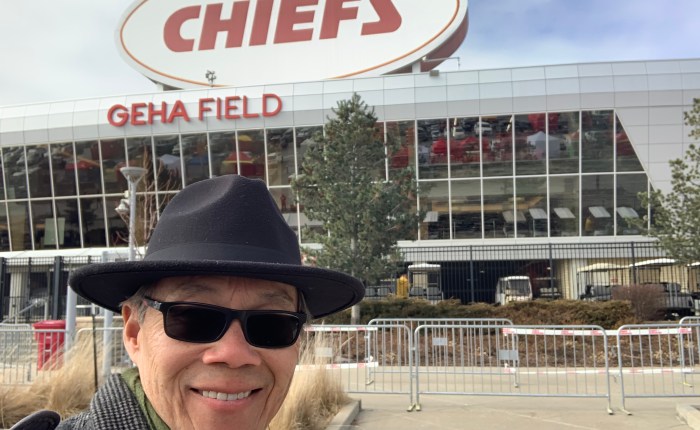
My trip to the AFC Championship game at Burrowhead Stadium didn’t end like I anticipated.

(KANSAS CITY, Mo) – Super Bowl appearances are elusive but not impossible. Like a blind squirrel finding that elusive hidden nut, anybody can get lucky and stumble upon one of them. It’s when you bag two that you know you’ve really made it big.

Cincinnati fell just short of making it to two Super Bowls in a row, falling to Kansas City 23 – 20 in a tense AFC championship contest played out before a packed house at Arrowhead Stadium.

“It aches, trust me,” head coach Zac Taylor said when asked about the loss. “To be this close. Our goal is to win the Super Bowl. To be seconds away from getting back there, and watching [the Chiefs] celebrate, it’s horrible. This team has invested so much in each other to get to this point.”

Ten wins in a row to finish out the year, three straight wins over the Chiefs, and that beatdown last week against the Buffalo Bills had everybody in the Queen City dreaming of an upcoming trip to the Arizona desert. Unfortunately, when expectations rise as such, it hurts that much more when you ultimately fall short.

Cincinnati quarterback Joe Burrow felt the pain immediately afterwards.

“Tough loss,” said Joey Franchise in a packed visitors media room the size of a broom closet. “We didn’t make the plays we needed to win this game. And they did down the stretch. That’s what it came down to.”

With the score tied at 20 and 2:30 left on the clock, Cincinnati forced a Kansas City punt and had the ball on their own six-yard line. These are the situations that Super Bowl dreams are made of. Surely Burrow would drive the Bengals down the field for the game-winning score—just as the clock runs out, right?

Wrong! After moving his team out to their own 35-yard line, Burrow was sacked, and the Bengals had to punt with thirty seconds remaining.

On their ensuing possession, with just 17 seconds left, the Chiefs Patrick Mahomes ran out of bounds after a five yard gain. Bengals defensive lineman Joseph Ossai clearly hit Mahomes late, resulting in a 15-yard penalty putting the ball on the Bengals 27-yard line. That set up Harrison Butker’s 45-yard game-winning field goal try. The ball cleared the uprights, and suddenly Cincinnati’s Super Bowl dreams abruptly ended on the confetti-laced turf of Burrowhead Stadium.

“It didn’t come down to that,” said Taylor, regarding Ossai’s penalty and it’s effect on the game’s outcome. “There’s a lot of other plays that we just missed out on.”

Yes, it’s true. Missing out on back-to-back Super Bowl appearances really does hurt. Here, however, is the irony in that statement. During this entire magical two-year run, no one really thought the Bengals were any good. Everyone regarded last year’s Super Bowl appearance as a lucky outlier. The talking media heads said that Zac Taylor was a flash in the pan who got lucky when his team got hot at the end of last year. When Cincinnati started out 0 – 2 to begin this season, the skeptics were quick to say, “I told you so.”

Then the offensive line began to gel, the defense started playing lights out, and Joe Burrow became the meteoric rising star that no one dared to bet against. The Bengals became damn good in the process. Everyone—me included—picked them to go all the way. I even purchased airline tickets (refundable ones, thankfully) to Phoenix.

Were our expectations realistic? I’m still not sure. Past history is difficult to shake. It’s hard trading three decades of playoff futility for a couple of magical seasons of success.

Perhaps Zac Taylor said it best when asked about the future of the franchise.

“It’s a special organization,” said the man steering the ship. “It’s special people leading it, [it’s a] special group of coaches, [and a] special group of players. We love representing our city and our fan base. It’s just time to get back to work.”

Those are certainly nice words. But in life and in football, actions speak louder than words. I watched Zac Taylor in the locker room afterwards greeting, consoling, congratulating, hugging, and shaking the hand of every one of his players.

The guy has shown he can coach ‘em up on the field. He’s also shown that he’s got a lot of character and class. That’s a great combination moving forward.

See you next year. WhoDey!

This blog posting was originally submitted as a Cincinnati Bengals Column for Sports View America publications.