
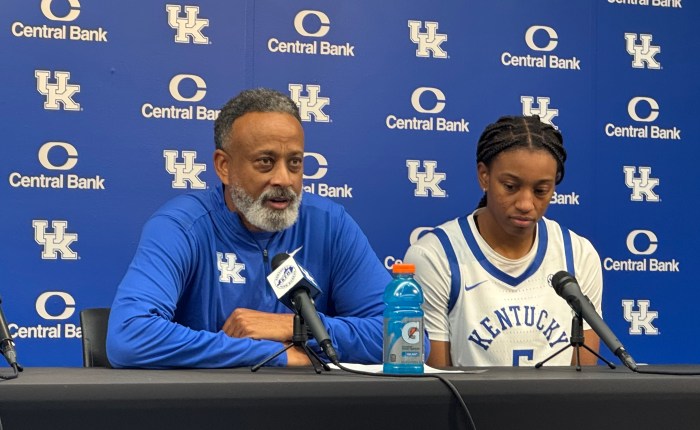
(LEXINGTON, Ky.) – I’m on to Kenny Brooks. Not in a stop-the-presses, breaking news kind of way. It’s more like the quiet realization that the man has cracked a code most coaches spend a lifetime chasing. If you want sustained success in basketball—real, transferable, program-defining success—get yourself a generational point guard, teach her, empower her, and then get out of the way just enough to let her become herself.
He did it with Georgia Amoore. And now, unmistakably, he’s doing it again with Tonie Morgan.
Morgan’s résumé is already starting to read like folklore. A buzzer-beater that stunned LSU last Thursday, followed by another surgical stat line—18 points, 14 assists—in a composed, methodical 74–52 dismantling of Missouri. Flashy when needed. Surgical when required. And always, always in control.
But the numbers only tell you what she’s doing. They rarely explain why—or how.
That’s where Brooks leaned back, grinned, and gave us the real scouting report—one that had nothing to do with crossover moves or assist totals.
“I don’t know what football team is doing good without a good quarterback,” Brooks quipped. “Tonie, she’s been phenomenal all year long… her willingness to be coached. She never makes a face when she doesn’t agree with something… she’s consistently just welcoming any kind of feedback and she takes it.”
There it is. The overlooked superpower.
Be Teachable.
In an era where athletes are branded before they’re built, where confidence sometimes masquerades as infallibility, Morgan’s greatest strength might be her posture in a film room. She watches. She listens. She absorbs. And then—this is the key—she applies.
Brooks made something else clear early, almost defensively, as if to protect Morgan from lazy comparisons: she is not trying to fill Georgia Amoore’s shoes. She’s building her own footprint. Different stride—with the same authority.
And authority she has.
Morgan can do it all. She scores at all three levels. She goes downhill with intention, not chaos. She distributes with either hand like she’s ambidextrous by design. She can take her defender one-on-one when the offense stalls. She understands shot selection. And she defends—not the Instagram kind of defense, but the grind-it-out, make-you-work-for-air variety.
Most importantly, Brooks has empowered Morgan to run the offense. Not just initiate it. Not just survive it. But to run it.
That kind of trust doesn’t come from a box score. It comes from habits—and a heck of a lot of communication and connection between coach and player.
Morgan explained it simply, the way players who truly understand their role often do.
“I have the ball a lot, so it is very important that I take care of it,” said the 5-foot-9 senior transfer from Georgia Tech. “So, when I do turn it over, I just move on. It happens… I just want to take care of it.”
That’s not coach-speak. That’s emotional maturity. Ownership without self-flagellation. Accountability without paralysis.
Teachable players don’t crumble when corrected or sulk when challenged. They don’t confuse coaching with criticism. They see feedback as fuel, not as insult.
And that—far more than a step-back jumper or a no-look dime—is what separates good point guards from the kind that quietly define eras.
Brooks knows it. He’s lived it. He’s building around it again.
Every great coach has a calling card. For Brooks, it might be this: he doesn’t just recruit talent; he intentionally seeks out posture and fit. The willingness to be molded. The humility to learn. The confidence to adapt.
Put a player like that at the point, and suddenly everything else aligns. Spacing makes sense. Tempo settles. Teammates breathe easier. Coaches sleep better.
Morgan’s story is still being written, but the early chapters are already instructive—not just for basketball, but for life. Be skilled, yes. Be confident, absolutely. But remain teachable through it all.
Because the players who last, the leaders who endure, and the programs that matter most are built not on ego—but on the desire to learn and get better.
And if Kenny Brooks keeps finding point guards like this?
Well… I’m really on to him now.
This article was originally written for distribution through Nolan Group Media publications.
Dr. John Huang is a retired orthodontist, military veteran, and award-winning author. Currently serving as a columnist for Nolan Group Media, he invites readers to follow him on social media @KYHuangs. Explore his latest, Whining For Posterity, and all his books at Amazon.
 huangswhinings