
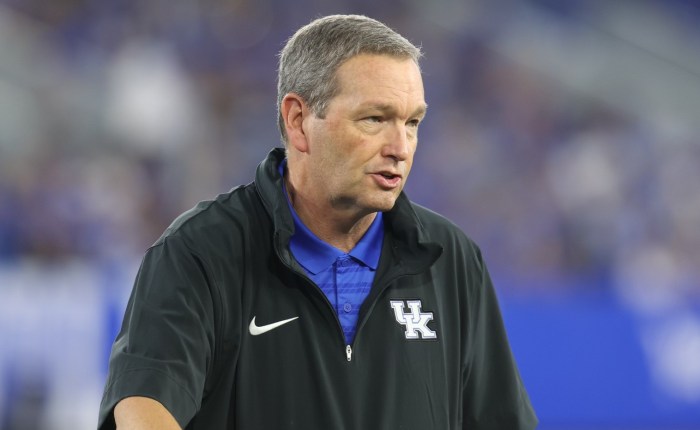
I’ll be the first to admit—I’m confused. Especially when listening to University of Kentucky Athletics Director Mitch Barnhart talk circles around himself.
In his interview with Matt Jones of Kentucky Sports Radio earlier today, Barnhart assured all the loyal BBN listeners that, even within this new landscape of college athletics, not only will UK not be cutting any sports, but he’s confident the university will be able to fund any new upcoming revenue share amounts.
Those are shockingly bold statements. The obvious retort is: How does Mitch know?
Because just moments earlier while addressing the media, Barnhart refused to disclose any specifics about the revenue sharing amounts, citing the “uncertainty” and “fluidity” of the entire new world order.
“We’re in the first month of this thing,” Barnhart told a roomful of attentive scribes thirsting after his every word. “Literally the first month. For anybody to sit in front of a group and say, ‘I’ve got all the answers after four weeks,’ good for you, good for you. I mean, we’ve talked about a decade’s worth of change that has happened in the last six to ten months of college athletics.”
“The change that has occurred has been massive,” he continued. “We don’t even have a governance structure in place really, to be honest with you.”
I always knew college athletics was a cutthroat business. That’s why I titled my debut novel Name, Image, and Murder. It was a fictional whodunit loosely based on the chaotic new world of NIL—the Wild Wild West of amateur sports gone pro. But I’m starting to think fiction might be safer than what’s actually brewing behind the scenes in Lexington.
You see, the same school that gave us Adolph Rupp, Dan Issel, Anthony Davis, and eight national championships is now poised at the crossroads of an athletic identity crisis. Do we leverage our exalted status as the greatest tradition in college basketball? Or do we bow before the almighty dollar in a noble attempt to keep all our boats floating? NIL has officially graduated from “name, image, and likeness” to “nobody is listening”—at least when it comes to making choices regarding long-term sustainability.
And now, with the recent House v. NCAA settlement ushering in the brave new world of revenue sharing, UK Athletics is walking a tightrope strung between Rupp Arena, Kroger Field, Memorial Coliseum, and Kentucky Proud Park.
On paper, the new rules sound reasonable. Schools can now pay players directly—up to $20.5 million a year in shared revenue. Kentucky has fully committed to this model, even creating a snazzy new LLC called Champions Blue. Sounds like a superhero franchise, right? Champions Blue! Defenders of BBN! As technically a nonprofit organization, I’m not sure what to make of it. Cynics might call it a financial shell game that makes Enron look like Little League bookkeeping.
Here’s the problem. Paying players is expensive. Kentucky projects a $31 million deficit next year, even after slashing perks, borrowing from the university, and shaking every couch cushion from Pikeville to Paducah. And with the bulk of revenue earmarked for men’s basketball and football, you can kiss some non-revenue sports goodbye faster than a 2-seed getting bounced by Saint Peter’s—regardless of what Mitch promises.
But wait, there’s more! Earlier reports citing multiple reliable sources claim UK is devoting 45% of its revenue-sharing budget directly to Mark Pope’s team. Even though Mark Stoops debunked that statement as “absolutely untrue,” many won’t believe him. This is, after all, a basketball school. Except when the football team has ten-win seasons. Or when the volleyball team is hoisting SEC banners. Or when someone on the rifle squad or track team wins Olympic gold. You know, the other student-athletes, who apparently don’t get to eat from the same buffet.
That’s where the danger lies. Not in the fairness of it all—college athletics has never been fair—but in the fragility of it.
What happens when Title IX lawyers come knocking, wondering why the women’s soccer team is using 1997 cleats while the men’s basketball team is taking private flights to Maui (yes, remember Maui)? What happens when boosters get bored with writing six-figure checks for backups who never leave the bench? What happens when ticket prices go up again to cover costs, and the average fan can’t afford to sit in the rafters without taking out a second mortgage?
What happens when your favorite in-state walk-on is replaced by a five-star diva who’s demanding an exorbitant NIL deal, a YouTube series, and three coveted parking spaces on campus?
This is not just a UK problem. This is an everywhere problem. But here in the Bluegrass, where we measure time in Final Fours and football tailgates, we feel the tremors more than most. It’s hard to build “La Familia” when everyone’s negotiating like La Cosa Nostra.
And don’t get me wrong—I’m not anti-athlete. I’m all for players getting their fair slice of the billion-dollar pie. But when the pie crust is crumbling and the recipe keeps changing, it’s hard to know whether we’re baking a dynasty or our athletics director is just blowing hot air.
Champions Blue may turn out to be a genius model. Or it may be a cautionary tale studied by future ADs with degrees in both sports management and disaster response. In either case, the margin for error is thinner than Mitch Barnhart’s top button.
As for me, I’m thinking about writing a sequel. Name, Image, and Mayhem: The NIL Strikes Back. It’ll feature a fictional blue-blood program that tried to buy its way to the top, only to realize it couldn’t afford loyalty, chemistry, or the next contract buyout. Spoiler alert: the villain isn’t the athlete, the booster, or the NCAA.
It’s the system. A system we all helped create. A system now careening down a one-way road where amateurism is dead, loyalty is negotiable, and tradition is mocked and poo-pooed.
So buckle up, BBN. The real madness isn’t in March anymore. It’s happening right now—behind closed doors, in budget meetings, where the stakes are higher than a last-second Aaron Harrison three-point bomb.
May God have mercy on us all.
Dr. John Huang is a retired orthodontist, military veteran, and award-winning author of Name, Image, and Murder. He serves as a reporter and columnist for Nolan Group Media. Follow him @KYHuangs on social media and find his books, including the soon-to-be-bestselling Whining for Posterity, here: https://www.Amazon.com/stores/Dr.-John-Huang/author/B092RKJBRD
 huangswhinings