
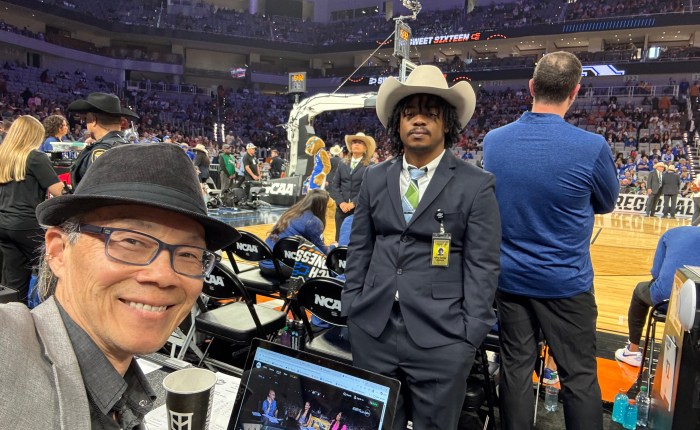
(FT. WORTH, TX.) — I didn’t expect the food to be better. But it was. The people are friendlier, the hospitality warmer, and the administrators here at the Women’s NCAA Regional actually seem glad you showed up.
And for a moment, you start to wonder—why doesn’t this feel like a bigger deal?
And then the games start, and reality creeps back in.
It’s not one glaring flaw so much as a collection of small ones that add up. Fewer shuttles. Fewer people who can answer basic questions. Less coordination where it matters. It feels like an event that’s been carefully decorated but never fully constructed. The effort is obvious. The execution, not quite.
And then you look up during a marquee game—UConn Huskies women’s basketball taking the floor at Dickies Arena—and the arena is half full.
Half.
That’s the part you can’t dress up.
Now let me make this personal, because sometimes that’s the only way the truth really lands. At the men’s NCAA Tournament, I’m usually sitting two time zones away from the action, tucked into overflow media seating, craning my neck past a forest of national media and podcast setups just to follow the game. It’s crowded, chaotic, and, if I’m being honest, a little ridiculous.
Here? I’ve got a great seat on press row. Front and center. Clear sightlines to the Kentucky bench. Easy access. The kind of seat you’d think I’d been lobbying for my entire career.
And instead of feeling like I’ve finally arrived, it feels like I’ve stumbled into the answer.
There’s space here.
There’s always space here.
Here’s the deal. If the Kentucky Wildcats men’s basketball team makes a regional, it’s not just different—it’s overwhelming. For fans and media alike, there’s no room to breathe. Every quote becomes doctrine. Every lineup decision gets debated like it’s a constitutional amendment. A throwaway comment in November turns into a full-blown philosophical argument by March.
We don’t just cover Kentucky basketball—we consume it. Obsess over it. Sometimes completely lose perspective over it.
And hovering over it all are the national big shots in their tailored suits, nodding knowingly, speaking in definitive tones—as if they alone have cracked the code the rest of us are still trying to understand.
That’s not just interest. That’s obsession.
And standing here, it’s hard not to ask—what would this place look like if even a fraction of that energy showed up?
Because the product here at the women’s tournament isn’t inferior. Spend any real time watching and you’ll see execution, toughness, and pride that hold up just fine. The reporters here are grinding, too—asking thoughtful questions, writing real stories, doing the job the right way. In many cases, they’re better prepared than the swarm that descends on the men’s tournament.
But that’s also the point.
These are the reporters who cover women’s basketball all year.
Where is everybody else?
Where’s the overflow, the national swarm, the sense that this matters on the same scale?
It’s not here. And that absence speaks louder than any press release about “investment.”
Because even Geno Auriemma—who has every reason to sell this game—finally sounded fed up. He rattled off the three-point shooting numbers from across the tournament, numbers that make you wince, and asked the obvious question about how you’re supposed to sell that to a paying audience. But then he went a step further and pointed directly at the system—6 a.m. shootarounds, disjointed practice schedules, logistical decisions that seem to ignore how basketball is actually played.
In other words, we’re asking the game to grow while quietly putting it in position to look worse than it is.
And then there’s the format itself, which feels like it was designed in a conference room without ever being lived in. This 8-team, double-regional setup is simply too cramped. Too many teams, too many obligations, too little space for anything to breathe. Access gets diluted, attention gets split, and instead of building momentum, everything flattens out into one long blur.
To make matters worse, we drop it right on top of the men’s tournament and ask the same audience to care about both at the exact same time. That’s not competition—it’s self-sabotage. You’re putting your product on the same stage as a machine you already know dominates the conversation, then acting surprised when it gets drowned out.
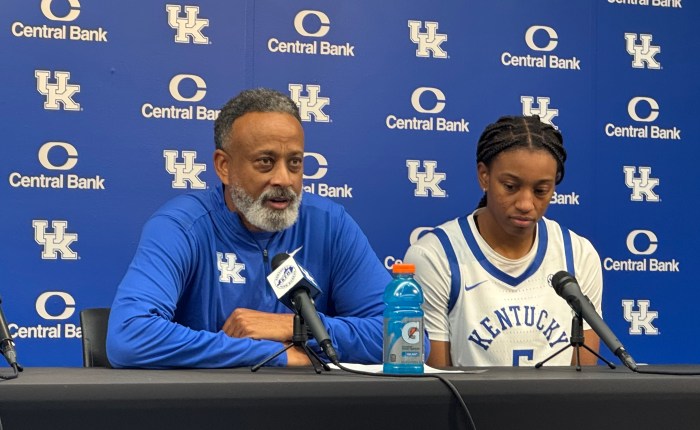
And then you hear Kenny Brooks.
Twenty-four years in the profession, and he’s still fighting for investment—not just financial, but emotional.
That word lingers, because it gets to the heart of what all of this really is.
You can renovate arenas. You can upgrade facilities. You can serve better food and print nicer credentials.
But you can’t manufacture emotional investment.
You either have it or you don’t.
Right now, we don’t. Not like we do on the men’s side, where we have almost too much of everything—too much attention, too much noise, too much manufactured urgency over games that sometimes don’t even deserve it.
Here with the women, it’s the opposite. Half-full arenas. Fewer voices. A quieter stage for a product that’s still being asked to prove itself while operating under conditions that make that task harder than it should be.
Same tournament. Same stakes. Two completely different realities.
One treated like a birthright.
The other treated like a suggestion.
And until that changes—until the investment, the execution, and, most importantly, the attention start pulling in the same direction—this gap isn’t going anywhere, no matter how good the basketball gets.
This article was originally written for distribution through Nolan Group Media publications.
Dr. John Huang is a retired orthodontist, military veteran, and award-winning author. Currently serving as a columnist for Nolan Group Media, he invites readers to follow him on social media @KYHuangs. Explore his latest, Whining for Posterity, and all his books at Amazon.
 huangswhinings