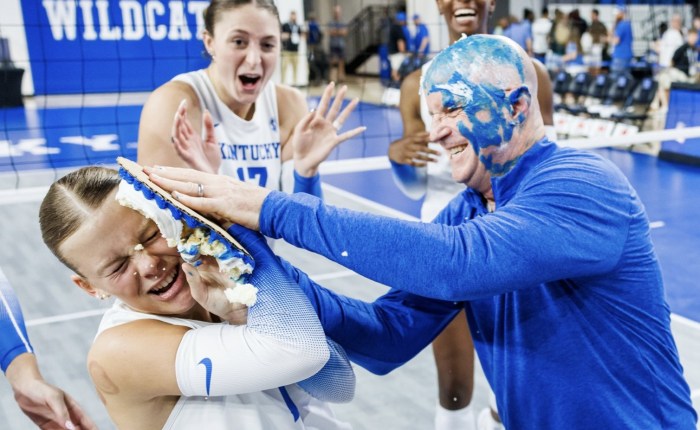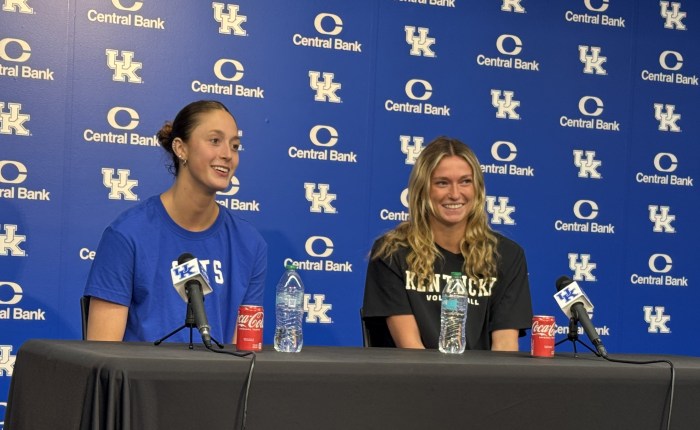
Just when I was ready to declare college athletics officially dead, two Kentucky volleyball players showed up to complicate my obituary.
AVCA All Americans Brooklyn DeLeye and Molly Tuozzo are coming back for another season. Yep, you heard that right. They’re returning to the same school, with the same coach, and wearing the same uniforms.
In today’s college sports landscape, where athletes change schools faster than coaches change their excuses, the announcement seemed almost revolutionary. Two outstanding players choosing to stay where they wanted to be—not because they couldn’t leave, but because they didn’t want to.
I’ve spent enough time lamenting the state of college athletics to qualify for a frequent-whiner discount. I’m sick of hearing about NIL negotiations, transfer portal shopping sprees, and players arriving in August and disappearing before anyone learns how to pronounce their names.
Over the last few years, college sports began resembling professional free agency with pep bands, alumni gatherings, and the occasional final exam.
Loyalty to your school, meanwhile, seemed headed for the endangered species list.
So when DeLeye and Tuozzo sat down Thursday to explain their decisions, I asked the question everyone seems obligated to ask nowadays.
What about the money?
I wasn’t necessarily asking how much they were making. That’s their business. But surely NIL opportunities factored into their decisions.
Tuozzo didn’t hesitate.
“I don’t think money really had a factor in my decision personally,” she said. “I think this place is just so special…it beats any type of money.”
DeLeye agreed.
Now, I’m not naive enough to believe money doesn’t matter in college athletics. Nor should anyone begrudge these young women whatever compensation they’ve earned. They’re exceptional athletes whose talents help fill arenas and build a growing sport.
But here’s something we’ve almost forgotten. Money isn’t the only thing that matters. I nearly teared up when Tuozzo admitted that even the thought of leaving Kentucky made her sad.
I asked both players to identify something Kentucky had given them that money couldn’t buy.
DeLeye talked about people. She gushed about her teammates, her coaches, the support staff, and about an entire community invested in something bigger than themselves.
“Everybody truly cares about this place,” she said. “You don’t see that everywhere else.”
Tuozzo spoke glowingly about Craig Skinner, not merely as a successful coach but as someone who genuinely cares about his players as people.
Imagine that—a coach whose value isn’t measured exclusively by his ability to assemble a roster or negotiate the next contract.
Skinner has built one of the nation’s premier volleyball programs, capturing the 2020 national championship, and establishing Kentucky as a perennial contender. But perhaps his greatest accomplishment is creating an environment where players want to remain even when they have other options.
That’s becoming increasingly rare.
I then asked both players directly about loyalty.
DeLeye said that when she chose Kentucky out of high school, she expected to spend her college career here. Four years later, nothing had changed.
“If we were going to make a decision for the fifth year, we knew it would be here and nowhere else.”
Tuozzo was equally emphatic.
“Loyalty is super important. There is no doubt in my mind that I wasn’t going to take a fifth year anywhere else. If I was going to take it anywhere, it was going to be here for sure.”
There was something refreshing about hearing those words. And it wasn’t because transferring is inherently wrong. Sometimes leaving is the best decision for an athlete. Sometimes coaches leave first. Sometimes promises get broken. Loyalty should never become a one-way obligation.
But there’s something beautiful about choosing to stay when you have the freedom to go.
And that’s what struck me about these two young women. Their decisions weren’t dictated by some antiquated rule requiring athletes to remain at one school. They had choices.
They chose Kentucky.
Better yet, they chose each other.
After four seasons together, DeLeye and Tuozzo talked about the special bond they’ve developed, the trust they’ve built, and the opportunity to share one more year. Those relationships don’t appear in the box score. There’s no NIL valuation for friendship.
But years from now, when the kills and digs have faded and their knees start sounding like mine, I suspect those relationships are what they’ll treasure most.
Of course, Kentucky still has volleyball matches to win. The Wildcats recently suffered consecutive defeats to Tennessee and Texas A&M, and Skinner has made it clear that talent alone won’t deliver another national championship. There’s work to do.
But Thursday wasn’t about winning. It was about belonging.
For those of us who grew up believing college athletics represented something more than transactions, the past few years have been difficult to stomach. We’ve watched cherished traditions disappear, rivalries become bargaining chips, and rosters turn into revolving doors.
I’ve wondered at times whether the emotional connection between athletes, universities, and fans could survive the turmoil.
Maybe I’ve been looking in the wrong places. Maybe instead of obsessing over who’s leaving, we ought to spend more time celebrating those who stay.
Brooklyn DeLeye and Molly Tuozzo didn’t solve everything that’s wrong with college sports.
They simply reminded me of something that’s still right.
And for one afternoon, this old whiner couldn’t find much to complain about.
Dr. John Huang is a retired orthodontist, military veteran, and award-winning author. He currently serves as a columnist for Nolan Group Media and invites readers to follow him on social media @KYHuangs. His latest book is Whining for Posterity, available on Amazon.