Pope’s Report Card is in—and it’s Telling

Pope’s Report Card is in—and it’s Telling

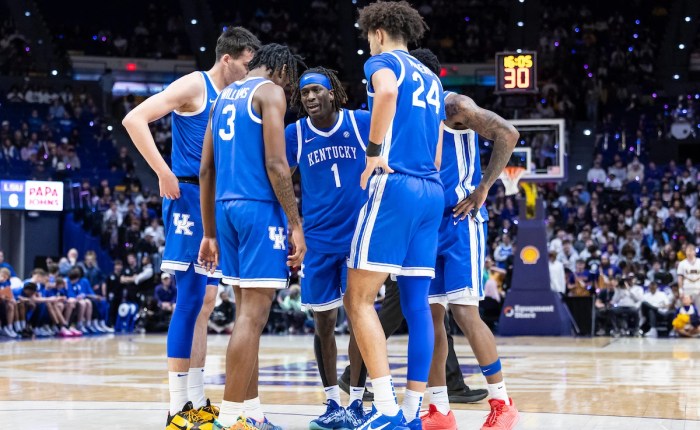
(LEXINGTON, Ky). – At the halfway point of the college basketball regular season, the midterm grades invariably come rolling in.

Recently, Isaac Trotter of CBS Sports essentially handed Mark Pope a midterm grade. His assessment wasn’t cruel or dramatic. It was purely academic.

A “D.”

Not dismissal or detention, but the kind of grade that comes with a quiet warning: You’re capable of more than this.

Trotter’s core point was simple. Pope understands Kentucky basketball. He knows the standard. He knows this isn’t it. And yet, nearly two seasons in, Kentucky is hovering around average on the floor while swimming in resources. The Sweet 16 run last year bought a lot of goodwill. This year’s results are washing away all the equity.

If this were a class, Kentucky isn’t failing—but it’s not honoring the syllabus.

Permit me to continue with this academic theme.

I was an A student for most of my life. Straight A’s through college and dental school. Not because I was the smartest in the room—but because I understood what my parents expected of me. Hence, it’s thoroughly frustrating watching someone clearly intelligent like Mark Pope struggle to translate knowledge into performance.

Pope is smart. That’s not debatable. He’s articulate, reflective, and overly analytical. He speaks like someone who actually read the assignment.

But here’s the disconnect: intelligence alone doesn’t earn grades. Outcomes do. Results matter.

Pope has acknowledged he’s considering “dumbing down” the offense for his players. In academic terms, that’s the moment a gifted professor realizes the class isn’t tracking and lowers the material. Sometimes that’s compassionate. Sometimes necessary. But at a place like Kentucky, it’s also risky.

Kentucky basketball is not remedial coursework.

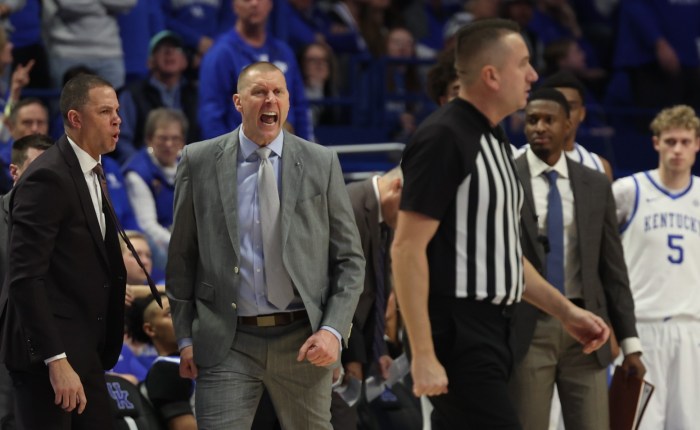
When I asked Pope about the “D” grade—give him credit—he didn’t argue the point. In fact, he leaned into it. He acknowledged that Kentucky isn’t meeting expectations. Not emotionally or philosophically—but factually. An 0–2 start in SEC play is an objective data point.

“If you told me the Kentucky coach started 0–2 in the SEC, a ‘D’ might be generous,” he stated bluntly.

That matters because Pope didn’t blame fans. He didn’t hide behind context. He didn’t suggest the grading was unfair. He framed it like how sports—and academics—actually work: you earn your score.

What Pope articulated well was this distinction: emotions can be messy, but outcomes aren’t. You don’t debate the final score. You don’t negotiate the grade. You own it.

While all that’s well and good for a season flirting with disaster, it’s remains the right thing to say. Any good coach can have an outlier of a bad year as far as their won/loss record.

Where concern still lingers is in the larger picture Trotter raised—and Pope didn’t fully address. Kentucky’s issues aren’t limited to a slow SEC start. The recruiting trail has gone quiet at a time when elite freshmen are choosing other destinations. Kentucky, historically, doesn’t miss on all of them.

In academic terms, that’s when top students stop enrolling because they’re unsure the program is still elite. In their minds, it’s no longer about nostalgia. It’s about trajectory.

Pope talked about not running from the “messy middle.” About digging in. About believing the ending will be good—but only if you acknowledge the poor start.

That’s encouraging rhetoric. Necessary rhetoric.

But at Kentucky, belief is never the final exam.

Results are.

This program doesn’t grade on effort, intent, or intelligence. It grades on preparation, clarity, and execution. You don’t grade on a curve in this class. You meet the standard—or you repeat the course.

Mark Pope clearly understands that.

The question now is whether understanding will translate into improvement—on the floor, on the recruiting trail, and ultimately on the transcript that matters most.

Because at Kentucky, a “D” isn’t destiny. It’s a dire warning.

Especially when the only acceptable grade is an “A.”

This article was originally written for distribution through Nolan Group Media publications.

Dr. John Huang is a retired orthodontist, military veteran, and award-winning author. Currently serving as a columnist for Nolan Group Media, he invites readers to follow him on social media @KYHuangs. Explore his latest, Whining For Posterity, and all his books at Amazon.
This Ain’t No Philosophy Seminar

This Ain’t No Philosophy Seminar

(LEXINGTON, Ky.) – When coaches are under fire, they usually don’t speak in riddles—they rant.

Jim Mora famously barked, “Playoffs?! Don’t talk about playoffs!”
Herm Edwards simplified the profession to its core: “You play to win the game.”
Mike Gundy, veins popping, yelled, “I’m a man! I’m 40!”

Those quotes didn’t require interpretation. They didn’t need a decoder ring. They landed because frustration stripped the message down to bone.

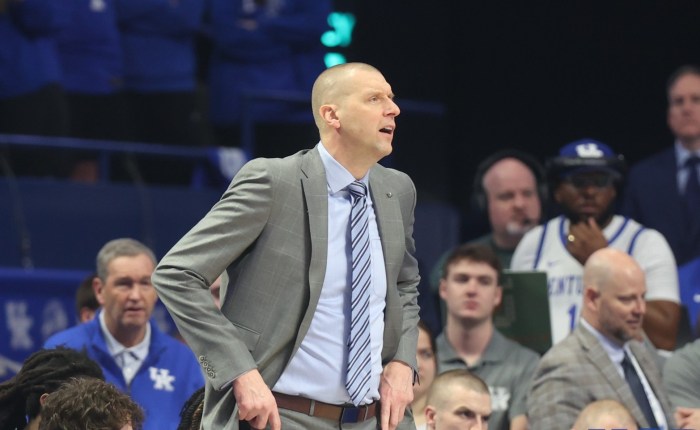
Which is why Mark Pope’s recent quote on his weekly coach’s show left so many Kentucky fans scratching their heads like they’d accidentally tuned into a philosophy podcast.

“What’s really important for us as coaches and as teammates is understanding the story that each of our guys and each member of our staff is telling themselves about what we’re going through right now…”

This is not a rant. It’s not normal coach-speak. It sounds more like a narrative symposium held in Ballroom A at the downtown Hyatt.

Before we dismiss it entirely—or turn it into a meme—let me explain why I might be uniquely qualified to translate what Pope was trying to say.

I spent decades as an orthodontist listening to people describe pain that wasn’t always where they thought it was. Patients told elaborate stories about one tooth when the real issue lived somewhere else entirely. My job wasn’t to validate the story. It was to identify the truth underneath it and fix the problem—whether the patient liked the diagnosis or not.

Coaching, at its best, works the same way.

So when Pope talks about “the story each guy is telling himself,” he’s really saying this:

Players are processing adversity differently. Some think it’s bad luck. Some think it’s their fault. Some think the system isn’t for them. Some think they should be playing more.

That part is reasonable, human, and accurate.

Then Pope says he wants to bring those stories back to two things: a point of truth and a point of common understanding.

Translation:
“We need everyone to stop lying to themselves—and agree on what we’re actually bad at.”

Still reasonable. Still logical. But strangely phrased for Kentucky basketball. It feels like Phil Jackson’s Zen without the structure—philosophy without the scoreboard support to justify it.

And that’s why it landed sideways.

Kentucky fans don’t need help understanding the story when the evidence is screaming:

• Slow starts
• Inconsistent effort
• Poor perimeter defense
• Questionable preparation

When you’ve had nearly two weeks to prepare and still fall behind by 21 points, the story doesn’t matter nearly as much as the symptoms. The frustration isn’t that Pope is wrong.

It’s that he’s explaining instead of commanding. At Kentucky, explanation often sounds like excuse—even when it’s not intended that way.

Fans are conditioned to expect blunt clarity in moments like this. Mora didn’t unpack emotional narratives. Edwards didn’t ask players how losing made them feel. Gundy didn’t workshop his truth.

They owned it.

That doesn’t mean Pope lacks intelligence or care. In fact, this quote suggests the opposite—he’s thoughtful, introspective, and trying to understand the human side of his team.

But this job isn’t graded on thoughtfulness. It’s graded on readiness—and ultimately wins and championships.

If every player is telling himself a different story, that’s not a literary problem. It’s a leadership one. Great programs don’t require narrative alignment sessions. They create roles so clear that internal monologues don’t matter.

At Kentucky, the story is supposed to be singular:

Defend.
Compete.
Earn minutes.
Win.

No subplots. No word-salad narratives from the coach. Kentucky basketball doesn’t need a narrator.

Pope’s quote might sound thoughtful in June. It sounds confusing in January.

And in January, Big Blue Nation is longing for something refreshingly old-school:

Less parable.
More accountability.

Let’s hope we get it.

This article was originally written for distribution through Nolan Group Media publications.

Dr. John Huang is a retired orthodontist, military veteran, and award-winning author. Currently serving as a columnist for Nolan Group Media, he invites readers to follow him on social media @KYHuangs. Explore his latest, Whining For Posterity, and all his books at Amazon.
Blue Lights, Dim Bulbs: Kentucky Basketball’s Alarming Drift

Blue Lights, Dim Bulbs: Kentucky Basketball’s Alarming Drift

Photo Credit: Mont Dawson/Kentucky Sports Radio

(LEXINGTON, Ky.) – There are losses, and then there are losses that linger. Kentucky’s 89–74 faceplant against Alabama wasn’t just another road hiccup or a “good learning experience” wrapped in coach-speak. It was the kind of loss that stares back at you and asks uncomfortable questions—about identity, preparation, leadership, and where exactly this thing is headed under Mark Pope.

Let me say this clearly before anyone starts torching me: I am not ready to give up on Pope. Not even close. But I am ready to admit that the trends are troubling—and Big Blue Nation has earned the right to be uneasy.

We were promised a Ferrari. What we’re driving right now feels suspiciously like a refurbished rental.

At BYU, Pope sold us on a high-powered, creative, free-flowing offense. Pace. Spacing. Ball movement. Thirty-five threes a game. What we’re seeing instead is a half-court offense that too often feels like it was designed during a layover in Omaha. There are long stretches where Kentucky looks unsure and—this hurts to type—disinterested.

Part of that is personnel, yes. This team has no dependable shooters. None. Zip. Zero. You can’t run a modern offense without the threat of the three. Defenses sag. Lanes disappear. Alabama didn’t guard Kentucky shooters—they just waited for them to miss. And when you combine that with shaky perimeter defense on the other end, you get the same result Nick Saban just witnessed courtside in Tuscaloosa.

Alabama hit a bunch of open shots. Kentucky mostly chased shadows behind the arc.

Here’s where my inner orthodontist starts grinding his teeth. Pope seems overly cautious with his best players, particularly Jaland Lowe and Jayden Quaintance. Development is important. Trust is important. A player’s future health is certainly important. But at some point, your best players have to play. Long enough to find rhythm. Long enough to lead. Long enough to play their way into shape and respond. Watching Kentucky tiptoe through their starting lineup feels less like strategy and more like risk aversion.

To add insult to injury, I’ve sensed a maddening lack of consistent effort with this team. It occasionally has flashes. “Beautiful ones” against overmatched teams like Bellarmine. But then—poof—it evaporates against quality competition. Loose balls become optional. Closeouts become suggestions.

And physicality? Fuhgeddaboudit!  

That’s not talent. That’s not scheme. That’s culture. And culture starts at the top.

Now for the big one. The one that makes me want to hit “delete.”

Preparation.

Kentucky had nearly two weeks to get ready for this game. Two weeks. And the Cats still fell behind by 21 points like they’d just been introduced to Alabama in the parking lot. That’s not about shots falling. That’s not about poor matchups. That’s not bad luck. That’s a flashing neon warning light.

Hey folks, the résumé is crumbling before our eyes. Quadrant opportunities are slipping away in a league that eats its own.

Worse yet, there’s the creeping fear that the entire empire might collapse if things don’t change—because Pope, fair or not, hasn’t yet shown he can recruit at the level this job demands. Kentucky doesn’t win on system alone—it wins when elite players choose it.

Everyone knows that Kentucky basketball is not a rebuild-and-hope program. It’s a reload-or-else one. If the talent pipeline doesn’t improve, the margin for error disappears entirely.

The bulbs are dimming. The optics are already bad. Kentucky falling behind by double digits in marquee games is happening way too often. Opponents make adjustments. Pope’s teams don’t. His timeouts feel reactive. His in-game answers elusive. And Pope’s postgame demeanor? Let’s just say “sore loser” is not the brand Big Blue Nation expects. This job requires accountability, humility, and leadership in front of a camera when things go sideways.

Kentucky basketball isn’t just a team. It’s an institution. A standard. A mirror we all see ourselves in, for better or worse.

I still believe Pope can get this right. But belief without course correction is just stubbornness dressed up as loyalty. The concerns are real. The trends are real. And if they aren’t addressed—soon, the dimming lights at Rupp won’t just be temporary.

They’ll be structural.

And that, my friends, is not something any of us signed up for.

This article was originally written for distribution through Nolan Group Media publications.

Dr. John Huang is a retired orthodontist, military veteran, and award-winning author. Currently serving as a columnist for Nolan Group Media, he invites readers to follow him on social media @KYHuangs. Explore his latest, Whining For Posterity, and all his books at Amazon.
The Scholarship Used to Be the Prize

The Scholarship Used to Be the Prize

(And Somewhere Along the Way, We Started Treating It Like a Coupon)

Let me get this out of the way early so nobody mistakes me for the guy yelling at clouds.

I know NIL is here to stay. I know players have always been paid. I know the system wasn’t pure, holy, or wrapped in a choir robe stitched by Sandy Bell in the UK Compliance office.

I’m not naïve. I’m just… disappointed. And there’s a difference.

Believe me, this isn’t about money. It’s about what money replaced.

Back in the day—cue the violin music, please—the scholarship was the prize. The scholarship was the golden ticket. It was the thing you earned, protected, and quietly understood could change the trajectory of your life.

Now? The sheepskin is an afterthought. A line item. Something you get thrown in after the collective wires the cash.

Wake up everyone! College sports didn’t just evolve. It inverted.

Players used to come to Kentucky for the name on the front of the jersey and hope—pray, even—that one day the name on the back might matter. Now the name on the back is everything, and the front is just a temporary billboard.

We’ve turned student-athletes into short-term mercenaries, and then we act surprised when loyalty evaporates faster than Vince Marrow’s blue wardrobe.

Again, I’m not anti-player. I’m anti-illusion. College sports has become all smoke and mirrors.

What bothers me isn’t that athletes are making money. It’s that we’ve somehow convinced them—and ourselves—that money is the point, not the fruit of hard-earned labor. We’ve normalized entitlement at warp speed. It no longer happens over multiple years of eligibilty. It’s now bestowed instantly.

A freshman hasn’t played a minute and already knows his “market value.” He doesn’t ask, How can I grow here? He asks, What’s my next leverage point? That’s not empowerment. That’s living one transaction at a time.

And the collateral damage of this lunacy? The college education—the very thing that was supposed to be the great equalizer—has been reduced to background noise.

Let me offer a confession from a man who looks suspiciously like a retired orthodontist with opinions.

My education made me rich. Not Warren Buffet-rich. Not even NIL-rich. But life-rich. It gave me a profession. It gave me options. It gave me the ability to fail and pivot and fail again without falling through the floorboards of society.

My college education wasn’t just about attending classes. It rewarded me with time—time to grow up, mess up, learn accountability, and figure out who I was when nobody was handing me a check. Let it be known that no booster ever Venmo’d me for showing up to Biology 101.

Now we’re telling kids—explicitly and implicitly—that education is optional, temporary, and secondary to their “brand.” That’s not progress. That’s negligent at best—and destructive at worst.

Here’s the part nobody wants to say out loud: If the scholarship no longer matters, the university no longer matters. And if the university no longer matters, then college sports becomes minor-league professional sports without contracts, guardrails, or accountability.

Which is exactly where we’re headed.

You can’t build culture on one-year leases.
You can’t preach loyalty while negotiating exits.
You can’t sell tradition to people shopping for the next upgrade.

And you certainly can’t pretend the system will hold when the foundation—education itself—has been hollowed out. When the value of the scholarship is cheapened, the value of the institution crumbles. When institutions crumble, so does the illusion that this was ever about anything more than money. And when the illusion dies, so does the sport we thought we loved.

I still watch. I still care. I still write. I still hope—perhaps foolishly—that the pendulum swings back toward balance instead of breaking loose entirely.

But make no mistake: this is doomsday not because athletes are getting paid—but because we’ve taught them that nothing else is worth valuing.

And when education becomes optional, everything downstream collapses. I don’t want to go backward. I want us to remember what was worth protecting as we move forward.

Happy New Year!
Now, please excuse me while I go ice my knee, check my blood pressure, and remind myself I’m not yelling at clouds.

I’m yelling at the future—because I still care about it.

This article was originally written for distribution through Nolan Group Media publications.
Dr. John Huang is a retired orthodontist, military veteran, and award-winning author. Currently serving as a columnist for Nolan Group Media, he invites readers to follow him on social media @KYHuangs. Explore his latest, Whining For Posterity, and all his books at Amazon.
When the Empire Crumbled in Nashville

When the Empire Crumbled in Nashville

Photo credit: KY INSIDER/Tristan Pharis

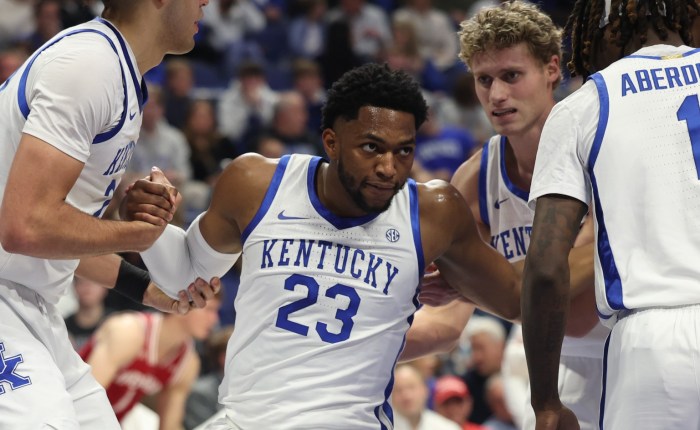
(NASHVILLE, Tn.) – Nobody died. Let’s be clear about that from the start. But walking out of Bridgestone Arena on that bleak December night, it sure felt like some small—but vital—part of me kicked the bucket. If grief truly comes in stages, Big Blue Nation skipped denial and bargaining entirely and hurtled straight into anger and depression. A 35-point blowout loss to Gonzaga will do that to you.

Thirty-five. Five touchdowns. A deficit so large you half-expected Diego Pavia to pad his Heisman stats by tossing one more.

The Cats shot 26% from the field—a number so pitiful you’d think they were tossing up prayer requests rather than basketballs. Meanwhile, Graham Ike—just one man, mind you—had more two-point field goals than the entire Kentucky roster. Let that sink in. One guy outscoring a blue-blood program in its own chosen sport. And not just any sport—the sport. The one woven into our DNA, passed down from grandparents to grandbabies like that sacred cloth Mark Pope keeps referencing.

This wasn’t just a loss. It was the fiber unraveling on holy ground—the third-most lopsided defeat in the shot clock era. We’ve known pain before. Saint Peter’s. Oakland. That 41-point thrashing from Vanderbilt—Vanderbilt!—that still wakes some of us with night sweats. Gardner Webb. Robert Morris in the NIT. Middle Tennessee State, if you really want to dig around in old wounds. But this… this seemed different. This was more visceral. This was more publicly humiliating. This was a blue mist turning into a funeral fog over Lower Broadway.

The boos rained down like I’ve never heard—sharp, heavy, and honest. Those weren’t spur-of-the-moment grumbles. Those were boos pulled from deep in the diaphragm—boos with ancestry.

And in the middle of it all stood Mark Pope. Clueless. Clutching his arms. Pacing. Staring. Hoping. Praying. Whatever offensive scheme existed remained locked in the bus. The defense was optional. The effort was zero. And the $22-million payroll—which should buy you at least a handful of competent dribbles—played like a group of guys who accidentally wandered in from the YMCA while looking for hot chicken.

Afterward, Pope sat there and took it. “All the boos we heard tonight were incredibly well deserved—mostly for me,” he acknowledged.

And credit where due—he’s right. BBN isn’t booing because we hate. BBN boos because we care too much. Because this program is stitched into our emotional circuitry. Because watching it flounder like this feels like watching a beloved family business collapse under the weight of mismanagement and market forces we don’t fully understand.

Because NIL—this new world we were forced into—feels like it’s quietly cannibalizing the very soul of Kentucky basketball.

Where do we go from here? That’s the question echoing from Lexington to London to Pikeville to Paducah. This program means so much—too much, maybe—and to see it decimated, hollowed out, and sold to the highest bidder leaves a taste in the mouth not unlike despair.

We’ve now lost six straight to AP Top 25 opponents. Six. That’s not a skid. That’s a full-blown car crash. Indiana comes calling next Saturday, carrying history and smugness in equal measure. I guarantee the Hoosiers are smelling fear the way sharks smell blood.

Pope keeps telling us he’s going to fix it. He says it every game, every press conference, every painful in-between: “We’ll fix it.”

But those words—once hopeful, once rousing—are starting to fall on ears that have gone numb from overuse. We’ve become the fanbase that cries wolf, except the wolves actually show up and chew our legs off every other week.

Nobody died. But something inside us sure felt like it did. The Empire may have crumbled in Nashville, but unlike the Romans, we don’t have the luxury of blaming the Visigoths. This collapse came from within—bad shots, bad schemes, bad chemistry, bad body language, bad vibes. The kind of decay you can’t just patch with a rah-rah press conference, a well-placed promise, or even a savior named Jayden Quaintance.

And here’s the uncomfortable truth that stings most of all—the one we don’t want to say out loud but feel gnawing at us anyway: we don’t know if this gets better. We don’t know if the fixes Pope keeps preaching about are real or wishful incantations. We don’t know if a program built on NIL money and one-year mercenaries can rediscover heart, pride, or purpose. We don’t know if next Saturday against Indiana is the first step back… or one more step into the void.

We don’t know. That’s the scary part.

Because for all our bluster and bravado, Big Blue Nation likes certainty. We like legacy. We like stability. We like knowing that no matter the chaos swirling through college hoops, Kentucky Basketball stands firm—unshakable, undeniable, eternal.

But standing outside Bridgestone Arena after that 35-point humiliation, looking into the hollow faces of fellow fans who traveled hundreds of miles for a beatdown they’ll never forget, it was impossible not to feel the ground shifting under our feet.

Maybe we rise from this. Maybe we don’t. Maybe this is rock bottom. Or maybe—we whisper it, barely audible—it’s a sign of something even more ominous.

Nobody died. But something has changed. And until this team proves otherwise, we’re left clinging to hope with one hand… and bracing for the worst with the other.

This article was originally written for distribution through Nolan Group Media publications.


Dr. John Huangis a retired orthodontist, military veteran, and award-winning author. Currently serving as a columnist for Nolan Group Media, he invites readers to follow him on social media @KYHuangs. Explore his latest, Whining For Posterity, and all his books at Amazon.
To Hell with the Standard (Champions Classic Edition)

To Hell with the Standard (Champions Classic Edition)

(LEXINGTON, KY.) – Mark Pope keeps telling us Kentucky didn’t “meet the standard,” but after that Michigan State demolition in the Champions Classic, I’m starting to think we’re comparing this team to the wrong standard entirely. Championship Number Nine? At this point, I’d settle for “don’t get pantsed on national television before halftime.”

You see, “the standard” sounds great when you’re at a booster dinner or a preseason pep rally. But when the Cats get embarrassed again in Madison Square Garden—when the defense leaks worse than a cheap umbrella and the chemistry looks like oil and vinegar—then the standard becomes a cruel, suffocating weight.

And surely you caught Pope’s postgame presser… ugh. The man looked like someone had just put his dog down. Depressed. Drained. Eyes sunken like he’d been up all night gathering data, crunching analytics, and questioning all his life decisions. This isn’t the buoyant, always-positive, program-resurrecting Pope we hoped for—this is a man preparing for a root canal without anesthesia.

Pope said his players weren’t ready for Louisville because of some “out-of-character” incident before the game. Well, what was the excuse against Michigan State? Nothing—nothing—about that latest performance looked in character for a team supposedly training every day under the ghostly shadow of the standard. At this point, the standard has morphed into a meaningless punchline.

And can we talk about the $22 million elephant in the room?
That’s right—this roster is collectively pulling in twenty-two million American dollars to play basketball. That’s not chump change.

And what are we getting for that hefty investment?

Poop. Absolute, unmitigated poop.

Defense? Poop.
Shot selection? Poop.
Effort? Poop.
Guys playing for an NBA audition instead of the name on the front of the jersey? Extra-strength poop with glitter.

Okay—I’ve vented enough. Let’s take a deep breath (maybe two) and accept the painful truth: Mark Pope inherited a proud tradition, but also a monster. Every coach who takes the Kentucky job eventually realizes the same terrifying thing—this fan base is passionately crazy. Anything less than a Final Four is failure. Anything short of cutting down the nets is unacceptable. That’s the gospel of Big Blue Nation.

But here’s the irony—we demand perfection from kids who can’t legally rent a car. We scream “UNACCEPTABLE!” into the Twitter void while eating buffalo wings in our recliners. We call for Pope’s head in November, then brag about our loyalty in March.

We’ve worshiped at the altar of the standard so long that we’ve forgotten why we fell in love with Kentucky basketball in the first place. It wasn’t just the championships—it was the magic. The tradition. The roar inside Rupp when some kid from Pikeville or Paducah drills a three. The way the team makes us feel like part of something larger than ourselves.

You can’t measure that with analytics. You can’t hang it from the rafters either. It’s a pulse. A heartbeat. And right now, that heartbeat’s faint—not because of the losses, but because we’ve forgotten how to simply enjoy the game.

So here’s my radical suggestion: to hell with the standard—for now.

Let’s stop counting banners and start counting moments. Let’s cheer the hustle play, the smart pass, the kid who dives on the floor when the game’s already out of reach. Let’s celebrate the little victories—the ones that don’t make SportsCenter but make us proud nonetheless.

Sure, this team may not be destined for the ninth championship banner. They may fumble away a few more games. The defense may still make you want to throw a shoe at your TV. But they’re our team. And if we can’t love them when they’re flawed and broken, we don’t deserve to love them when they’re flying high.

The sky isn’t really falling. It just feels that way because we’ve been staring upward too long, waiting for the next banner to drop.

Let’s stop pretending this is a title run and just… watch basketball. Enjoy the wild, maddening, forehead-smacking circus it becomes. Appreciate Pope trying to hold the universe together with bailing wire while the players try to remember how to guard a ball screen.

Because if you don’t laugh, you’ll cry. And if you don’t ditch the standard, you’ll be the one feeling the root canal.

Championship Nine isn’t walking through that door.
But maybe joy can.
If we let it.

And if this $22-million roster ever decides to stop playing like poop, well… we’ll call that manna from heaven.

This article was originally written for distribution through Nolan Group Media publications.

Dr. John Huang is a retired orthodontist, military veteran, and award-winning author. Currently serving as a columnist for Nolan Group Media, he invites readers to follow him on social media @KYHuangs. Explore his latest, “Whining For Posterity,” and all his books at https://www.Amazon.com/stores/Dr.-John-Huang/author/B092RKJBRD

Top of Form

Bottom of Form

Battle at the Yum: Brotherly Love, Bluegrass Style

Battle at the Yum: Brotherly Love, Bluegrass Style

(LEXINGTON, Ky.) – I’ve been to a lot of games at the KFC Yum! Center over the years, and one constant remains: somebody always spills beer on me. Maybe it’s the cramped seats, maybe it’s divine retribution for my unapologetic “L’s down,” or just that smug smirk when Kentucky pulls off that inevitable upset. But whatever the reason, it’s always the same warm, yeasty baptism by Yuengling. Welcome to the Kentucky–Louisville rivalry, friends—where good manners and mutual sportsmanship go to die.

When Kentucky invades the Yum on Tuesday night, it won’t just be another non-conference matchup—it’ll be a civil war disguised as basketball. Don’t let the early date on the calendar fool you. Sure, the game won’t decide an SEC or ACC title, and yes, both programs are still figuring out rotations, chemistry, and playing through injuries. But if you think this one doesn’t matter, try telling that to the guy in the bird suit mugging for the cameras behind Kentucky’s bench.

Here’s the scary part. The Wildcats might not know what they’re walking into. Mark Pope’s shiny new roster—brimming with transfers, freshmen, and enthusiasm—hasn’t yet been immersed in the unholy water of this rivalry. You can study film all you want, but no amount of game tape or analytics prepares you for 22,000 red-clad fanatics who hate everything about you down to the shade of your underwear. This isn’t just basketball—it’s bragging rights and cultural warfare.

To the Louisville faithful, Kentucky is the privileged older brother, always hogging the spotlight, driving the fancy car, and bragging about his NBA friends. The Cardinals, meanwhile, are the petulant little sibling—scrappy, defiant, and perpetually insecure. They’ll do anything to get big brother’s attention, even if it means tossing a drink in his face or keying his Ferrari.

Speaking of Ferraris, Pope’s team is still learning to shift gears smoothly. We’ve seen flashes of brilliance—fast breaks that hum, defense that smothers, and a jaw-dropping Collin Chandler dunk—but also some of the sputtering you’d expect from a group still breaking in the new parts. Louisville, on the other hand, is in the midst of its own identity crisis under coach Pat Kelsey. Kelsey’s energy borders on cartoonish—think Red Bull-fueled pep rally meets evangelical tent revival. He and Pope are oddly similar in their intensity, their positivity, and their charming—but goofy—awkwardness.

If it weren’t for their height difference, these two might actually be long-lost twins separated at birth. Both are relentlessly upbeat. Both quote leadership manuals like scripture. And both probably wear out their assistants with midnight text chains about “culture” and “accountability.” The difference? Pope has the keys to the big blue mansion, while Kelsey’s still trying to get the plumbing fixed in the old red house down the street.

Then there’s last year’s dustup—when Pope put Kelsey in a friendly “headlock” during a midgame scrum. Add in the rumored “verbal altercation” outside a top recruit’s home, and you’ve got another colorful chapter in UK-UL lore. It’s all fun and games—until it’s not.

Expect some fireworks on Tuesday. Louisville will treat this like their Super Bowl, their one shining moment to prove they’re not entirely irrelevant. Kentucky, meanwhile, would like nothing more than to quiet the rowdy red masses and head back down I-64 with the smug satisfaction that only a rivalry win provides.

This particular game might not have the national stakes of years past. Remember, it’s happening way too early. Both teams are still under construction—a mix of promise and potential waiting for the right foundation. But pride, not perfection, will define the night. The winner gets the city for a year; the loser gets excuses.

And let’s be honest—Kentucky fans need this one. After the ups and downs of recent seasons, after the heartbreaks and early exits, Big Blue Nation wants tangible proof that Pope’s vision is more than just those “beautiful” slogans he’s been preaching since his arrival in Lexington. A win at the Yum would do wonders for morale, momentum, and those all-important selection committee resumes down the road.

Remember also that rivalries are less about rankings and more about respect—or, in this case, disrespect. You don’t beat Louisville for seeding; you beat Louisville because you can’t stand them.

So yes, I’ll make the trip again. I’ll brave the hecklers, dodge the popcorn, and pray the beer showers are light this year. Because there’s nothing quite like Kentucky versus Louisville—the noise, the tension, the mutual loathing wrapped in a shared love for basketball. It’s messy, it’s emotional, and it’s absolutely glorious.

This article was originally written for distribution through Nolan Group Media publications.

Dr. John Huang is a retired orthodontist, military veteran, and award-winning author. Currently serving as a columnist for Nolan Group Media, he invites readers to follow him on social media @KYHuangs. Explore his latest, “Whining For Posterity,” and all his books at https://www.Amazon.com/stores/Dr.-John-Huang/author/B092RKJBRD

The House Always Wins

The House Always Wins

What good is it for someone to gain the whole world, yet forfeit their soul?

Remember when the worst thing to happen in a basketball game was Perry Stevenson goaltending a free throw or Christian Laettner stomping on someone’s chest? Those were simpler times. Now we’ve got Chauncey Billups and Terry Rozier being investigated for sports gambling.

Welp, shame on us. We got what we asked for.

When we opened the floodgates to legalized sports betting, we were told it would be harmless fun—a way to “enhance fan engagement.” The marketing geniuses promised us responsible wagering, clean oversight, and a little extra tax revenue for our schools. What we actually got was a nation of addicts-in-training, daily fantasy junkies, and people screaming at their phones during the fourth quarter of a meaningless midweek NBA game because they needed one more rebound to hit the over.

And yes, I get it. Gambling itself isn’t inherently evil. It’s not like betting on Kentucky to cover the spread automatically condemns your soul to perdition. But let’s not pretend we didn’t invite the devil in when we started normalizing this stuff as if it were just another harmless hobby.

I know because I’m wired that way myself. I’ve got an addictive personality. Always have. I still remember the euphoric rush of winning my first NCAA tournament bracket—strutting around like Einstein in sneakers because I had correctly predicted some 11-seed Cinderella run to the Sweet 16. Then came fantasy football. Oh, the sweet taste of victory on Monday night! I’d sit there with one player left in the lineup, calculating yards and touchdowns like a Wall Street trader watching his stock portfolio. When my guy scored, I’d practically levitate off the couch.

You see, that’s the problem. It’s never enough. You always want a little more action, a little bigger hit of adrenaline, the proverbial dopamine rush. For people like me, that’s a slippery slope. One day you’re betting a friendly five bucks with your buddies; the next day you’re mortgaging the house because the Bengals can’t possibly blow another lead.

The truth is, gambling can ruin lives. It destroys families, wrecks bank accounts, and turns decent people into liars and thieves. It feeds on desperation and ego—the belief that you can beat the odds, that you’re smarter than the system or your neighbor down the street, that this next parlay will finally get you even. Spoiler alert: the house always wins.

And when that “house” happens to be tied to the integrity of our sports, that’s when things really go south. If you can’t watch a game without wondering whether the ref’s call was clean, or whether the player missed that shot on purpose, what are we even cheering for? The beauty of sports has always been its purity—hard work, skill, competition. Gambling muddies that. It injects suspicion where there should instead be joy.

Money, of course, is the root of it all. It always is. Money draws in the riff raff, the hustlers, and the shadowy figures waiting in the alleys of every major sports scandal. Organized crime didn’t just disappear when we legalized betting; it just put on a nicer suit and opened an app. The lure of easy cash will always attract those looking to exploit the system—and sadly, some of those people will have locker room access.

When I was growing up, sports were an escape from the mess of the world—a pure and noble pursuit of excellence. Now they’re just another line item in somebody’s betting portfolio. Every pitch, every possession, every field goal attempt is a potential profit or loss. Even the broadcasters can’t resist dropping the over/under like it’s part of the game itself.

And while we’re pointing fingers, let’s not forget the sports radio guys who spend half their shows preaching about “responsible gambling” while the other half reading ad copy for the very apps causing the mess. Spare me the sanctimony. You can’t sermonize about integrity one minute and then tell me to “hammer the over” with a promo code the next.

I’m not naïve. I know you can’t unring the bell. Gambling is here to stay. The toothpaste is out of the tube, and no amount of moral handwringing is going to put it back. But we can at least be honest about what it’s doing to us. For every “responsible gamer” out there treating it like entertainment, there are dozens more suckers sinking deeper into the quicksand.

I suppose it’s fine if you know your limits—if you can place a small wager and walk away without checking your phone every five minutes. But for most people, those limits blur over time. The lines between fun and fixation disappear, and before long, you’re chasing losses like Calipari after Covid.

So yeah, when I hear about Chauncey Billups and Terry Rozier getting tangled in the gambling web, I’m not shocked—I’m sad. Sad for them, sad for the sport, sad for the fans who still believe in fair play. Because the more this stuff spreads, the more we risk losing what made us fall in love with sports in the first place.

I’m not preaching here. Like I said, I’m as susceptible as anyone. If gambling apps had been around when I was younger, I might have been one of those guys refreshing DraftKings under the table during Sunday service. (I’m joking… mostly.) But maybe that’s why I’m so wary of it now. I know how easy it is to get hooked, how quickly something innocent can become destructive.

So as these investigations unfold, I’ll be watching—not for the point spreads or the odds, but for the soul of the game itself. Because if we keep going down this road, if we keep letting money and manipulation call the shots, one day we might wake up and realize the thrill is gone. The joy’s been replaced by suspicion, and the purity of the game by the price of the bet.

And when that happens, it won’t matter who wins or loses. The house will have already won.

Dr. John Huang is a retired orthodontist, military veteran, and award-winning author. Currently serving as a columnist for Nolan Group Media, he invites readers to follow him on social media @KYHuangs. Explore his latest, “Whining For Posterity,” and all his books at https://www.Amazon.com/stores/Dr.-John-Huang/author/B092RKJBRD

Mark Pope’s Ferrari: Kentucky Basketball’s Drive for a Championship

Mark Pope’s Ferrari: Kentucky Basketball’s Drive for a Championship

(LEXINGTON, Ky.) – When Mark Pope stood before the assembled media the other day and said, “We got a great Ferrari and we can’t wait to take it for a spin,” I thought he was referring to the team’s on-court performance. You know—sleek offensive design, turbocharged energy, cornering on a dime. What I didn’t realize was that the real Ferrari might be the one he’s been paying for—rumored to be worth about $22 million in NIL payouts.

Apparently, this isn’t your dad’s Kentucky basketball team, cobbled together with a few well-placed ten-dollar-handshakes. Nope, this is a shiny new model, custom-built with top-of-the-line NIL features, luxury international imports, and more horsepower than a herd of wild stallions. Pope, of course, is the guy behind the wheel—white-knuckled, grinning ear to ear, and just itching to mash the accelerator.

Unfortunately, he may have already dinged the fender.

Before Big Blue Nation could even buckle their seatbelts, the Ferrari hit a pothole during the Blue-White Scrimmage in Memorial Coliseum. Starting point guard Jaland Lowe, the Pitt transfer recruited specifically to pilot this high-powered offense, went down with a shoulder injury. It didn’t appear to be a fiery crash—but still—you never want to see your lead driver headed to the pit before the first lap.

And what a lap it was. The Blue-White game—usually a glorified layup line wrapped in applause—felt more like a demolition derby this year. Players were crashing the glass with impunity, fighting through screens like the bench was calling, and snarling like the game meant a trip to the Final Four.

I’ve covered a lot of Blue-White scrimmages in my day, but I’ve never seen one that intense. The pace was frenetic, the emotions were high, and the competition was fierce. Pope has these guys revved up like they’re chasing Banner No. 9, rehearsing for One Shining Moment before the first ball is even tipped.

And that’s the rub, isn’t it? The new head coach hasn’t just brought a fresh energy—he’s brought a fresh philosophy. Gone are the days of “these guys are young” or “trust the process.” Pope doesn’t do slow builds or cautious optimism. He’s out there saying, in essence, “We’re Kentucky. We play to win it all—every game, every drill, every scrimmage.”

That kind of bravado plays beautifully in October. It’s the stuff fans dream about while their football team self-destructs. But it’s also a lot to live up to over the grind of a five-month season.

Because as thrilling as it is to hear your coach talk about Ferraris, championship hunts, and competitive fire, there’s a fine line between confidence and burnout. The season’s an endurance race, not a drag strip. The question isn’t whether this team can go 200 mph—it’s whether they can stay on the track long enough to see the checkered flag.

Now, before you accuse me of pouring water on Pope’s premium fuel, let me be clear: I love the swagger. After years of seeing a fan base divided between believers and doubters, there’s something downright refreshing about having a head coach who plants his flag, goes for the jugular and says, “These guys want to win, always.” No hedging, no excuses, no talk about youth or rebuilding.

Pope’s message to his players—and to all of us—is unmistakable: Kentucky basketball doesn’t back down. Whether it’s an intra-squad scrimmage on the UK campus or a March showdown in Madison Square Garden, they’re going to play with everything they’ve got.

But maybe, just maybe, he could keep one hand on the brake for a bit.

Because here comes Purdue—No. 1 in the country, with the nation’s top point guard in Braden Smith—rolling into town Friday night for the first exhibition. On paper, it’s a game that doesn’t count. But try telling that to a fan base that treats October tune-ups like NCAA Tournament play-ins. Win by 20 and the hype train leaves the station at warp speed. Lose by 20 and the “Ferrari” gets called a lemon before Thanksgiving.

That’s just life in the Bluegrass, where basketball is religion and patience is in short supply. Pope knows that better than anyone—he lived it as a player, and now he’s living it as the man in charge.

So, should he tamp it back a bit? Probably not. This is who Mark Pope is—the mad scientist, analytics guru, relentless, and unafraid to dream big. He’s not the kind of guy to idle in neutral while everyone else takes the safe route.

Besides, Ferraris aren’t built for cautious Sunday drives. They’re built to turn heads, scorch the pavement, and leave the competition in the dust.

Still, if there’s one lesson to remember, it’s that championship seasons aren’t won in October—they’re tuned there. Let’s just hope by the time March rolls around, the paint isn’t scratched, the tires aren’t bald, and the driver hasn’t run out of gas.

Because as any Kentucky fan knows, it’s not about how loud the engine roars at the start. It’s about how fast—and how fearlessly—you finish.

—and the only finish line that matters this year runs through Indianapolis.

Dr. John Huang is a retired orthodontist, military veteran, and award-winning author. Currently serving as a columnist for Nolan Group Media, he invites readers to follow him on social media @KYHuangs. Explore his latest, “Whining For Posterity,” and all his books at https://www.Amazon.com/stores/Dr.-John-Huang/author/B092RKJBRD