Will Stein Wants You to Lose Your Mind

Will Stein Wants You to Lose Your Mind

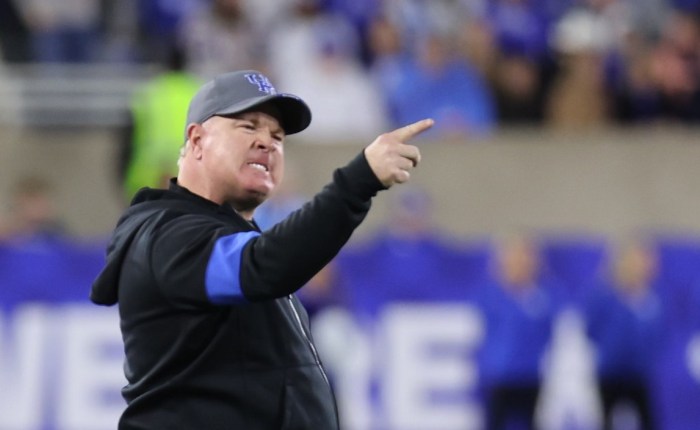
Will Stein has a simple request for Kentucky fans Saturday.

Lose your minds.

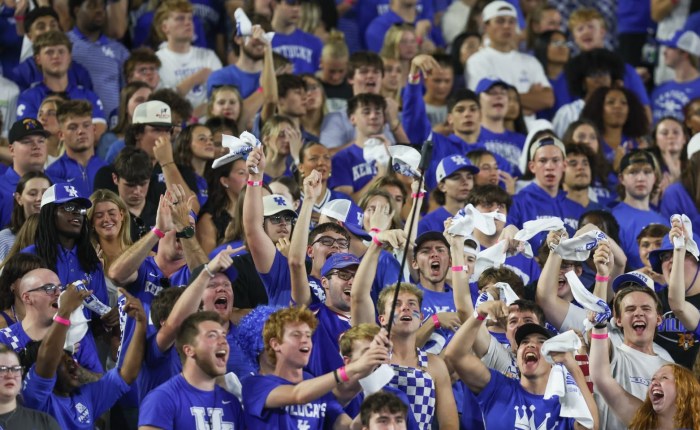
Scream. Yell. Get to Kroger Field early. Forget the tailgate. Be in your seat for warmups. Make so much noise that Alabama quarterback Keelon Russell has to communicate using hand signals, smoke signals or perhaps divine intervention.

Stein wants 65,000 people watching his team warm up. He wants the loudest game in Kentucky football history.

“I want people’s voices hoarse when they leave here,” Stein said Tuesday. “They got to take off work on Monday because they can’t talk.”

Finally, a doctor’s excuse I can enthusiastically endorse.

There’s just one catch.

While Stein wants the rest of us behaving like complete lunatics, he wants his football team to remain approximately as emotional as a Bill Belichick press conference.

I’m not sure Kentucky fans can fathom that. After all, SEC Nation is coming to town. Alabama is paying a visit. Kentucky hasn’t beaten the Crimson Tide since 1997. The game is on national television. Surely there must be some benefit to harnessing all that emotion.

Nope.

“Emotions get you beat,” Stein said. “We want our fans to be emotional. We don’t want us, as players or coaches, to be emotional.”

I’m not sure I buy it. Not completely, anyway.

There is a difference between being emotional and being controlled by emotion. And if ever there were a Saturday when Kentucky could use a little extra juice, I’m guessing the one with Alabama standing on the opposite sideline might qualify.

Emotion can make you reckless. It can also make you run through somebody.

It can make you jump offsides. It can also make you chase a ball carrier another five yards.

It can make you try to be a hero. It can also convince you that the five-star guy lined up across from you isn’t nearly as intimidating as everybody spent all week telling you he was.

Surely Stein knows that. In fact, I suspect he knows it better than he’s letting on. Maybe “emotions get you beat” is exactly what a head coach should tell us on Tuesday. Maybe what gets said inside the Kentucky locker room at 3:20 Saturday afternoon sounds just a little different.

Wink, wink.

Because Stein himself is creating an emotional powder keg. He wants 65,000 people inside Kroger Field for warmups. He wants the place louder than it has ever been. He wants Kentucky fans screaming until they need sick leave. That’s an awful lot of gasoline to pour around the building if you don’t intend for your football team to feel any of the heat.

Stein has been preaching his thermostat-versus-thermometer analogy since he arrived. Thermometers react to their surroundings. Thermostats set the temperature.

Saturday may provide the ultimate laboratory experiment. Because the temperature inside Kroger Field figures to be 487 degrees.

Kentucky is 2–39–1 all-time against Alabama. The Wildcats haven’t beaten the Crimson Tide since 1997.

Stein was there.

He was seven or eight years old and remembers the tailgates and K House more than the actual football game.

Someone asked whether he planned to show his players highlights of that historic victory. Stein acknowledged that he probably should. Then he remembered something horrifying. None of his players were alive.

“I was asking a kid today,” Stein said. “I was like, ‘When were you born?’ In like 2004? I’m like, ‘Oh, shit.’”

There it was again.

For those keeping score at home, that’s two consecutive Stein press conferences with a mild profanity outbreak. After beating Youngstown State, he nearly dropped an F-bomb while explaining his plans to celebrate with a cold beer. This time, discovering that you’re old enough to coach people born in 2004 apparently did the trick.

Wait until somebody tells him they don’t remember Tim Tebow.

Stein insists Saturday isn’t a defining game.

“They’re all big,” he said. “Youngstown State last week was the biggest game of our season because that was the first game. Now we play Alabama.”

Come on, Coach. This one is bigger. SEC Nation isn’t setting up shop in Lexington because Kentucky is playing Youngstown State. ABC isn’t putting it on national television because it’s just another game. And 65,000 people aren’t being ordered into Kroger Field early because Stein desperately wants them to see stretching.

This is Alabama. Stein knows it. His players know it. Big Blue Nation certainly knows it.

The trick isn’t pretending Saturday is just another football game. It’s recognizing that it isn’t—and then playing like it is.

That’s where I think Stein is exactly right. Use the emotion. Don’t let the emotion use you.

So perhaps Saturday afternoon, somewhere behind those closed locker-room doors, the thermostat gets turned up just a notch. Maybe Stein reminds his players what opportunity is standing on the other side of that door. Maybe his voice gets a little louder. Maybe there’s even an adjective we aren’t allowed to print.

Then the doors open.

The players run out.

And everybody settles down.

Except us.

We’re supposed to lose our minds.

Dr. John Huang is a retired orthodontist, military veteran, and award-winning author. Currently serving as a columnist for Nolan Group Media, he invites readers to follow him on social media @KYHuangs. Explore his latest, Whining for Posterity, and all his books at Amazon.
A Face Full of Cake

A Face Full of Cake

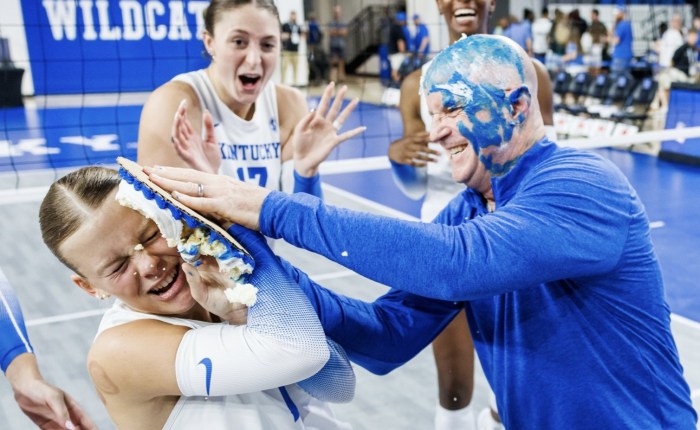
Craig Skinner and Trinity Ward square off in an epic cake battle celebrating Skinner’s 500th career victory (Photo Credit UK Athletics/Kentucky Volleyball).

(LEXINGTON, Ky.) — Craig Skinner won his 500th volleyball match Saturday night, which apparently earned him the traditional reward reserved for legendary coaches everywhere.

A face full of cake.

Kentucky swept South Florida at Historic Memorial Coliseum, setting off a postgame celebration that included video tributes, family congratulations, and Trinity Ward being entrusted with the cake.

Bad idea.

“I was like, ‘Do I get to throw it in his face?’” Ward said.

She did.

Skinner retaliated, Ward claimed she was “tapping out,” and everyone eventually survived long enough to discuss a considerably more impressive accomplishment.

Five hundred wins.

“The 500 thing is not on my radar,” Skinner said.

Maybe it should be. Five hundred victories don’t happen accidentally, particularly at a place where Skinner wasn’t exactly inheriting a volleyball dynasty when he arrived 22 years ago.

He left Nebraska as a career assistant coach without really knowing whether he could successfully run his own program. He and his wife, Megan, came to Kentucky figuring he would see what he could build and perhaps move along after three to five years.

“They’re at the bottom,” Skinner recalled thinking. “Let’s see what we can do.”

So much for the five-year plan.

Skinner stayed, and somewhere along the way Kentucky volleyball went from trying to become relevant to becoming one of the programs everybody else recognizes.

The Wildcats now compete for SEC and national championships, draw large crowds to Historic Memorial Coliseum and receive invitations to the kinds of events that would have sounded preposterous when Skinner arrived. They’ll play UCLA on Wednesday and then face Penn State next weekend at Wrigley Field.

Those aren’t the opportunities Skinner inherited.

They’re the opportunities he helped create.

The interesting part, however, is listening to him explain how.

After Kentucky swept Utah State on Friday night, Skinner talked about the difficult week of practice that followed an earlier loss to Pittsburgh. He thought his team had gotten a little too comfortable.

“Comfort is the enemy of great,” he said.

So practice became decidedly less comfortable.

Skinner doesn’t necessarily believe the old coaching cliché that you play exactly like you practice. Players make mistakes. Execution isn’t always perfect. Some practices are ugly.

What matters to him is the effort behind them.

“I think you play to the effort you give,” he said.

A night later, after victory No. 500 and another sweep—this time over South Florida—Skinner offered an additional glimpse into a philosophy that has served him pretty well for more than two decades.

“Coaches are teachers,” he said. “As soon as coaches lose sight of that, that’s typically when they go off the rails.”

His players seem to understand that part of him better than anybody.

When asked what makes Skinner effective as a teacher, they didn’t talk about sophisticated volleyball strategy or championship-level motivational speeches. They talked about patience. They talked about his willingness to explain something differently when a player doesn’t understand it the first time. They talked about his consistency and how he shows up for them the same way every day regardless of what might be happening in his own life.

They also revealed that he makes a mean risotto and can apparently perform a backflip off a diving board.

I didn’t see either of those accomplishments listed in his official UK bio.

But the number 500 wasn’t what made Skinner emotional Saturday night. Watching the video tributes from former players did.

He remembered what those players were like when they first arrived in Lexington and, more importantly, the people they had become by the time they left.

“That motivates me more than wins,” he said.

Don’t misunderstand him. Skinner likes winning just fine.

“Wins are great, and championships are great, and we all are striving to do that,” he said. “Don’t let people kid you when they say they’re not.”

He’s simply learned that the best way to accumulate victories isn’t necessarily to obsess over accumulating victories.

Teach players. Develop them. Demand effort. Get an entire group of people, as Skinner put it, “looking down the same tracks at the same time.”

Do that long enough and apparently the wins start piling up.

Five hundred of them, to be exact.

Saturday night was supposed to celebrate everything Craig Skinner has accomplished during his 22 years at Kentucky. Instead, it may have provided a pretty good explanation for how he accomplished it.

And when somebody tells you to take off your glasses for a team picture while Trinity Ward is standing nearby holding a cake, don’t fall for it.

Dr. John Huang is a retired orthodontist, military veteran, and award-winning author. He currently serves as a columnist for Nolan Group Media and invites readers to follow him on social media @KYHuangs. His latest book is Whining for Posterity, available on Amazon.

Welcome to the SEC, J. Batt. Greg Sankey Would Like a Word.

Welcome to the SEC, J. Batt. Greg Sankey Would Like a Word.

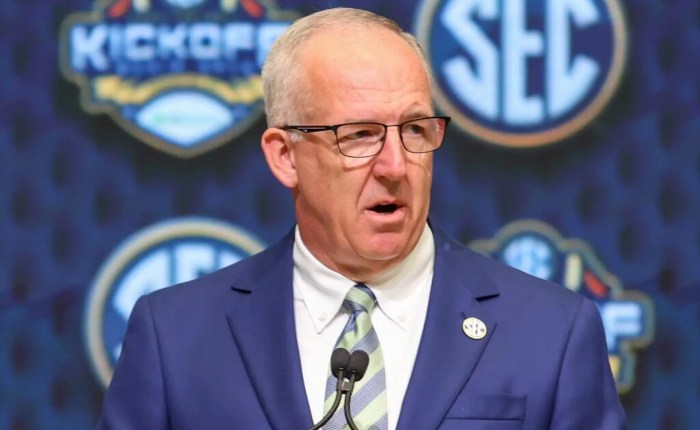
Greg Sankey, pictured at the SEC media day in July. Photo Credit: Jordan Godfree / Imagn Images

J. Batt has had a pretty good honeymoon.

Since arriving at Kentucky, the new athletics director has talked about listening to fans, improving their experience, and positioning the Wildcats to compete at the highest level. He has opened doors. Now we may find out whether he’s willing to kick one down.

Because Mark Mitchell’s eligibility has suddenly become about something much bigger than whether Kentucky adds another talented basketball player. It’s about power. And Greg Sankey and the SEC have plenty of it.

According to CBS Sports’ Matt Norlander, SEC presidents have reaffirmed conference rules that could prevent Mitchell from playing for Kentucky this season. Mitchell played at Missouri last year but didn’t enter the transfer portal during the spring window.

There’s a pretty good reason for that. He wasn’t eligible. Mitchell had exhausted his eligibility after four seasons of college basketball. There was no reason to enter the portal because, as far as everyone knew, there wasn’t another college season to play.

Then everything changed.

Mitchell and other players challenged the NCAA’s eligibility rules in court. A Jefferson County judge granted a temporary restraining order allowing Mitchell to pursue a fifth season. He entered the portal, committed to Kentucky, and suddenly Mark Pope had another experienced piece for a roster with championship aspirations.

Enter the SEC. According to Norlander, Mitchell is believed to fall under the SEC’s prohibition on intraconference transfers because he didn’t enter the portal during the designated window.

Rules are rules. Except when complying with them requires a time machine. How exactly was Mitchell supposed to enter the portal in April for a fifth season that didn’t exist? Unless Doc Brown and a DeLorean are somewhere in Kentucky’s NIL budget, I’m not sure how that was supposed to work.

That’s the question Kentucky should be asking forcefully.

The timing couldn’t be more interesting.

The SEC also just adopted severe penalties in a separate but related eligibility battle for schools that roster athletes who previously signed professional contracts or declared for professional drafts without properly withdrawing. Those penalties reportedly can include a half-season suspension for the head coach, massive financial penalties, and even the loss of conference voting privileges.

That’s not a slap on the wrist. That’s Sankey walking into the room carrying a sledgehammer.

There’s a reason for it.

The NCAA has spent years getting pummeled in court. Every time college sports’ governing bodies draw another line around amateurism, somebody seems to find a judge willing to erase it.

So the SEC is trying something different. Instead of punishing the player, punish the school. Make the consequences painful enough and nobody will dare test the rule.

That’s clever. Whether it survives a legal challenge is another matter. More immediately, we’ll see whether Kentucky is willing to push back.

This is where Batt comes in.

Batt’s early months have included plenty of popular decisions. Better concessions. More fan engagement. Open practices. Even an invitation for aging media members to risk orthopedic surgery playing basketball.

I’ve applauded all of it.

This, on the other hand, is different.

Kentucky isn’t fighting the NCAA from some distant outpost. It’s potentially challenging its own conference and arguably the most powerful commissioner in college athletics.

And Kentucky isn’t merely a victim of SEC governance, either. It’s a member. Its president sits at the same table as everybody else’s. The conference’s rules are ultimately the product of its own institutions.

That makes this situation complicated. It also makes it fascinating.

I’m not suggesting Kentucky should recklessly throw Mitchell onto the floor and dare Sankey to suspend Mark Pope.

There’s a difference between courage and stupidity.

But Kentucky should fight every reasonable fight for him.

Ask for the waiver. Challenge the interpretation. Support Mitchell’s legal efforts where appropriate. Make the SEC explain why a player should be punished for missing a deadline he had no conceivable reason to meet.

And if those avenues fail?

Then Batt has a decision to make.

Because there will be other Mark Mitchells. College athletics is changing too rapidly for there not to be. Courts will rule. Players will sue. Conferences will respond. Rules written six months earlier will collide with circumstances nobody anticipated.

Somebody eventually will discover exactly where the SEC’s authority ends. Kentucky doesn’t necessarily need to volunteer to be the guinea pig. LSU appears perfectly willing to handle that assignment. But Kentucky shouldn’t run from the laboratory, either.

Batt has spent his first few months telling Big Blue Nation that Kentucky intends to think bigger.

Good.

Here’s his chance.

Welcome to the SEC, J. Batt. Greg Sankey would like a word. Something tells me this meeting won’t be about concession prices.

Dr. John Huang is a retired orthodontist, military veteran, and award-winning author. He currently serves as a columnist for Nolan Group Media and invites readers to follow him on social media @KYHuangs. His latest book is Whining for Posterity, available on Amazon.

This Ain’t No Philosophy Seminar

This Ain’t No Philosophy Seminar

(LEXINGTON, Ky.) – When coaches are under fire, they usually don’t speak in riddles—they rant.

Jim Mora famously barked, “Playoffs?! Don’t talk about playoffs!”
Herm Edwards simplified the profession to its core: “You play to win the game.”
Mike Gundy, veins popping, yelled, “I’m a man! I’m 40!”

Those quotes didn’t require interpretation. They didn’t need a decoder ring. They landed because frustration stripped the message down to bone.

Which is why Mark Pope’s recent quote on his weekly coach’s show left so many Kentucky fans scratching their heads like they’d accidentally tuned into a philosophy podcast.

“What’s really important for us as coaches and as teammates is understanding the story that each of our guys and each member of our staff is telling themselves about what we’re going through right now…”

This is not a rant. It’s not normal coach-speak. It sounds more like a narrative symposium held in Ballroom A at the downtown Hyatt.

Before we dismiss it entirely—or turn it into a meme—let me explain why I might be uniquely qualified to translate what Pope was trying to say.

I spent decades as an orthodontist listening to people describe pain that wasn’t always where they thought it was. Patients told elaborate stories about one tooth when the real issue lived somewhere else entirely. My job wasn’t to validate the story. It was to identify the truth underneath it and fix the problem—whether the patient liked the diagnosis or not.

Coaching, at its best, works the same way.

So when Pope talks about “the story each guy is telling himself,” he’s really saying this:

Players are processing adversity differently. Some think it’s bad luck. Some think it’s their fault. Some think the system isn’t for them. Some think they should be playing more.

That part is reasonable, human, and accurate.

Then Pope says he wants to bring those stories back to two things: a point of truth and a point of common understanding.

Translation:
“We need everyone to stop lying to themselves—and agree on what we’re actually bad at.”

Still reasonable. Still logical. But strangely phrased for Kentucky basketball. It feels like Phil Jackson’s Zen without the structure—philosophy without the scoreboard support to justify it.

And that’s why it landed sideways.

Kentucky fans don’t need help understanding the story when the evidence is screaming:

• Slow starts
• Inconsistent effort
• Poor perimeter defense
• Questionable preparation

When you’ve had nearly two weeks to prepare and still fall behind by 21 points, the story doesn’t matter nearly as much as the symptoms. The frustration isn’t that Pope is wrong.

It’s that he’s explaining instead of commanding. At Kentucky, explanation often sounds like excuse—even when it’s not intended that way.

Fans are conditioned to expect blunt clarity in moments like this. Mora didn’t unpack emotional narratives. Edwards didn’t ask players how losing made them feel. Gundy didn’t workshop his truth.

They owned it.

That doesn’t mean Pope lacks intelligence or care. In fact, this quote suggests the opposite—he’s thoughtful, introspective, and trying to understand the human side of his team.

But this job isn’t graded on thoughtfulness. It’s graded on readiness—and ultimately wins and championships.

If every player is telling himself a different story, that’s not a literary problem. It’s a leadership one. Great programs don’t require narrative alignment sessions. They create roles so clear that internal monologues don’t matter.

At Kentucky, the story is supposed to be singular:

Defend.
Compete.
Earn minutes.
Win.

No subplots. No word-salad narratives from the coach. Kentucky basketball doesn’t need a narrator.

Pope’s quote might sound thoughtful in June. It sounds confusing in January.

And in January, Big Blue Nation is longing for something refreshingly old-school:

Less parable.
More accountability.

Let’s hope we get it.

This article was originally written for distribution through Nolan Group Media publications.

Dr. John Huang is a retired orthodontist, military veteran, and award-winning author. Currently serving as a columnist for Nolan Group Media, he invites readers to follow him on social media @KYHuangs. Explore his latest, Whining For Posterity, and all his books at Amazon.

I’m on to Kenny Brooks

I’m on to Kenny Brooks

(LEXINGTON, Ky.) – I’m on to Kenny Brooks. Not in a stop-the-presses, breaking news kind of way. It’s more like the quiet realization that the man has cracked a code most coaches spend a lifetime chasing. If you want sustained success in basketball—real, transferable, program-defining success—get yourself a generational point guard, teach her, empower her, and then get out of the way just enough to let her become herself.

He did it with Georgia Amoore. And now, unmistakably, he’s doing it again with Tonie Morgan.

Morgan’s résumé is already starting to read like folklore. A buzzer-beater that stunned LSU last Thursday, followed by another surgical stat line—18 points, 14 assists—in a composed, methodical 74–52 dismantling of Missouri. Flashy when needed. Surgical when required. And always, always in control.

But the numbers only tell you what she’s doing. They rarely explain why—or how.

That’s where Brooks leaned back, grinned, and gave us the real scouting report—one that had nothing to do with crossover moves or assist totals.

“I don’t know what football team is doing good without a good quarterback,” Brooks quipped. “Tonie, she’s been phenomenal all year long… her willingness to be coached. She never makes a face when she doesn’t agree with something… she’s consistently just welcoming any kind of feedback and she takes it.”

There it is. The overlooked superpower.

Be Teachable.

In an era where athletes are branded before they’re built, where confidence sometimes masquerades as infallibility, Morgan’s greatest strength might be her posture in a film room. She watches. She listens. She absorbs. And then—this is the key—she applies.

Brooks made something else clear early, almost defensively, as if to protect Morgan from lazy comparisons: she is not trying to fill Georgia Amoore’s shoes. She’s building her own footprint. Different stride—with the same authority.

And authority she has.

Morgan can do it all. She scores at all three levels. She goes downhill with intention, not chaos. She distributes with either hand like she’s ambidextrous by design. She can take her defender one-on-one when the offense stalls. She understands shot selection. And she defends—not the Instagram kind of defense, but the grind-it-out, make-you-work-for-air variety.

Most importantly, Brooks has empowered Morgan to run the offense. Not just initiate it. Not just survive it. But to run it.

That kind of trust doesn’t come from a box score. It comes from habits—and a heck of a lot of communication and connection between coach and player.

Morgan explained it simply, the way players who truly understand their role often do.

“I have the ball a lot, so it is very important that I take care of it,” said the 5-foot-9 senior transfer from Georgia Tech. “So, when I do turn it over, I just move on. It happens… I just want to take care of it.”

That’s not coach-speak. That’s emotional maturity. Ownership without self-flagellation. Accountability without paralysis.

Teachable players don’t crumble when corrected or sulk when challenged. They don’t confuse coaching with criticism. They see feedback as fuel, not as insult.

And that—far more than a step-back jumper or a no-look dime—is what separates good point guards from the kind that quietly define eras.

Brooks knows it. He’s lived it. He’s building around it again.

Every great coach has a calling card. For Brooks, it might be this: he doesn’t just recruit talent; he intentionally seeks out posture and fit. The willingness to be molded. The humility to learn. The confidence to adapt.

Put a player like that at the point, and suddenly everything else aligns. Spacing makes sense. Tempo settles. Teammates breathe easier. Coaches sleep better.

Morgan’s story is still being written, but the early chapters are already instructive—not just for basketball, but for life. Be skilled, yes. Be confident, absolutely. But remain teachable through it all.

Because the players who last, the leaders who endure, and the programs that matter most are built not on ego—but on the desire to learn and get better.

And if Kenny Brooks keeps finding point guards like this?

Well… I’m really on to him now.

This article was originally written for distribution through Nolan Group Media publications.

Dr. John Huang is a retired orthodontist, military veteran, and award-winning author. Currently serving as a columnist for Nolan Group Media, he invites readers to follow him on social media @KYHuangs. Explore his latest, Whining For Posterity, and all his books at Amazon.
To Hell with the Standard (Champions Classic Edition)

To Hell with the Standard (Champions Classic Edition)

(LEXINGTON, KY.) – Mark Pope keeps telling us Kentucky didn’t “meet the standard,” but after that Michigan State demolition in the Champions Classic, I’m starting to think we’re comparing this team to the wrong standard entirely. Championship Number Nine? At this point, I’d settle for “don’t get pantsed on national television before halftime.”

You see, “the standard” sounds great when you’re at a booster dinner or a preseason pep rally. But when the Cats get embarrassed again in Madison Square Garden—when the defense leaks worse than a cheap umbrella and the chemistry looks like oil and vinegar—then the standard becomes a cruel, suffocating weight.

And surely you caught Pope’s postgame presser… ugh. The man looked like someone had just put his dog down. Depressed. Drained. Eyes sunken like he’d been up all night gathering data, crunching analytics, and questioning all his life decisions. This isn’t the buoyant, always-positive, program-resurrecting Pope we hoped for—this is a man preparing for a root canal without anesthesia.

Pope said his players weren’t ready for Louisville because of some “out-of-character” incident before the game. Well, what was the excuse against Michigan State? Nothing—nothing—about that latest performance looked in character for a team supposedly training every day under the ghostly shadow of the standard. At this point, the standard has morphed into a meaningless punchline.

And can we talk about the $22 million elephant in the room?
That’s right—this roster is collectively pulling in twenty-two million American dollars to play basketball. That’s not chump change.

And what are we getting for that hefty investment?

Poop. Absolute, unmitigated poop.

Defense? Poop.
Shot selection? Poop.
Effort? Poop.
Guys playing for an NBA audition instead of the name on the front of the jersey? Extra-strength poop with glitter.

Okay—I’ve vented enough. Let’s take a deep breath (maybe two) and accept the painful truth: Mark Pope inherited a proud tradition, but also a monster. Every coach who takes the Kentucky job eventually realizes the same terrifying thing—this fan base is passionately crazy. Anything less than a Final Four is failure. Anything short of cutting down the nets is unacceptable. That’s the gospel of Big Blue Nation.

But here’s the irony—we demand perfection from kids who can’t legally rent a car. We scream “UNACCEPTABLE!” into the Twitter void while eating buffalo wings in our recliners. We call for Pope’s head in November, then brag about our loyalty in March.

We’ve worshiped at the altar of the standard so long that we’ve forgotten why we fell in love with Kentucky basketball in the first place. It wasn’t just the championships—it was the magic. The tradition. The roar inside Rupp when some kid from Pikeville or Paducah drills a three. The way the team makes us feel like part of something larger than ourselves.

You can’t measure that with analytics. You can’t hang it from the rafters either. It’s a pulse. A heartbeat. And right now, that heartbeat’s faint—not because of the losses, but because we’ve forgotten how to simply enjoy the game.

So here’s my radical suggestion: to hell with the standard—for now.

Let’s stop counting banners and start counting moments. Let’s cheer the hustle play, the smart pass, the kid who dives on the floor when the game’s already out of reach. Let’s celebrate the little victories—the ones that don’t make SportsCenter but make us proud nonetheless.

Sure, this team may not be destined for the ninth championship banner. They may fumble away a few more games. The defense may still make you want to throw a shoe at your TV. But they’re our team. And if we can’t love them when they’re flawed and broken, we don’t deserve to love them when they’re flying high.

The sky isn’t really falling. It just feels that way because we’ve been staring upward too long, waiting for the next banner to drop.

Let’s stop pretending this is a title run and just… watch basketball. Enjoy the wild, maddening, forehead-smacking circus it becomes. Appreciate Pope trying to hold the universe together with bailing wire while the players try to remember how to guard a ball screen.

Because if you don’t laugh, you’ll cry. And if you don’t ditch the standard, you’ll be the one feeling the root canal.

Championship Nine isn’t walking through that door.
But maybe joy can.
If we let it.

And if this $22-million roster ever decides to stop playing like poop, well… we’ll call that manna from heaven.

This article was originally written for distribution through Nolan Group Media publications.

Dr. John Huang is a retired orthodontist, military veteran, and award-winning author. Currently serving as a columnist for Nolan Group Media, he invites readers to follow him on social media @KYHuangs. Explore his latest, “Whining For Posterity,” and all his books at https://www.Amazon.com/stores/Dr.-John-Huang/author/B092RKJBRD

Top of Form

Bottom of Form

Battle at the Yum: Brotherly Love, Bluegrass Style

Battle at the Yum: Brotherly Love, Bluegrass Style

(LEXINGTON, Ky.) – I’ve been to a lot of games at the KFC Yum! Center over the years, and one constant remains: somebody always spills beer on me. Maybe it’s the cramped seats, maybe it’s divine retribution for my unapologetic “L’s down,” or just that smug smirk when Kentucky pulls off that inevitable upset. But whatever the reason, it’s always the same warm, yeasty baptism by Yuengling. Welcome to the Kentucky–Louisville rivalry, friends—where good manners and mutual sportsmanship go to die.

When Kentucky invades the Yum on Tuesday night, it won’t just be another non-conference matchup—it’ll be a civil war disguised as basketball. Don’t let the early date on the calendar fool you. Sure, the game won’t decide an SEC or ACC title, and yes, both programs are still figuring out rotations, chemistry, and playing through injuries. But if you think this one doesn’t matter, try telling that to the guy in the bird suit mugging for the cameras behind Kentucky’s bench.

Here’s the scary part. The Wildcats might not know what they’re walking into. Mark Pope’s shiny new roster—brimming with transfers, freshmen, and enthusiasm—hasn’t yet been immersed in the unholy water of this rivalry. You can study film all you want, but no amount of game tape or analytics prepares you for 22,000 red-clad fanatics who hate everything about you down to the shade of your underwear. This isn’t just basketball—it’s bragging rights and cultural warfare.

To the Louisville faithful, Kentucky is the privileged older brother, always hogging the spotlight, driving the fancy car, and bragging about his NBA friends. The Cardinals, meanwhile, are the petulant little sibling—scrappy, defiant, and perpetually insecure. They’ll do anything to get big brother’s attention, even if it means tossing a drink in his face or keying his Ferrari.

Speaking of Ferraris, Pope’s team is still learning to shift gears smoothly. We’ve seen flashes of brilliance—fast breaks that hum, defense that smothers, and a jaw-dropping Collin Chandler dunk—but also some of the sputtering you’d expect from a group still breaking in the new parts. Louisville, on the other hand, is in the midst of its own identity crisis under coach Pat Kelsey. Kelsey’s energy borders on cartoonish—think Red Bull-fueled pep rally meets evangelical tent revival. He and Pope are oddly similar in their intensity, their positivity, and their charming—but goofy—awkwardness.

If it weren’t for their height difference, these two might actually be long-lost twins separated at birth. Both are relentlessly upbeat. Both quote leadership manuals like scripture. And both probably wear out their assistants with midnight text chains about “culture” and “accountability.” The difference? Pope has the keys to the big blue mansion, while Kelsey’s still trying to get the plumbing fixed in the old red house down the street.

Then there’s last year’s dustup—when Pope put Kelsey in a friendly “headlock” during a midgame scrum. Add in the rumored “verbal altercation” outside a top recruit’s home, and you’ve got another colorful chapter in UK-UL lore. It’s all fun and games—until it’s not.

Expect some fireworks on Tuesday. Louisville will treat this like their Super Bowl, their one shining moment to prove they’re not entirely irrelevant. Kentucky, meanwhile, would like nothing more than to quiet the rowdy red masses and head back down I-64 with the smug satisfaction that only a rivalry win provides.

This particular game might not have the national stakes of years past. Remember, it’s happening way too early. Both teams are still under construction—a mix of promise and potential waiting for the right foundation. But pride, not perfection, will define the night. The winner gets the city for a year; the loser gets excuses.

And let’s be honest—Kentucky fans need this one. After the ups and downs of recent seasons, after the heartbreaks and early exits, Big Blue Nation wants tangible proof that Pope’s vision is more than just those “beautiful” slogans he’s been preaching since his arrival in Lexington. A win at the Yum would do wonders for morale, momentum, and those all-important selection committee resumes down the road.

Remember also that rivalries are less about rankings and more about respect—or, in this case, disrespect. You don’t beat Louisville for seeding; you beat Louisville because you can’t stand them.

So yes, I’ll make the trip again. I’ll brave the hecklers, dodge the popcorn, and pray the beer showers are light this year. Because there’s nothing quite like Kentucky versus Louisville—the noise, the tension, the mutual loathing wrapped in a shared love for basketball. It’s messy, it’s emotional, and it’s absolutely glorious.

This article was originally written for distribution through Nolan Group Media publications.

Dr. John Huang is a retired orthodontist, military veteran, and award-winning author. Currently serving as a columnist for Nolan Group Media, he invites readers to follow him on social media @KYHuangs. Explore his latest, “Whining For Posterity,” and all his books at https://www.Amazon.com/stores/Dr.-John-Huang/author/B092RKJBRD

In Stoops We Trust (Whether You Like It or Not)

In Stoops We Trust (Whether You Like It or Not)

(LEXINGTON, Ky.) – Funny how one Saturday can change the entire temperature of the Bluegrass. Just a week ago, half of Big Blue Nation was ready to pack Mark Stoops’ bags for him. With Kentucky’s huge 38-7 victory over Florida on Saturday night, the path to bowl eligibility now becomes a whole lot clearer. Suddenly, the same folks who wanted Stoops’ head on a platter are out shopping for “In Stoops We Trust” T-shirts.

That’s life in the SEC—one minute you’re an overpaid underachiever, the next you’re the savior of the Commonwealth. But whether you were cheering Stoops before Florida or rediscovering your faith afterward, one thing remains constant: the man deserves to stay. Not because of one big win, but because of the foundation he’s built and the culture he’s created.

Let’s face it, the honeymoon was long over before tonight. The flowers had wilted, the champagne went flat, and the marriage between Mark Stoops and Big Blue Nation felt more like a 25-year-old couch—no longer comfortable, visibly soiled, and sagging in all the wrong places.

Everywhere you turned, folks were hollering for divorce. Social media was ablaze with “Fire Stoops” hashtags. Radio hosts were frothing at the mouth and ready to kick him to the curb and swipe right on someone—anyone—new.

Well, not anymore, my friend. Before we stick that “For Sale” sign in Stoops’ front yard, let’s take a deep breath, pour ourselves a glass of Kentucky bourbon, and think this through with a little perspective—and a dash of sanity.

For one, let’s talk dollars and sense. That buyout? Thirty-seven. Million. Dollars. That’s not a typo. That’s not Monopoly money. That kind of cash could fund an entire NIL war chest and keep Cutter Boley grinning for the next couple of years.

And let’s not forget history. Mark Stoops is the winningest coach in Kentucky football history. Think about that. More wins than Bear Bryant during his Kentucky days. More wins than Fran Curci, Jerry Claiborne, or Rich Brooks combined (well, close enough for rhetorical effect). Sure, some of those wins came against glorified high schools disguised as non-conference opponents, but they still count in the record book—and on the paycheck.

People forget how bleak it was before Stoops. Joker Phillips limped out the door with the fanbase howling. The program was a punchline, a perennial cellar dweller where bowl games were as rare as John Calipari NCAA wins post Covid. Stoops changed that. He brought stability. He brought hope. He brought swagger. And yes, he even brought us a ten-win season—twice! That’s not stale; that’s historic.

Now, I get it. Things felt stagnant the past couple of years. The offense sputtered forever, the defense gave up too many big plays, and the postgame pressers all sounded like reruns of Groundhog Day. Stoops kept saying, “We’ll clean it up; get back to work.” But it started feeling like the same spilled milk being mopped up year after year.

But let me ask the question that haunts every program stuck in the “fire him” cycle: Who you gonna get that’s better?

Seriously. Who?

Nick Saban’s busy counting his retirement checks. Kirby Smart’s not walking through that door. Urban Meyer? Please—he couldn’t even handle Jacksonville. And as much as people want to throw out names like Jon Sumrall or Will Stein, let’s pump the brakes. Sumrall’s a fine coach, but running Tulane isn’t the same as running an SEC program with boosters, egos, and ESPN cameras breathing down your neck. And Will Stein? He’s got promise, sure—but he’s barely had time to unpack at Oregon. Handing him the keys to Kentucky football right now would be like giving a 16-year-old your trusted Mercedes and hoping for the best.

Coaching transitions are messy. You could just as easily end up with the next hot coordinator who flames out in two seasons, leaving us all longing for the good ol’ days when Stoops at least got us to the Music City Bowl.

And here’s something people overlook: his players still believe in him. They play hard. They don’t quit. Even when the scoreboard turns ugly, they fight to the end. That’s not nothing. That’s culture—culture that Mark Stoops built brick by brick. You can’t fake that, and you certainly can’t buy it with NIL money. Remember when Kentucky teams used to fold faster than a lawn chair at a tailgate? Not anymore. This group—his group—competes, cares, and represents the program with pride. They don’t flinch. That’s his real legacy.

What Stoops provides—whether fans admit it or not—is stability. And in the volatile world of college football, stability is the rarest commodity. It’s not sexy. It’s not flashy. But it’s the bedrock on which long-term success is built. Programs like Iowa, Wisconsin, and Kansas State built entire identities on stability. They don’t panic after a bad season. They reload, recalibrate, and keep grinding.

And that’s what Stoops does best. He grinds. He builds men, not just football players. He develops two-star recruits into NFL draft picks. He preaches accountability, loyalty, and hard work. Those aren’t buzzwords; they’re virtues—spiritual ones, even.

Maybe that’s what this whole debate boils down to. We’ve lost our patience in a world of instant gratification. We want quick fixes, shiny new toys, and miracle seasons. But life—like faith—isn’t about the quick fix. It’s about perseverance through the dry spells. It’s about trust.

The Bible says in Galatians 6:9, “Let us not grow weary in doing good, for in due season we will reap, if we do not give up.” That’s not just good theology—it’s good football philosophy. Stoops has been sowing seeds in rocky soil for over a decade. He’s weathered storms, endured heartbreaks, and still kept this program relevant. That’s not a man you throw away. That’s a man you stand by.

So before you call the moving truck, Big Blue Nation, remember: the grass isn’t always bluer on the other side. Sometimes, the real victory is learning to bloom where you’re planted.

And if you don’t like that spiritual analogy, fine—think of it this way: $37 million buys a lot of forgiveness.

This article was originally written for distribution through Nolan Group Media publications.

Dr. John Huang is a retired orthodontist, military veteran, and award-winning author. Currently serving as a columnist for Nolan Group Media, he invites readers to follow him on social media @KYHuangs. Explore his latest, “Whining For Posterity,” and all his books at https://www.Amazon.com/stores/Dr.-John-Huang/author/B092RKJBRD

Mark Pope’s Ferrari: Kentucky Basketball’s Drive for a Championship

Mark Pope’s Ferrari: Kentucky Basketball’s Drive for a Championship

(LEXINGTON, Ky.) – When Mark Pope stood before the assembled media the other day and said, “We got a great Ferrari and we can’t wait to take it for a spin,” I thought he was referring to the team’s on-court performance. You know—sleek offensive design, turbocharged energy, cornering on a dime. What I didn’t realize was that the real Ferrari might be the one he’s been paying for—rumored to be worth about $22 million in NIL payouts.

Apparently, this isn’t your dad’s Kentucky basketball team, cobbled together with a few well-placed ten-dollar-handshakes. Nope, this is a shiny new model, custom-built with top-of-the-line NIL features, luxury international imports, and more horsepower than a herd of wild stallions. Pope, of course, is the guy behind the wheel—white-knuckled, grinning ear to ear, and just itching to mash the accelerator.

Unfortunately, he may have already dinged the fender.

Before Big Blue Nation could even buckle their seatbelts, the Ferrari hit a pothole during the Blue-White Scrimmage in Memorial Coliseum. Starting point guard Jaland Lowe, the Pitt transfer recruited specifically to pilot this high-powered offense, went down with a shoulder injury. It didn’t appear to be a fiery crash—but still—you never want to see your lead driver headed to the pit before the first lap.

And what a lap it was. The Blue-White game—usually a glorified layup line wrapped in applause—felt more like a demolition derby this year. Players were crashing the glass with impunity, fighting through screens like the bench was calling, and snarling like the game meant a trip to the Final Four.

I’ve covered a lot of Blue-White scrimmages in my day, but I’ve never seen one that intense. The pace was frenetic, the emotions were high, and the competition was fierce. Pope has these guys revved up like they’re chasing Banner No. 9, rehearsing for One Shining Moment before the first ball is even tipped.

And that’s the rub, isn’t it? The new head coach hasn’t just brought a fresh energy—he’s brought a fresh philosophy. Gone are the days of “these guys are young” or “trust the process.” Pope doesn’t do slow builds or cautious optimism. He’s out there saying, in essence, “We’re Kentucky. We play to win it all—every game, every drill, every scrimmage.”

That kind of bravado plays beautifully in October. It’s the stuff fans dream about while their football team self-destructs. But it’s also a lot to live up to over the grind of a five-month season.

Because as thrilling as it is to hear your coach talk about Ferraris, championship hunts, and competitive fire, there’s a fine line between confidence and burnout. The season’s an endurance race, not a drag strip. The question isn’t whether this team can go 200 mph—it’s whether they can stay on the track long enough to see the checkered flag.

Now, before you accuse me of pouring water on Pope’s premium fuel, let me be clear: I love the swagger. After years of seeing a fan base divided between believers and doubters, there’s something downright refreshing about having a head coach who plants his flag, goes for the jugular and says, “These guys want to win, always.” No hedging, no excuses, no talk about youth or rebuilding.

Pope’s message to his players—and to all of us—is unmistakable: Kentucky basketball doesn’t back down. Whether it’s an intra-squad scrimmage on the UK campus or a March showdown in Madison Square Garden, they’re going to play with everything they’ve got.

But maybe, just maybe, he could keep one hand on the brake for a bit.

Because here comes Purdue—No. 1 in the country, with the nation’s top point guard in Braden Smith—rolling into town Friday night for the first exhibition. On paper, it’s a game that doesn’t count. But try telling that to a fan base that treats October tune-ups like NCAA Tournament play-ins. Win by 20 and the hype train leaves the station at warp speed. Lose by 20 and the “Ferrari” gets called a lemon before Thanksgiving.

That’s just life in the Bluegrass, where basketball is religion and patience is in short supply. Pope knows that better than anyone—he lived it as a player, and now he’s living it as the man in charge.

So, should he tamp it back a bit? Probably not. This is who Mark Pope is—the mad scientist, analytics guru, relentless, and unafraid to dream big. He’s not the kind of guy to idle in neutral while everyone else takes the safe route.

Besides, Ferraris aren’t built for cautious Sunday drives. They’re built to turn heads, scorch the pavement, and leave the competition in the dust.

Still, if there’s one lesson to remember, it’s that championship seasons aren’t won in October—they’re tuned there. Let’s just hope by the time March rolls around, the paint isn’t scratched, the tires aren’t bald, and the driver hasn’t run out of gas.

Because as any Kentucky fan knows, it’s not about how loud the engine roars at the start. It’s about how fast—and how fearlessly—you finish.

—and the only finish line that matters this year runs through Indianapolis.

Dr. John Huang is a retired orthodontist, military veteran, and award-winning author. Currently serving as a columnist for Nolan Group Media, he invites readers to follow him on social media @KYHuangs. Explore his latest, “Whining For Posterity,” and all his books at https://www.Amazon.com/stores/Dr.-John-Huang/author/B092RKJBRD