Forgive Me, Father, for I Have Doubted

Forgive Me, Father, for I Have Doubted

I owe Will Stein an apology. And possibly a fruit basket.

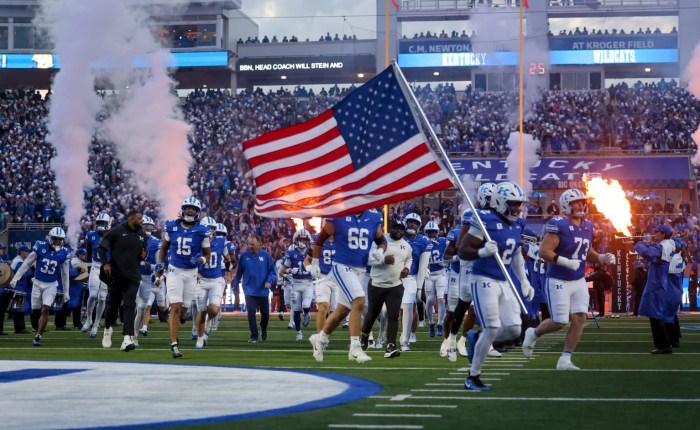
Shortly before kickoff against South Carolina, Kentucky’s first-year head coach told Tom Leach that his team had enjoyed a productive week of practice. The players were focused, their mindset was right, and everybody was ready to play.

Seventeen unanswered points later, I suggested on social media that the right mindset and focus must have missed the team bus. Perhaps they were still enjoying the complimentary hotel breakfast. Whatever the case, they certainly weren’t anywhere near Williams-Brice Stadium.

Apparently, they were just running late.

Kentucky 35, South Carolina 34 in overtime. It was the largest come-from-behind road victory in Kentucky football history, courtesy of a team that evidently believes the first quarter is optional and a fan base that has collectively exhausted its supply of blood pressure medication.

I’ve followed Kentucky football for more than half a century. I’ve witnessed enough heartbreaking losses to qualify for federal disaster assistance, watched promising seasons disappear faster than complimentary food in a press box, and spent countless Saturday evenings wondering why I continue subjecting myself to this particular form of recreational torture. So cut me some slack if I remain a tad bit cynical.

Just when I was ready to pronounce the patient dead, somebody brought out the defibrillator.

Kenny Minchey deserves a substantial portion of the credit. His final numbers won’t necessarily send Heisman voters scrambling for their ballots, but 28 completions in 41 attempts, 272 passing yards, and three touchdowns tell only part of the story. With the running game struggling to establish itself, Minchey had to help bring Kentucky back through the air.

And he had plenty of accomplices. Kenny Darby caught 12 passes for 96 yards and a touchdown, while Nic Anderson contributed five receptions for 80 yards and another score. Willie Rodriguez added five catches for 57 yards before delivering the two most important points of the afternoon.

With Kentucky’s comeback hanging in the balance, Rodriguez hauled in the decisive two-point conversion that turned a remarkable rally into a historic victory. Somewhere across the Commonwealth, grown men were hugging strangers, frightening household pets, and making promises to the Almighty that they’ll conveniently forget before next Sunday.

Will Stein called them his Comeback Cats. He also talked about a band of brothers, an expression I’ve generally associated with coaches who have run out of original material for their motivational speeches. But I’m beginning to believe him. This team has now demonstrated an unusual ability to absorb punishment and regroup without surrendering.

I’m not suggesting that spotting SEC opponents 17 points is a sustainable business model. In fact, I’d strongly recommend against it. But there is something rather intoxicating about watching a Kentucky football team refuse to accept the inevitable.

Which brings us to LSU.

A week ago, the Tigers’ upcoming visit might have inspired the usual combination of cautious optimism and gastrointestinal distress. Now I’m contemplating possibilities that would have seemed certifiably insane when South Carolina was running roughshod over Kentucky’s defense.

What if this team is actually good? What if Stein has assembled something special? What if the Wildcats can somehow defeat LSU and turn the remainder of this season into an extended celebration of everything we’ve spent decades believing Kentucky football could become?

Somebody confiscate my computer before I start researching College Football Playoff hotel accommodations.

Of course, there’s a rather significant difference between believing you can beat anybody and actually demonstrating that you can play four competent quarters against somebody. Kentucky has developed an impressive capacity for surviving adversity, but I’d prefer that the Wildcats occasionally experiment with avoiding it altogether.

Still, two extraordinary road victories over Texas A&M and South Carolina have changed the conversation. The dream that seemed so improbable when the season began is suddenly alive and well.

And if the Comeback Cats somehow knock off LSU next Saturday, I may have to reconsider my entire philosophy of Kentucky football.

Just one request, Coach.

Next time, please make sure the mindset and focus arrive before kickoff. My cardiologist and I would greatly appreciate it.

Dr. John Huang is a retired orthodontist, military veteran, and award-winning author. Currently serving as a columnist for Nolan Group Media, he invites readers to follow him on social media @KYHuangs. Explore his latest, Whining for Posterity, and all his books at Amazon.
The Power of the Power K

The Power of the Power K

I have never understood why a letter can make grown men emotional.

Then somebody puts a Power K on a Kentucky football helmet, and suddenly men my age start pining for a bygone era. Voices soften and eyes glaze over. Somebody inevitably says they ought to bring the darn thing back permanently.

Never mind that it is basically a K with another K hiding inside it. To Kentucky football fans of a certain vintage, it might as well be the family crest.

The Power K comes from a different Kentucky football world. There were no transfer portals, collectives, helmet communication systems, or $40 million rosters. Nobody spent the offseason wondering which five-star quarterback might be available for the right NIL package or which embattled head coach would ride off into the sunset with a ridiculous multi-million dollar buyout.

We spent it wondering whether we could beat Vanderbilt.

Sometimes we couldn’t.

This is important to understanding the Power K.

Kentucky basketball nostalgia is easy. You remember winning championships, raising banners, and attending Final Fours. You watched Goose Givens score 41 points in a national championship game, the Unforgettables nearly beating Duke, and Tony Delk raining threes. There is generally a trophy somewhere in the memory.

Kentucky football nostalgia requires considerably more imagination.

There were good teams, of course, great players, and memorable wins. There were a few seasons when Kentucky legitimately mattered nationally.

Derrick Ramsey quarterbacked one of them.

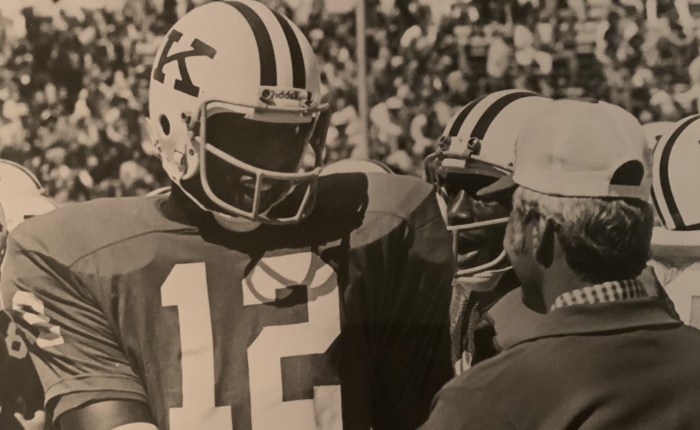
I had the privilege years later of helping Derrick tell his story in a book, and maybe that’s one reason the Power K hits me differently now. I don’t just see a logo when I look at those old pictures. I see Derrick wearing it. A kid from Hastings, Florida, who came to Kentucky via Camden, New Jersey, and ended up quarterbacking the Wildcats to a 10-1 season.

There he is in those old photographs, that Power K sitting on the side of his helmet.

Derrick was young, strong, and full of possibility.

Weren’t we all?

That’s the sneaky thing about nostalgia. We think we’re remembering football when we’re really remembering ourselves.

The Power K takes me back to Commonwealth Stadium before somebody decided stadium names should sound like supermarkets. It takes me back to parking in somebody’s yard, listening to Cawood on the radio, and believing every September that this might finally be the year.

Usually it wasn’t.

And still we came.

That’s the part younger Kentucky fans may never completely understand. Kentucky football did not require loyalty because it won. Kentucky football required loyalty because it was ours.

We sat through the losses. We froze our fannies off sitting directly on those cold metal bleachers in November. We watched Tennessee and Florida beat us in ways that occasionally violated several provisions of the Geneva Convention. We studied recruiting classes filled with players we’d never heard of and somehow convinced ourselves that half of them were underrated.

Then we came back the next Saturday. And the next year. And the year after that. Maybe that’s why an old K can do something that a slick new logo never will. Look at it long enough and you can almost see the people who used to sit beside you.

Your dad.

Your old college roommate.

The buddy who had the parking pass.

The guy who always brought the bourbon, purely for medicinal purposes.

You remember walking into Commonwealth Stadium together when the trees were turning and the air had that unmistakable October chill. You remember the band. The roar. The blue jerseys. The Power K flashing under the lights.

You remember thinking there would always be another Saturday.

There isn’t.

That’s what gets me now.

Derrick Ramsey is 20 years old forever in those photographs. Art Still is bearing down on another quarterback. Cawood is still behind the microphone. Commonwealth Stadium is still Commonwealth Stadium.

And somewhere in those stands is a younger version of me, with more hair and fewer worries, believing with absolutely no supporting evidence whatsoever that Kentucky is about to win.

I’d give a lot to sit next to that guy again.

Just for one Saturday.

So, yes, bring back the Power K whenever you want. Put it on the helmets. Paint it at midfield. Sell it on shirts to aging Kentucky fans who already own far too many Kentucky shirts.

We’ll buy another one. Because you’re not really selling us a logo. You’re selling us a ticket back.

And for just a moment, when that old Power K comes running out of the tunnel, we’re all young and carefree again.

Dr. John Huang is a retired orthodontist, military veteran, and award-winning author. He currently serves as a columnist for Nolan Group Media and invites readers to follow him on social media @KYHuangs. His latest book is Whining for Posterity, available on Amazon.

Because of Me?

Because of Me?

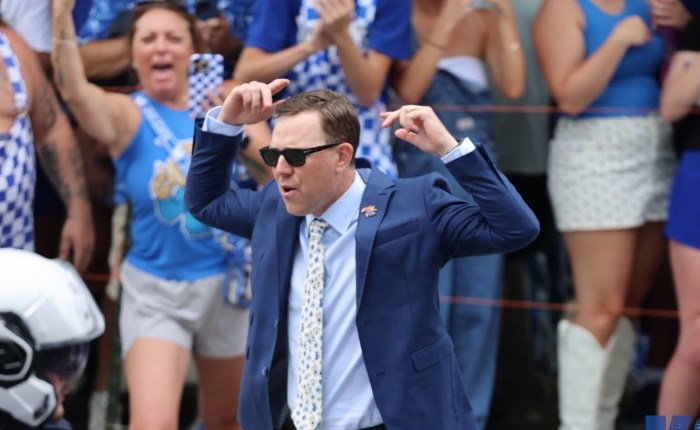
When Will Stein was asked at SEC Media Days why Kentucky football will succeed now after years of inconsistency, his answer wasn’t long.

“Because of me.”

That’s certainly one way to grab a headline.

My first reaction? I actually laughed.

My second reaction? I’m still not sure what to think.

On one hand, I appreciate confidence. You don’t become an SEC head coach by doubting yourself. If you don’t believe you’re the right person for the job, why should anyone else? Fans have spent years begging for coaches with swagger, vision, and the ability to convince recruits that Kentucky can compete with anyone.

Will Stein clearly believes all of that.

In today’s college football landscape, maybe he almost has to.

Coaches aren’t just coaches anymore. They’re CEOs, fundraisers, recruiters, salesmen, and motivational speakers rolled into one. Every microphone is another recruiting pitch. Every quote is designed for social media. Every appearance is another chance to create momentum.

Perhaps “Because of me” wasn’t really directed at reporters.

Perhaps it was directed at every high school recruit listening.

Still…

There is a fine line between confidence and arrogance.

Stein has already made comments suggesting that everyone wants to play for Will Stein. Now comes, “Because of me.”

At some point, the words begin to pile up.

And eventually, they demand results.

The Bible offers a timeless warning: “Pride goes before destruction, a haughty spirit before a fall.”

Those words weren’t written for football coaches, but they apply remarkably well. The higher you build yourself up publicly, the farther you have to fall if things don’t work out.

That’s what gives me pause.

Kentucky football doesn’t have the luxury of making bold proclamations without consequences. This isn’t Alabama. It isn’t Georgia. It isn’t Ohio State.

National audiences are already skeptical of Kentucky football. Many expect the Wildcats to finish somewhere in the middle or bottom of the SEC. Every confident sound bite becomes another receipt waiting to be pulled out if the season starts 2-3 or 3-4.

The internet never forgets. Neither do opposing fan bases. If Kentucky wins, Stein will look like a genius. If Kentucky struggles, those same quotes will be replayed endlessly. The memes practically write themselves.

That’s the risk.

Personally, I’ve always preferred coaches who let their teams do the talking.

Nick Saban rarely made games about himself. Mark Stoops built Kentucky largely by embracing an underdog mentality. Even Mark Pope, as energetic as he is, usually redirects praise toward his players, the program, or Big Blue Nation. Most coaches instinctively redirect the credit away from themselves.

Stein’s approach feels different.

More personal.

More confrontational.

More “watch me.”

Maybe that’s exactly what Kentucky needs.

Maybe the program has spent too many years trying to prove it belongs instead of acting like it already does. Confidence can be contagious. Players often reflect the personality of their coach. If Stein genuinely believes Kentucky is about to become something special, perhaps that belief spreads throughout the locker room.

I’d love nothing more than to look back in December and say his confidence was completely justified.

In fact, Kentucky fans should hope that’s exactly what happens.

Because if Stein backs up every word with victories, nobody will care how bold his quotes sounded in July.

Winning has a remarkable way of turning arrogance into leadership.

But until then, I’m reserving judgment.

Confidence is essential.

Cockiness is entertaining.

Results are everything.

One thing is certain: Will Stein has ensured that people are paying attention.

Now comes the hard part.

Living up to “Because of me.”

Dr. John Huang is a retired orthodontist, military veteran, and award-winning author. Currently serving as a columnist for Nolan Group Media, he invites readers to follow him on social media @KYHuangs. Explore his latest, Whining for Posterity, and all his books at Amazon.
Why Kentucky Didn’t Want Another Mitch Barnhart

Why Kentucky Didn’t Want Another Mitch Barnhart

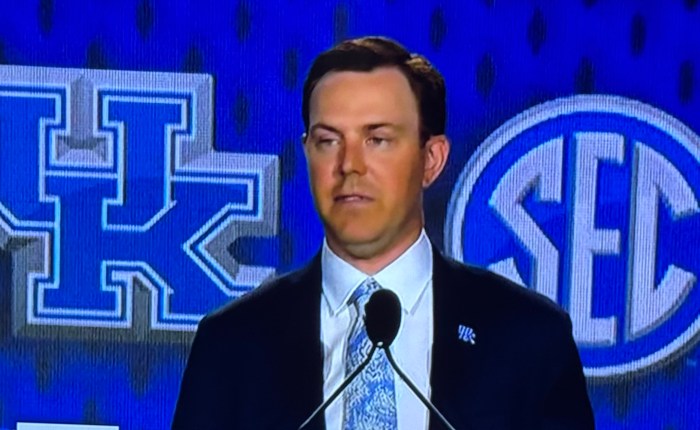
The easiest way to understand Kentucky’s hiring of J Batt is to stop thinking about Mitch Barnhart. In fact, the farther away you get from Mitch Barnhart, the closer you get to understanding why Kentucky made this hire.

That’s not criticism. It’s reality.

For twenty-three years, Mitch Barnhart was exactly what Kentucky needed. He was steady, measured, patient, and dependable—all necessary traits for the head honcho in charge.

If Mitch Barnhart were a vehicle, he would have been a Toyota Camry. He wasn’t flashy. He wasn’t loud. He wasn’t constantly reminding you how innovative he was. He simply started every morning and got you where you needed to go.

For more than two decades, that was a tremendous asset. The problem, however, isn’t that Barnhart changed. The problem is that college athletics did.

The world Mitch Barnhart mastered no longer exists.

When Barnhart arrived in Lexington, players couldn’t transfer freely. NIL wasn’t a thing. Revenue sharing wasn’t a thing. Athletic departments weren’t competing against professional franchises for attention. Nobody was discussing private equity investments in college sports. Most fans had never heard the words “collective” or “portal.”

Back then, an athletics director hired coaches, built facilities, balanced budgets, and tried not to make national headlines. Today? Today an athletics director needs to be part CEO, part fundraiser, part lawyer, part economist, part politician, and part crisis manager. Somewhere along the way, college athletics stopped being a department and became an industry.

That’s why Kentucky’s hiring of J Batt feels so significant.

Kentucky wasn’t looking for the next Mitch Barnhart.

Kentucky was looking for Mitch Barnhart’s opposite.

Again, that’s not an insult. It’s a recognition that the job description has fundamentally changed.

Barnhart represented stability. Mitch Barnhart ran Kentucky athletics the way your favorite small-town banker used to run a bank. He knew people. He remembered names. He understood that relationships mattered. You got the sense he could walk through a student-athlete dining hall and recognize half the room.

J Batt inherits a world where the athletics director is less small-town banker and more hedge fund manager. The challenge isn’t remembering everyone’s name. The challenge is making sure the balance sheet survives long enough for there to be a team wearing the jersey.

Barnhart spent years carefully building Kentucky athletics.

J Batt arrives at a time when the entire structure of college sports seems to change on a monthly basis.

One man was built for certainty.

The other was hired for chaos.

And make no mistake—chaos is exactly what college athletics has become. Schools are paying players. Players are changing schools. Conferences are expanding. Conferences are disappearing. Lawsuits are flying. Revenue-sharing models are being rewritten. Television contracts are driving decisions that would have seemed absurd a decade ago.

The sport isn’t evolving. It’s mutating. Which is why I find Kentucky’s hire so fascinating. The university didn’t simply replace an athletics director. It acknowledged reality.

For years, Kentucky’s greatest advantages were tradition, facilities, fan support, and resources. Those things still matter. But they no longer guarantee anything. Today, success depends on navigating a constantly shifting landscape where the rules seem to change faster than the scoreboards.

The modern athletics director isn’t simply protecting an institution. He’s repositioning it. That’s a different skill set. It’s also a different personality.

Mitch Barnhart always felt like a caretaker.

J Batt feels more like a venture capitalist.

One was entrusted with preserving what Kentucky had built.

The other is being asked to figure out what Kentucky must become.

Those are very different assignments. And that’s why this hire feels bigger than many fans realize.

Most people will judge J Batt by wins and losses. That’s understandable. Fans should care about wins and losses. But his biggest challenge may have nothing to do with scoreboards. His challenge is ensuring Kentucky remains Kentucky while college athletics transforms into something none of us fully recognize.

That’s not easy. In some ways, it’s impossible. Because the truth is that the college sports many of us grew up loving are already gone.

The amateur model is gone.

The old recruiting model is gone.

The old roster-building model is gone.

The old business model is gone.

What’s replacing them remains a work in progress.

Which brings us back to J Batt. Kentucky didn’t hire him because Mitch Barnhart failed. Kentucky hired him because the world Mitch Barnhart mastered disappeared.

The next decade won’t be about protecting the past. It will be about surviving the future.

And that may be the most important hire Kentucky has made in years.

Dr. John Huang is a retired orthodontist, military veteran, and award-winning author. He currently serves as a columnist for Nolan Group Media and invites readers to follow him on social media @KYHuangs. His latest book is Whining for Posterity, available on Amazon.

NIL, APR, and Other Fairy Tales

NIL, APR, and Other Fairy Tales

The University of Kentucky Athletic Department proudly announced this week that UK student-athletes achieved a combined 3.471 GPA this spring, marking the 28th straight semester above a 3.0.

Twenty-eight straight semesters. That’s a mark of unparalleled consistency.

The release was filled with impressive numbers. Four hundred fifty-nine athletes above a 3.0. One hundred thirty-six with perfect 4.0 GPAs. Volleyball leading the way with a staggering 3.865 GPA. Men’s basketball posting a sparkling 3.59. Football climbing above a 3.0. Eight teams earning perfect APR scores.

And honestly, those accomplishments deserve recognition. A lot of these athletes work incredibly hard balancing travel, practices, media obligations, workouts, NIL appearances, social media branding, and actual coursework. The academic support staffs deserve medals for somehow keeping all the trains running on time in an environment that increasingly resembles free agency with mascots.

Still, forgive me if I chuckled while reading the release.

Because while UK is celebrating APR scores and graduation rates, the rest of college athletics now operates like a bizarre hybrid of the NFL, Wall Street, and reality television. Revenue sharing has arrived with a vengeance. NIL collectives function like salary-cap departments. Boosters debate roster construction with the intensity of Fortune 500 executives discussing quarterly earnings. Coaches talk openly about roster retention costs while fans stalk transfer portal announcements like day traders watching stock tickers.

Yet every spring, universities still release these glowing academic reports with the warm sincerity of a church bulletin.

“At Kentucky, the educational mission remains central,” Mitch Barnhart said in the release.

And I actually believe he believes that. I do.

But the contrast is impossible to ignore.

One minute, fans are screaming online about the desperate need for a seven-foot rim protector who can defend ball screens and shoot 38 percent from three. The next minute, the university puts out an APR graphic like educational outcomes are all that matter.

That’s what makes modern college athletics such magnificent theater.

We’ve created a world where a freshman quarterback can earn more money before his sophomore year than several university professors combined, yet schools still expect us to become emotionally moved over cumulative GPA announcements.

Again, this isn’t anti-education. Quite the opposite. I still genuinely love universities. My family funds scholarships. I spent decades in healthcare and education-related environments. I’m one of the few media people who asks academically related questions and questions APR outcomes. I believe academics matter deeply.

Which is precisely why this whole charade fascinates me so much.

The NCAA still unveils APR scores every year with all the drama of sacred scripture being lowered from the mountaintop. The Academic Progress Rate remains one of those phrases that sounds incredibly important while simultaneously causing most fans’ eyes to glaze over instantly.

We all understand that the average fan is far more concerned about whether Kentucky has enough NIL money to keep a backup guard from transferring to Arkansas next Tuesday.

At this point, “student-athlete” feels less like a meaningful description and more like a nostalgic phrase from another era. Like “video rental store” or “collect call.”

I especially enjoyed seeing men’s basketball post a 3.59 GPA. A 3.59 at Kentucky, no less. That’s genuinely impressive considering half the fan base spent the offseason demanding more “dudes” and another year of eligibility for Otega Oweh.

The real heroes in all this may honestly be the academic counselors. Somewhere inside the Joe Craft Center, an exhausted advisor is probably trying to have a serious discussion about long-term educational development with a teenager whose NIL valuation already exceeds the salary of multiple associate professors combined. The fact those conversations happen with straight faces is one of the true miracles of modern college athletics.

And maybe that’s why these academic numbers feel so strange now. Not fake. Not meaningless. Just disconnected from what college sports has become.

A 3.471 GPA in the NIL and revenue-sharing era simply does not carry the same context it once did. Not with online coursework, massive institutional support systems, and billions of dollars floating around the enterprise. College athletics has evolved into a professional entertainment business carefully wrapped inside educational branding, and everybody involved knows it.

The schools know it.

The coaches know it.

The players know it.

The fans absolutely know it.

We just keep pretending otherwise because “student-athlete” sounds far more wholesome than “young entertainment employee with a Maserati and a meal plan.”

So yes, congratulations to UK Athletics. The accomplishments are real, and the work behind them deserves praise.

But every time I read one of these glowing academic press releases, I still can’t help but picture some wealthy booster proudly nodding at the 3.471 GPA announcement while simultaneously texting a collective representative:

“Wonderful. Now how much for that five-star offensive tackle?”

Dr. John Huang is a retired orthodontist, military veteran, and award-winning author. He currently serves as a columnist for Nolan Group Media and invites readers to follow him on social media @KYHuangs. His latest book is Whining for Posterity, available on Amazon.

The Scholarship Used to Be the Prize

The Scholarship Used to Be the Prize

(And Somewhere Along the Way, We Started Treating It Like a Coupon)

Let me get this out of the way early so nobody mistakes me for the guy yelling at clouds.

I know NIL is here to stay. I know players have always been paid. I know the system wasn’t pure, holy, or wrapped in a choir robe stitched by Sandy Bell in the UK Compliance office.

I’m not naïve. I’m just… disappointed. And there’s a difference.

Believe me, this isn’t about money. It’s about what money replaced.

Back in the day—cue the violin music, please—the scholarship was the prize. The scholarship was the golden ticket. It was the thing you earned, protected, and quietly understood could change the trajectory of your life.

Now? The sheepskin is an afterthought. A line item. Something you get thrown in after the collective wires the cash.

Wake up everyone! College sports didn’t just evolve. It inverted.

Players used to come to Kentucky for the name on the front of the jersey and hope—pray, even—that one day the name on the back might matter. Now the name on the back is everything, and the front is just a temporary billboard.

We’ve turned student-athletes into short-term mercenaries, and then we act surprised when loyalty evaporates faster than Vince Marrow’s blue wardrobe.

Again, I’m not anti-player. I’m anti-illusion. College sports has become all smoke and mirrors.

What bothers me isn’t that athletes are making money. It’s that we’ve somehow convinced them—and ourselves—that money is the point, not the fruit of hard-earned labor. We’ve normalized entitlement at warp speed. It no longer happens over multiple years of eligibilty. It’s now bestowed instantly.

A freshman hasn’t played a minute and already knows his “market value.” He doesn’t ask, How can I grow here? He asks, What’s my next leverage point? That’s not empowerment. That’s living one transaction at a time.

And the collateral damage of this lunacy? The college education—the very thing that was supposed to be the great equalizer—has been reduced to background noise.

Let me offer a confession from a man who looks suspiciously like a retired orthodontist with opinions.

My education made me rich. Not Warren Buffet-rich. Not even NIL-rich. But life-rich. It gave me a profession. It gave me options. It gave me the ability to fail and pivot and fail again without falling through the floorboards of society.

My college education wasn’t just about attending classes. It rewarded me with time—time to grow up, mess up, learn accountability, and figure out who I was when nobody was handing me a check. Let it be known that no booster ever Venmo’d me for showing up to Biology 101.

Now we’re telling kids—explicitly and implicitly—that education is optional, temporary, and secondary to their “brand.” That’s not progress. That’s negligent at best—and destructive at worst.

Here’s the part nobody wants to say out loud: If the scholarship no longer matters, the university no longer matters. And if the university no longer matters, then college sports becomes minor-league professional sports without contracts, guardrails, or accountability.

Which is exactly where we’re headed.

You can’t build culture on one-year leases.
You can’t preach loyalty while negotiating exits.
You can’t sell tradition to people shopping for the next upgrade.

And you certainly can’t pretend the system will hold when the foundation—education itself—has been hollowed out. When the value of the scholarship is cheapened, the value of the institution crumbles. When institutions crumble, so does the illusion that this was ever about anything more than money. And when the illusion dies, so does the sport we thought we loved.

I still watch. I still care. I still write. I still hope—perhaps foolishly—that the pendulum swings back toward balance instead of breaking loose entirely.

But make no mistake: this is doomsday not because athletes are getting paid—but because we’ve taught them that nothing else is worth valuing.

And when education becomes optional, everything downstream collapses. I don’t want to go backward. I want us to remember what was worth protecting as we move forward.

Happy New Year!
Now, please excuse me while I go ice my knee, check my blood pressure, and remind myself I’m not yelling at clouds.

I’m yelling at the future—because I still care about it.

This article was originally written for distribution through Nolan Group Media publications.
Dr. John Huang is a retired orthodontist, military veteran, and award-winning author. Currently serving as a columnist for Nolan Group Media, he invites readers to follow him on social media @KYHuangs. Explore his latest, Whining For Posterity, and all his books at Amazon.
In Stoops We Trust (Whether You Like It or Not)

In Stoops We Trust (Whether You Like It or Not)

(LEXINGTON, Ky.) – Funny how one Saturday can change the entire temperature of the Bluegrass. Just a week ago, half of Big Blue Nation was ready to pack Mark Stoops’ bags for him. With Kentucky’s huge 38-7 victory over Florida on Saturday night, the path to bowl eligibility now becomes a whole lot clearer. Suddenly, the same folks who wanted Stoops’ head on a platter are out shopping for “In Stoops We Trust” T-shirts.

That’s life in the SEC—one minute you’re an overpaid underachiever, the next you’re the savior of the Commonwealth. But whether you were cheering Stoops before Florida or rediscovering your faith afterward, one thing remains constant: the man deserves to stay. Not because of one big win, but because of the foundation he’s built and the culture he’s created.

Let’s face it, the honeymoon was long over before tonight. The flowers had wilted, the champagne went flat, and the marriage between Mark Stoops and Big Blue Nation felt more like a 25-year-old couch—no longer comfortable, visibly soiled, and sagging in all the wrong places.

Everywhere you turned, folks were hollering for divorce. Social media was ablaze with “Fire Stoops” hashtags. Radio hosts were frothing at the mouth and ready to kick him to the curb and swipe right on someone—anyone—new.

Well, not anymore, my friend. Before we stick that “For Sale” sign in Stoops’ front yard, let’s take a deep breath, pour ourselves a glass of Kentucky bourbon, and think this through with a little perspective—and a dash of sanity.

For one, let’s talk dollars and sense. That buyout? Thirty-seven. Million. Dollars. That’s not a typo. That’s not Monopoly money. That kind of cash could fund an entire NIL war chest and keep Cutter Boley grinning for the next couple of years.

And let’s not forget history. Mark Stoops is the winningest coach in Kentucky football history. Think about that. More wins than Bear Bryant during his Kentucky days. More wins than Fran Curci, Jerry Claiborne, or Rich Brooks combined (well, close enough for rhetorical effect). Sure, some of those wins came against glorified high schools disguised as non-conference opponents, but they still count in the record book—and on the paycheck.

People forget how bleak it was before Stoops. Joker Phillips limped out the door with the fanbase howling. The program was a punchline, a perennial cellar dweller where bowl games were as rare as John Calipari NCAA wins post Covid. Stoops changed that. He brought stability. He brought hope. He brought swagger. And yes, he even brought us a ten-win season—twice! That’s not stale; that’s historic.

Now, I get it. Things felt stagnant the past couple of years. The offense sputtered forever, the defense gave up too many big plays, and the postgame pressers all sounded like reruns of Groundhog Day. Stoops kept saying, “We’ll clean it up; get back to work.” But it started feeling like the same spilled milk being mopped up year after year.

But let me ask the question that haunts every program stuck in the “fire him” cycle: Who you gonna get that’s better?

Seriously. Who?

Nick Saban’s busy counting his retirement checks. Kirby Smart’s not walking through that door. Urban Meyer? Please—he couldn’t even handle Jacksonville. And as much as people want to throw out names like Jon Sumrall or Will Stein, let’s pump the brakes. Sumrall’s a fine coach, but running Tulane isn’t the same as running an SEC program with boosters, egos, and ESPN cameras breathing down your neck. And Will Stein? He’s got promise, sure—but he’s barely had time to unpack at Oregon. Handing him the keys to Kentucky football right now would be like giving a 16-year-old your trusted Mercedes and hoping for the best.

Coaching transitions are messy. You could just as easily end up with the next hot coordinator who flames out in two seasons, leaving us all longing for the good ol’ days when Stoops at least got us to the Music City Bowl.

And here’s something people overlook: his players still believe in him. They play hard. They don’t quit. Even when the scoreboard turns ugly, they fight to the end. That’s not nothing. That’s culture—culture that Mark Stoops built brick by brick. You can’t fake that, and you certainly can’t buy it with NIL money. Remember when Kentucky teams used to fold faster than a lawn chair at a tailgate? Not anymore. This group—his group—competes, cares, and represents the program with pride. They don’t flinch. That’s his real legacy.

What Stoops provides—whether fans admit it or not—is stability. And in the volatile world of college football, stability is the rarest commodity. It’s not sexy. It’s not flashy. But it’s the bedrock on which long-term success is built. Programs like Iowa, Wisconsin, and Kansas State built entire identities on stability. They don’t panic after a bad season. They reload, recalibrate, and keep grinding.

And that’s what Stoops does best. He grinds. He builds men, not just football players. He develops two-star recruits into NFL draft picks. He preaches accountability, loyalty, and hard work. Those aren’t buzzwords; they’re virtues—spiritual ones, even.

Maybe that’s what this whole debate boils down to. We’ve lost our patience in a world of instant gratification. We want quick fixes, shiny new toys, and miracle seasons. But life—like faith—isn’t about the quick fix. It’s about perseverance through the dry spells. It’s about trust.

The Bible says in Galatians 6:9, “Let us not grow weary in doing good, for in due season we will reap, if we do not give up.” That’s not just good theology—it’s good football philosophy. Stoops has been sowing seeds in rocky soil for over a decade. He’s weathered storms, endured heartbreaks, and still kept this program relevant. That’s not a man you throw away. That’s a man you stand by.

So before you call the moving truck, Big Blue Nation, remember: the grass isn’t always bluer on the other side. Sometimes, the real victory is learning to bloom where you’re planted.

And if you don’t like that spiritual analogy, fine—think of it this way: $37 million buys a lot of forgiveness.

This article was originally written for distribution through Nolan Group Media publications.

Dr. John Huang is a retired orthodontist, military veteran, and award-winning author. Currently serving as a columnist for Nolan Group Media, he invites readers to follow him on social media @KYHuangs. Explore his latest, “Whining For Posterity,” and all his books at https://www.Amazon.com/stores/Dr.-John-Huang/author/B092RKJBRD

“Name, Image, and Mayhem: Kentucky’s NIL Cliffhanger”

“Name, Image, and Mayhem: Kentucky’s NIL Cliffhanger”

I’ll be the first to admit—I’m confused. Especially when listening to University of Kentucky Athletics Director Mitch Barnhart talk circles around himself.

In his interview with Matt Jones of Kentucky Sports Radio earlier today, Barnhart assured all the loyal BBN listeners that, even within this new landscape of college athletics, not only will UK not be cutting any sports, but he’s confident the university will be able to fund any new upcoming revenue share amounts.

Those are shockingly bold statements. The obvious retort is: How does Mitch know?

Because just moments earlier while addressing the media, Barnhart refused to disclose any specifics about the revenue sharing amounts, citing the “uncertainty” and “fluidity” of the entire new world order.

“We’re in the first month of this thing,” Barnhart told a roomful of attentive scribes thirsting after his every word. “Literally the first month. For anybody to sit in front of a group and say, ‘I’ve got all the answers after four weeks,’ good for you, good for you. I mean, we’ve talked about a decade’s worth of change that has happened in the last six to ten months of college athletics.”

“The change that has occurred has been massive,” he continued. “We don’t even have a governance structure in place really, to be honest with you.”  

I always knew college athletics was a cutthroat business. That’s why I titled my debut novel Name, Image, and Murder. It was a fictional whodunit loosely based on the chaotic new world of NIL—the Wild Wild West of amateur sports gone pro. But I’m starting to think fiction might be safer than what’s actually brewing behind the scenes in Lexington.

You see, the same school that gave us Adolph Rupp, Dan Issel, Anthony Davis, and eight national championships is now poised at the crossroads of an athletic identity crisis. Do we leverage our exalted status as the greatest tradition in college basketball? Or do we bow before the almighty dollar in a noble attempt to keep all our boats floating? NIL has officially graduated from “name, image, and likeness” to “nobody is listening”—at least when it comes to making choices regarding long-term sustainability.

And now, with the recent House v. NCAA settlement ushering in the brave new world of revenue sharing, UK Athletics is walking a tightrope strung between Rupp Arena, Kroger Field, Memorial Coliseum, and Kentucky Proud Park.

On paper, the new rules sound reasonable. Schools can now pay players directly—up to $20.5 million a year in shared revenue. Kentucky has fully committed to this model, even creating a snazzy new LLC called Champions Blue. Sounds like a superhero franchise, right? Champions Blue! Defenders of BBN! As technically a nonprofit organization, I’m not sure what to make of it. Cynics might call it a financial shell game that makes Enron look like Little League bookkeeping.

Here’s the problem. Paying players is expensive. Kentucky projects a $31 million deficit next year, even after slashing perks, borrowing from the university, and shaking every couch cushion from Pikeville to Paducah. And with the bulk of revenue earmarked for men’s basketball and football, you can kiss some non-revenue sports goodbye faster than a 2-seed getting bounced by Saint Peter’s—regardless of what Mitch promises.

But wait, there’s more! Earlier reports citing multiple reliable sources claim UK is devoting 45% of its revenue-sharing budget directly to Mark Pope’s team. Even though Mark Stoops debunked that statement as “absolutely untrue,” many won’t believe him. This is, after all, a basketball school. Except when the football team has ten-win seasons. Or when the volleyball team is hoisting SEC banners. Or when someone on the rifle squad or track team wins Olympic gold. You know, the other student-athletes, who apparently don’t get to eat from the same buffet.

That’s where the danger lies. Not in the fairness of it all—college athletics has never been fair—but in the fragility of it.

What happens when Title IX lawyers come knocking, wondering why the women’s soccer team is using 1997 cleats while the men’s basketball team is taking private flights to Maui (yes, remember Maui)? What happens when boosters get bored with writing six-figure checks for backups who never leave the bench? What happens when ticket prices go up again to cover costs, and the average fan can’t afford to sit in the rafters without taking out a second mortgage?

What happens when your favorite in-state walk-on is replaced by a five-star diva who’s demanding an exorbitant NIL deal, a YouTube series, and three coveted parking spaces on campus?

This is not just a UK problem. This is an everywhere problem. But here in the Bluegrass, where we measure time in Final Fours and football tailgates, we feel the tremors more than most. It’s hard to build “La Familia” when everyone’s negotiating like La Cosa Nostra.

And don’t get me wrong—I’m not anti-athlete. I’m all for players getting their fair slice of the billion-dollar pie. But when the pie crust is crumbling and the recipe keeps changing, it’s hard to know whether we’re baking a dynasty or our athletics director is just blowing hot air.

Champions Blue may turn out to be a genius model. Or it may be a cautionary tale studied by future ADs with degrees in both sports management and disaster response. In either case, the margin for error is thinner than Mitch Barnhart’s top button.

As for me, I’m thinking about writing a sequel. Name, Image, and Mayhem: The NIL Strikes Back. It’ll feature a fictional blue-blood program that tried to buy its way to the top, only to realize it couldn’t afford loyalty, chemistry, or the next contract buyout. Spoiler alert: the villain isn’t the athlete, the booster, or the NCAA.

It’s the system. A system we all helped create. A system now careening down a one-way road where amateurism is dead, loyalty is negotiable, and tradition is mocked and poo-pooed.

So buckle up, BBN. The real madness isn’t in March anymore. It’s happening right now—behind closed doors, in budget meetings, where the stakes are higher than a last-second Aaron Harrison three-point bomb.

May God have mercy on us all.


Dr. John Huang is a retired orthodontist, military veteran, and award-winning author of Name, Image, and Murder. He serves as a reporter and columnist for Nolan Group Media. Follow him @KYHuangs on social media and find his books, including the soon-to-be-bestselling Whining for Posterity, here: https://www.Amazon.com/stores/Dr.-John-Huang/author/B092RKJBRD

Cats’ Meow: Ole Miss Smackdown

Cats’ Meow: Ole Miss Smackdown

Dane Key (career-high eight catches for 105 yards) and Barion Brown (five catches for 88 yards) celebrate one of the most improbable upsets in Kentucky Football history. Photo Credit: Tres Terrell / Cats Coverage.

(ATLANTA, Ga.) – If you happened to hear some loud meowing coming from Oxford, Mississippi, this past Saturday, you weren’t mistaken. No, it wasn’t a new strain of southern Mississippi feline infestation—it was the Kentucky Wildcats who went prowling deep into Rebel territory and left with a purr-fectly thrilling 20-17 victory. And just like that, Big Blue Nation experienced the kind of upset that gives SEC elite sleepless nights and Wildcat fans reason to crowd surf and burn couches the rest of the week.

Okay, I have to come clean. I didn’t see the game. In fact, I couldn’t even keep up with it in real time. Ah, the joys of modern air travel. There I was, soaring above the clouds, trying to connect to the internet with the same desperation Mark Stoops mustered calling a 4th-and-7 deep in his own territory. My Wi-Fi was about as reliable as a Tennessee fan’s manners, buffering at every crucial moment. But even from 30,000 feet, the excitement of Kentucky’s monumental upset win over No. 6 Ole Miss somehow seeped through, giving me one of my top football fan moments of all time. I still think that Florida upset from a few years back was the biggest (I was there in person for that magical three-decade streak-buster). But this one—even in abstentia—comes in hot on its heels.

Rebel Yell Turned to Rebel Yawn

Here’s what I pieced together from my lofty perch in seat 16E. The stage was set for a party at the Grove. Ole Miss, the high-flying, swaggering Rebels, rolled in undefeated at 4-0, daring anyone to slow them down. They led the nation in scoring, they led in defense, they led in just about everything except humility—and let’s be honest, who needs that in football? But the Cats, sitting at a less-than-flashy 3-2, came to crash the party, with quarterback Brock Vandagriff in the starring role.

What Ole Miss hadn’t counted on was a night filled with bizarre twists and turns. The first possession went according to script with the Rebels slicing downfield like a hot knife through butter for a 7 – 0 lead. For Wildcat fans, this one was turning ugly early. But Vandagriff, who had previously been allergic to hot starts, responded in kind by leading Kentucky down the field on the Cats’ first possession, and what do you know? Points! A field goal to kick things off—a small victory that had many in BBN saying, “Not so fast, my friend.”

Kentucky’s Big Bet Pays Off

The rest of the game proceeded like a chess match, except Mark Stoops decided to channel his inner Lane Kiffin and go all riverboat gambler. With just over two minutes to go and the Cats facing 4th-and-7 from their own 20-yard line, Stoops said, “Why play it safe?” No more “Captain Conservative” label—he called the play to let it fly. Vandagriff did just that, connecting with Barion Brown on a stunning 63-yard bomb. A heave, a prayer, and suddenly, Kentucky had an opening.

Barion Brown—speedster extraordinaire—ran like he was tired of jet sweeps and with that one electrifying fly pattern, he set up the winning touchdown. Tight end Josh Kattus, atoning for a couple of previously dropped passes, grabbed a fumbled loose ball at the two-yard line and lunged into the end zone. It wasn’t exactly what you’d call textbook offense, but as every Kentucky fan knows, beauty in football is in the eye of the scoreboard.

Defense, Deliveries, and Desperation

Pay Brad White whatever he wants. The Rebels came into this matchup thinking they’d walk all over Kentucky, but instead, they got smacked in the mouth by a Wildcats defense that wasn’t having any of it. Octavious Oxendine roared like his namesake in the trenches, recording two huge sacks and living in the Rebels’ backfield rent-free. Then there was JQ Hardaway—he didn’t just come to play, he came to make life miserable for every Rebel who dared cross him, setting a career-high 11 tackles, and yes, forcing a fumble too. Deone Walker was Deone Walker—enough said.

Ole Miss was punting left and right, which is something they’re just not used to doing. Kentucky forced five punts on a team that had only punted four times in their previous four games combined. Can anyone say three-and out?

And speaking of kicking, there was Kentucky’s kicker Alex Raynor—Mr. Automatic—who’s quickly turning Kentucky into Field Goal U. Two more field goals extended his streak to a school-record 14 straight. Somewhere in the Bluegrass, Austin MacGinnis must have been raising a glass in salute.

Clutch Cats Close It Out

The game-winning drive had all the trappings of Kentucky drama—close calls, fumbles, and sheer, unfiltered joy. Kattus’ recovery and dive into the end zone with 2:25 left in regulation was the exclamation point. The kind of sentence that said, “Hell, yeah. Eat this, all you doubters who sold your season tickets after the South Carolina loss!” But with Ole Miss still breathing, it was J.J. Weaver, forever a fan-favorite and all-around game-wrecker, who had the final word, sacking Jaxson Dart and effectively shutting the door on Ole Miss’s hopes of a last-minute miracle. Their last-ditch field goal attempt shanked embarrassingly wide, and Vaught-Hemingway Stadium fell into a stunned silence—the same stunned silence pouring out from the heart of Athens when a Kirby Smart-coached defensive juggernaut falls behind by four touchdowns.

History and Context, Whimsical and Wild

This was Kentucky’s first win at Ole Miss since the glory days of 1978. You heard that right—disco, polyester, and a young Mark Stoops with plenty of hair and no pot belly. Now, some forty-six years later, Stoops orchestrated his magnum opus—beating a sixth-ranked Ole Miss squad in their own house when nobody gave him a chance. It was Kentucky’s highest-ranked road win at an SEC campus stadium ever. Not at No. 10 Vanderbilt in 1947, and not even over No. 1 Ole Miss in Jackson in 1964—it’s this one. And for Mark Stoops, who’s now in his 12th year and building a statue one giant win at a time, this was his 12th-ranked victory, his highest yet, and perhaps his most whimsical of all.

The critics may say Stoops can’t win the big one, but if upsetting No. 6 Ole Miss on the road isn’t a big one, what is? Since 2018, Kentucky is 12-16 against AP-ranked teams—not the kind of record that gets engraved in marble, but for a program once synonymous with SEC cellar-dwelling, it’s nothing short of a revelation.

Enjoy it Cat fans.

I’m still flying above the clouds.

Dr. John Huang is a retired orthodontist, military veteran, and award-winning author. He currently serves as a columnist for Nolan Group Media. You can follow him on social media @KYHuangs and check out his debut novel—“Name, Image, and Murder”—and all his books at https://www.Amazon.com/stores/Dr.-John-Huang/author/B092RKJBRD

This post appeared first as a column for Nolan Group Media publications.