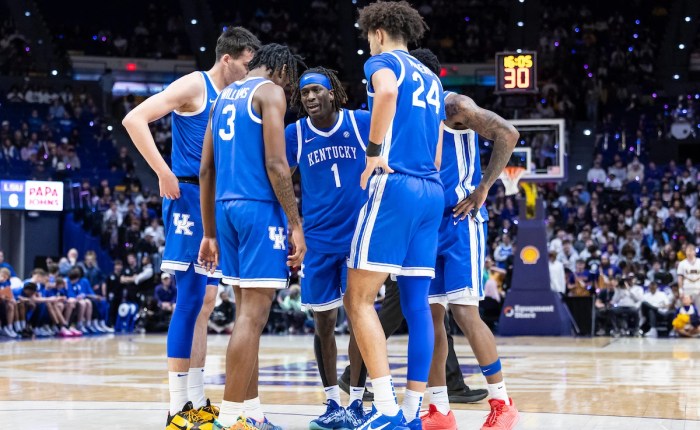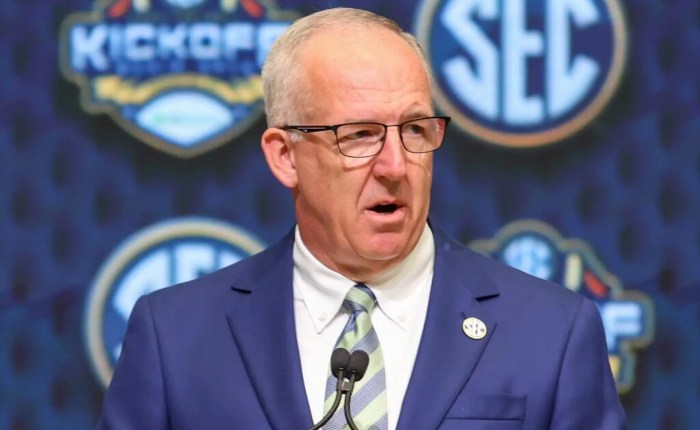
Greg Sankey, pictured at the SEC media day in July. Photo Credit: Jordan Godfree / Imagn Images
J. Batt has had a pretty good honeymoon.
Since arriving at Kentucky, the new athletics director has talked about listening to fans, improving their experience, and positioning the Wildcats to compete at the highest level. He has opened doors. Now we may find out whether he’s willing to kick one down.
Because Mark Mitchell’s eligibility has suddenly become about something much bigger than whether Kentucky adds another talented basketball player. It’s about power. And Greg Sankey and the SEC have plenty of it.
According to CBS Sports’ Matt Norlander, SEC presidents have reaffirmed conference rules that could prevent Mitchell from playing for Kentucky this season. Mitchell played at Missouri last year but didn’t enter the transfer portal during the spring window.
There’s a pretty good reason for that. He wasn’t eligible. Mitchell had exhausted his eligibility after four seasons of college basketball. There was no reason to enter the portal because, as far as everyone knew, there wasn’t another college season to play.
Then everything changed.
Mitchell and other players challenged the NCAA’s eligibility rules in court. A Jefferson County judge granted a temporary restraining order allowing Mitchell to pursue a fifth season. He entered the portal, committed to Kentucky, and suddenly Mark Pope had another experienced piece for a roster with championship aspirations.
Enter the SEC. According to Norlander, Mitchell is believed to fall under the SEC’s prohibition on intraconference transfers because he didn’t enter the portal during the designated window.
Rules are rules. Except when complying with them requires a time machine. How exactly was Mitchell supposed to enter the portal in April for a fifth season that didn’t exist? Unless Doc Brown and a DeLorean are somewhere in Kentucky’s NIL budget, I’m not sure how that was supposed to work.
That’s the question Kentucky should be asking forcefully.
The timing couldn’t be more interesting.
The SEC also just adopted severe penalties in a separate but related eligibility battle for schools that roster athletes who previously signed professional contracts or declared for professional drafts without properly withdrawing. Those penalties reportedly can include a half-season suspension for the head coach, massive financial penalties, and even the loss of conference voting privileges.
That’s not a slap on the wrist. That’s Sankey walking into the room carrying a sledgehammer.
There’s a reason for it.
The NCAA has spent years getting pummeled in court. Every time college sports’ governing bodies draw another line around amateurism, somebody seems to find a judge willing to erase it.
So the SEC is trying something different. Instead of punishing the player, punish the school. Make the consequences painful enough and nobody will dare test the rule.
That’s clever. Whether it survives a legal challenge is another matter. More immediately, we’ll see whether Kentucky is willing to push back.
This is where Batt comes in.
Batt’s early months have included plenty of popular decisions. Better concessions. More fan engagement. Open practices. Even an invitation for aging media members to risk orthopedic surgery playing basketball.
I’ve applauded all of it.
This, on the other hand, is different.
Kentucky isn’t fighting the NCAA from some distant outpost. It’s potentially challenging its own conference and arguably the most powerful commissioner in college athletics.
And Kentucky isn’t merely a victim of SEC governance, either. It’s a member. Its president sits at the same table as everybody else’s. The conference’s rules are ultimately the product of its own institutions.
That makes this situation complicated. It also makes it fascinating.
I’m not suggesting Kentucky should recklessly throw Mitchell onto the floor and dare Sankey to suspend Mark Pope.
There’s a difference between courage and stupidity.
But Kentucky should fight every reasonable fight for him.
Ask for the waiver. Challenge the interpretation. Support Mitchell’s legal efforts where appropriate. Make the SEC explain why a player should be punished for missing a deadline he had no conceivable reason to meet.
And if those avenues fail?
Then Batt has a decision to make.
Because there will be other Mark Mitchells. College athletics is changing too rapidly for there not to be. Courts will rule. Players will sue. Conferences will respond. Rules written six months earlier will collide with circumstances nobody anticipated.
Somebody eventually will discover exactly where the SEC’s authority ends. Kentucky doesn’t necessarily need to volunteer to be the guinea pig. LSU appears perfectly willing to handle that assignment. But Kentucky shouldn’t run from the laboratory, either.
Batt has spent his first few months telling Big Blue Nation that Kentucky intends to think bigger.
Good.
Here’s his chance.
Welcome to the SEC, J. Batt. Greg Sankey would like a word. Something tells me this meeting won’t be about concession prices.
Dr. John Huang is a retired orthodontist, military veteran, and award-winning author. He currently serves as a columnist for Nolan Group Media and invites readers to follow him on social media @KYHuangs. His latest book is Whining for Posterity, available on Amazon.