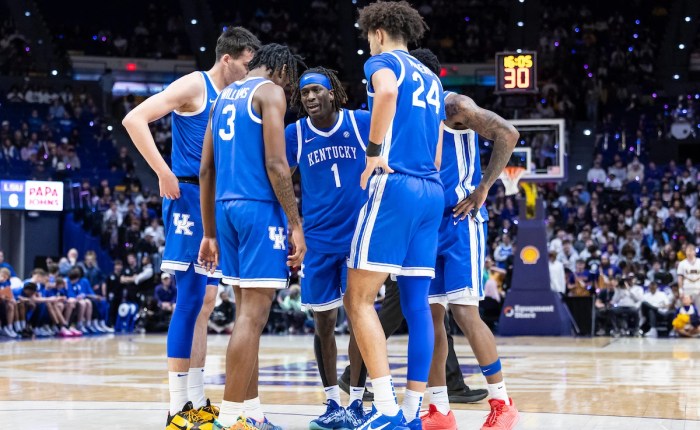
“Name, Image, and Mayhem: Kentucky’s NIL Cliffhanger”

“Name, Image, and Mayhem: Kentucky’s NIL Cliffhanger”

I’ll be the first to admit—I’m confused. Especially when listening to University of Kentucky Athletics Director Mitch Barnhart talk circles around himself.

In his interview with Matt Jones of Kentucky Sports Radio earlier today, Barnhart assured all the loyal BBN listeners that, even within this new landscape of college athletics, not only will UK not be cutting any sports, but he’s confident the university will be able to fund any new upcoming revenue share amounts.

Those are shockingly bold statements. The obvious retort is: How does Mitch know?

Because just moments earlier while addressing the media, Barnhart refused to disclose any specifics about the revenue sharing amounts, citing the “uncertainty” and “fluidity” of the entire new world order.

“We’re in the first month of this thing,” Barnhart told a roomful of attentive scribes thirsting after his every word. “Literally the first month. For anybody to sit in front of a group and say, ‘I’ve got all the answers after four weeks,’ good for you, good for you. I mean, we’ve talked about a decade’s worth of change that has happened in the last six to ten months of college athletics.”

“The change that has occurred has been massive,” he continued. “We don’t even have a governance structure in place really, to be honest with you.”  

I always knew college athletics was a cutthroat business. That’s why I titled my debut novel Name, Image, and Murder. It was a fictional whodunit loosely based on the chaotic new world of NIL—the Wild Wild West of amateur sports gone pro. But I’m starting to think fiction might be safer than what’s actually brewing behind the scenes in Lexington.

You see, the same school that gave us Adolph Rupp, Dan Issel, Anthony Davis, and eight national championships is now poised at the crossroads of an athletic identity crisis. Do we leverage our exalted status as the greatest tradition in college basketball? Or do we bow before the almighty dollar in a noble attempt to keep all our boats floating? NIL has officially graduated from “name, image, and likeness” to “nobody is listening”—at least when it comes to making choices regarding long-term sustainability.

And now, with the recent House v. NCAA settlement ushering in the brave new world of revenue sharing, UK Athletics is walking a tightrope strung between Rupp Arena, Kroger Field, Memorial Coliseum, and Kentucky Proud Park.

On paper, the new rules sound reasonable. Schools can now pay players directly—up to $20.5 million a year in shared revenue. Kentucky has fully committed to this model, even creating a snazzy new LLC called Champions Blue. Sounds like a superhero franchise, right? Champions Blue! Defenders of BBN! As technically a nonprofit organization, I’m not sure what to make of it. Cynics might call it a financial shell game that makes Enron look like Little League bookkeeping.

Here’s the problem. Paying players is expensive. Kentucky projects a $31 million deficit next year, even after slashing perks, borrowing from the university, and shaking every couch cushion from Pikeville to Paducah. And with the bulk of revenue earmarked for men’s basketball and football, you can kiss some non-revenue sports goodbye faster than a 2-seed getting bounced by Saint Peter’s—regardless of what Mitch promises.

But wait, there’s more! Earlier reports citing multiple reliable sources claim UK is devoting 45% of its revenue-sharing budget directly to Mark Pope’s team. Even though Mark Stoops debunked that statement as “absolutely untrue,” many won’t believe him. This is, after all, a basketball school. Except when the football team has ten-win seasons. Or when the volleyball team is hoisting SEC banners. Or when someone on the rifle squad or track team wins Olympic gold. You know, the other student-athletes, who apparently don’t get to eat from the same buffet.

That’s where the danger lies. Not in the fairness of it all—college athletics has never been fair—but in the fragility of it.

What happens when Title IX lawyers come knocking, wondering why the women’s soccer team is using 1997 cleats while the men’s basketball team is taking private flights to Maui (yes, remember Maui)? What happens when boosters get bored with writing six-figure checks for backups who never leave the bench? What happens when ticket prices go up again to cover costs, and the average fan can’t afford to sit in the rafters without taking out a second mortgage?

What happens when your favorite in-state walk-on is replaced by a five-star diva who’s demanding an exorbitant NIL deal, a YouTube series, and three coveted parking spaces on campus?

This is not just a UK problem. This is an everywhere problem. But here in the Bluegrass, where we measure time in Final Fours and football tailgates, we feel the tremors more than most. It’s hard to build “La Familia” when everyone’s negotiating like La Cosa Nostra.

And don’t get me wrong—I’m not anti-athlete. I’m all for players getting their fair slice of the billion-dollar pie. But when the pie crust is crumbling and the recipe keeps changing, it’s hard to know whether we’re baking a dynasty or our athletics director is just blowing hot air.

Champions Blue may turn out to be a genius model. Or it may be a cautionary tale studied by future ADs with degrees in both sports management and disaster response. In either case, the margin for error is thinner than Mitch Barnhart’s top button.

As for me, I’m thinking about writing a sequel. Name, Image, and Mayhem: The NIL Strikes Back. It’ll feature a fictional blue-blood program that tried to buy its way to the top, only to realize it couldn’t afford loyalty, chemistry, or the next contract buyout. Spoiler alert: the villain isn’t the athlete, the booster, or the NCAA.

It’s the system. A system we all helped create. A system now careening down a one-way road where amateurism is dead, loyalty is negotiable, and tradition is mocked and poo-pooed.

So buckle up, BBN. The real madness isn’t in March anymore. It’s happening right now—behind closed doors, in budget meetings, where the stakes are higher than a last-second Aaron Harrison three-point bomb.

May God have mercy on us all.


Dr. John Huang is a retired orthodontist, military veteran, and award-winning author of Name, Image, and Murder. He serves as a reporter and columnist for Nolan Group Media. Follow him @KYHuangs on social media and find his books, including the soon-to-be-bestselling Whining for Posterity, here: https://www.Amazon.com/stores/Dr.-John-Huang/author/B092RKJBRD

Let Freedom Ring

Let Freedom Ring

I first penned this essay back in April of 2019. It still remains one of my favorite pieces. Happy Birthday, America!

Final Four? I don’t care. I guess I’m a sore loser. The minute Kentucky gets eliminated in the NCAA tournament, I just want to get as far away from basketball as possible. In 2017, right after UNC’s Luke Maye sent the Wildcats prematurely packing, I immediately started packing for my own trip to Turks and Caicos. When Kansas State upset the Big Blue a year later, I booked the first flight out for the Florida Gulf Coast. In 2019, unfortunately, I headed out early again—to someplace far away from Minneapolis, where I could put overtime losses to Bruce Pearl completely out of sight and out of mind.

You see, less than twenty-four hours after returning from the disappointment in Kansas City, I was stuffing my suitcase for Washington, DC. I’ve been there many times over the course of my lifetime, but never while the cherry blossoms were in full bloom. I was killing two birds with one stone on this trip—making my wife happy and NOT watching basketball during the first weekend in April.

Ah, the memories came flooding back. My first visit to our nation’s capital was with my mom and dad back in the mid-1960s. As newly minted, starry-eyed, first-generation immigrants from China, my parents wanted to show firsthand—to their number one son—the sights and symbols representing their personal pursuit of the American dream. Where better than Washington, DC, where founding fathers and freedom fighters named Washington, Jefferson, and Abraham Lincoln stood sentinel over democracy? Granted, I was only six years old at the time, but something deep down inside of me still resonated with this Land of Opportunity. Even back then, the inalienable rights of life, liberty, and the pursuit of happiness sounded pretty darned good to me.

I returned to DC again in the early 1980s, this time as a recent college graduate, indoctrinated with the liberal agenda and misguided cynicism flowing out of all university campuses. The city had a different vibe for me this time around. Thoughts of American imperialism, social injustice, and racial inequality sadly replaced the wide-eyed innocence of my earlier visit. With malice towards none; charity for all suddenly became a slogan that pipedreams were made of. Not going to happen in this America, I surmised at the time.

I returned to Washington again in the early 1990s, a thirty-something professional with a beautiful wife and one-year-old daughter in tow. Ten years in the military with a stint living overseas, and my thoughts on America had changed. The good ole’ USA was now all about capitalism—making a buck, keeping up with the Joneses, and paying off your mortgage. To me, DC represented all that was worth striving for—the money of the Federal Reserve, the power on Capitol Hill, and the status of the West Wing. I have a dream. It was a different dream than Dr. Martin Luther King had, but it was my dream, nonetheless.

And now, nearly three decades later, I’m back again—armed with a lifetime of experiences and a bucketload of supposedly new wisdom. It’s somewhat bittersweet. My mom has since passed, my daughter is all grown up, and I’ve been retired and put out to pasture. On a beautiful sunny weekday morning, I stroll leisurely along the National Mall, with plenty of time to ruminate about life’s regrets, growing old, and what America has meant to me.

Over a half a century as a naturalized American citizen gives me a perspective grounded mostly in gratitude. I’m grateful for many things—a fine education, access to health care, and languorous walks with my dog. But as I pause in front of all the different war memorials, I realize that the thing I’m mostly grateful for in America is freedom. Freedom to speak, write, gather, and worship as I choose. The United States of America still has its faults, but in terms of individual freedom, it remains the greatest nation on the face of the earth.

Walking up the steps of the Jefferson Memorial, I’m reminded that with freedom comes responsibility. Freedom isn’t free. Many have died fighting for it. “May we think of freedom, not as the right to do as we please, but as the opportunity to do what is right.” (author unknown)

Our Founding Fathers got it right in the beginning. “We hold these truths to be self-evident: that all men are created equal, that they are endowed by their Creator with certain inalienable rights, among these are life, liberty, and the pursuit of happiness…” May Washington, DC, remain forever a bastion of liberty and a beacon for democracy. Let freedom ring!

By the way, the cherry blossoms were beautiful in April. My wife is happy. Final Four? Who does Duke play again?

Dr. John Huang is a retired orthodontist, military veteran, and award-winning author. Currently serving as a columnist for Nolan Group Media, he invites readers to follow him on social media @KYHuangs. If you enjoy his writing, please check out his newest book, “Whining for Posterity,” available here: https://www.amazon.com/dp/B0FDLCGR1P

The Top Five Reasons NOT to Buy My Book

The Top Five Reasons NOT to Buy My Book

Let’s face it. We’re all inundated these days—with political propaganda, fast food coupons, and suspicious texts warning that your bank account’s been compromised. So when a washed-up orthodontist-turned-sportswriter announces his eighth book, your first instinct might be to mutter “bless his heart,” roll your eyes, and scroll on by.

But before you do, allow me—with all the humility I can muster—to present:

The Top Five Reasons NOT to Buy My New Book, Whining for Posterity: Life, Sports, and Other Things Worth Complaining About


Reason #5: You’ve Already Heard It All Before

Fair. At least the five people outside my immediate family who’ve read all my blogs, chuckled at my columns, and survived a few of my Facebook rants might think so. You know who you are.

You’re thinking, “I don’t need a bound compilation of recycled material cluttering up my coffee table.”

Touché. But this is the director’s cut. Whining for Posterity includes never-before-seen edits, timely updates, and slightly embarrassing bonus reflections by yours truly—organized into tidy little categories like “Life,” “Love,” “Politics,” “Religion,” “Travel,” and “Sports.”

Skip the spiritual stuff. Go straight to the football whining if that’s your thing. I won’t be offended.


Reason #4: You Don’t Like Complaining

Neither do I. That’s why I wrote a whole book about it.

Let me clarify: this isn’t just me griping about the Bengals’ play-calling or America’s healthcare system. It’s an honest, often humorous, occasionally heartfelt look at the little frustrations of life—and the big lessons hiding behind them.

Think of it as therapy, but with fewer co-pays and more Rick Pitino references.


Reason #3: You’re Holding Out for the Movie

Ah yes, the inevitable blockbuster. Picture it: Jackie Chan as me, Meryl Streep as my long-suffering editor, and John Calipari making a surprise cameo as himself.

Sadly, Hollywood hasn’t called. Yet.

So for now, your only option is to read the book. Don’t worry—it’s got plot twists, emotional payoffs, and enough laugh-out-loud moments to keep even the most distracted reader engaged. There’s something in it for everyone.

Best of all? It’s cheaper than a bucket of overpriced movie popcorn.


Reason #2: You Think I’m Just Trying to Make a Buck

Please. I’m a writer. If I wanted to make money, I’d still be straightening teeth.

Truth is, I’m donating all the proceeds from this book to charity. Not because I’m a saint—but because YOU are. Plus, I’d rather give the money away than explain to the IRS why I spent it all on road trips with the Wildcats.

So when you buy Whining for Posterity, you’re not just supporting me. You’re supporting a good cause—and giving yourself (or someone you’re regifting it to) a few laughs, a few tears, and maybe even a fresh perspective on this maddening miracle we call life.


Reason #1: You’d Rather Read John Grisham

Who wouldn’t? I’m no John Grisham.

But here’s the truth: Whining for Posterity isn’t a legal thriller. Nor is it just a collection of gripes and giggles. It’s a scrapbook of moments—some hilarious, some heartfelt—that remind us what really matters. Relationships. Family. Faith. Our dogs. The everyday absurdities that make life worth living.

At some point, we all start thinking about what we’re leaving behind. Not money or monuments, but memories, stories, and maybe a few lessons others can carry forward.

This book is my way of doing that. A little piece of my voice—whiny as it is—preserved for whoever wants to listen.

So no, you don’t have to read it. But if you do, I hope it makes you think a little more about your own legacy—the one you’re writing every day, whether you realize it or not.

Because whining, at its core, is just love in disguise. A love that refuses to let life pass by unnoticed.


So there you have it. Five completely legitimate, totally reasonable, utterly unconvincing reasons not to buy my book.

But if, despite all that, you feel compelled to grab a copy of Whining for Posterity, I won’t stop you. In fact, I’m thanking you now in advance. Flag me down and I’ll sign it for you—maybe even buy you lunch, or at the very least, offer a heartfelt “bless your heart.”

Whining for Posterity—available now on Amazon and wherever books silently judge you from your nightstand. Click here to purchase. https://www.amazon.com/dp/B0FDLCGR1P

#WhiningForPosterity
#BuyItAnyway
#ComplainingWithPurpose

The Things You Do on Vacation That You’d Never Do at Home: A Spanish Confession

The Things You Do on Vacation That You’d Never Do at Home: A Spanish Confession

There are things I do on vacation that I’d never—ever—do at home.

Like walking 30,000 steps a day without even realizing it. Or eating a double scoop of gelato twice a day for ten straight days. Or running through the streets of Madrid at sunrise, pretending I’m training for the Running of the Bulls—when in reality, I just needed to justify that fourth tapa.

Spain does something to a man.

It started in Mallorca—an island paradise where even the olives and goat cheese just taste different. I landed there with noble intentions: journal my thoughts like Hemingway, observe the culture like a wise old soul, eat modestly. By day two, I was fully converted to Spanish vacation mode: buying pastries like the new Publix just opened, napping like it was my birthright, and ordering churros with chocolate just to feel like I belonged.

From Mallorca, it was on to Seville, where the sun is hot (107 degrees hot), the flamenco is hotter, and I began living life by the empanada. In Seville, I discovered that eating tapas isn’t just about food—it’s a philosophy. A way of sampling life one delicious, questionably healthy bite at a time.

On a day trip to Córdoba, I strolled through the Mezquita in silence, pretending I was a thoughtful wanderer like old Papa Hemingway himself. What would Ernest have written about these mosaic arches and quiet courtyards? Probably something deep and tragic. I mostly just thought about lunch.

Then it was on to Granada—by train, of course. Because in Spain, trains aren’t just a mode of transportation; they’re a way of life. Smooth, punctual, and entirely unintelligible if you don’t speak the language. I spent much of my time staring at the departure board like it was the Rosetta Stone, my high school Spanish offering little consolation to my malfunctioning Google Translate app.

In Granada, the Alhambra ruins made me feel both very small and very blessed. The detail! The history! The surrounding view! The stairs! So many stairs.

By the time we arrived in Madrid, my legs were numb, my stomach perpetually full, and my heart wide open. Madrid is a city that moves—fast, loud, bold—but also knows how to slow down for a three-hour dinner and a midnight stroll. I woke early to run through the streets, dodging pigeons and pastelerías, attempting to sweat out last night’s chorizo.

And honestly? Running the streets is still the best way to get to know a city. In a strange land where I don’t speak the language and every corner holds something unexpected—a street musician, a café, a cathedral—I feel like I can run forever. Untethered. Without a care or thought for the burdens awaiting me back home.

And that’s the magic of it. The freedom. The permission to be someone different for a little while. Slowing down. Listening more. Laughing freely. Being present.

But the best part? The part that no amount of tapas, gelato, or flamenco shows could match?

I got to travel with my daughter. How many old geezers get to spend two whole weeks traipsing the Iberian Peninsula alone with their precious little girl?

Katie’s all grown now—wise, worldly, and entirely too fluent in the ways of train travel and Google Maps. She led the way through alleyways and marketplaces, museums and miradores. She handled the bookings, translated the menus, and reminded me gently (but persistently) to wear sunscreen.

But most importantly, she shared herself. We talked about life and faith and food. We watched sunsets and street performers and people from every corner of the globe. And in those quiet moments between destinations, I saw glimpses of who she’s become—and maybe, just maybe, she saw me as a dad she’ll still always look up to.

So yes, I do things on vacation I would never do at home.

And maybe that’s the point.

Because when you step out of your routine, off your turf, and into a world where you don’t know the language or the rules or what’s in your soup, you also step into possibility. Into wonder. Into grace.

And if you’re lucky—really lucky—you step into memories that will stay with you forever.


Dr. John Huang is a retired orthodontist, military veteran, and award-winning author. Currently serving as a columnist for Nolan Group Media, he invites readers to follow him on social media @KYHuangs. His newest book, Whining for Posterity, releases on July 1.

The Big Dog Defects: Loyalty Goes to the Dogs

The Big Dog Defects: Loyalty Goes to the Dogs

They say dogs are man’s best friend. They’re loyal to a fault and faithful to the end. But what happens when the Big Dog himself starts sniffing around another yard and decides the grass really is greener over in the Commonwealth’s least fashionable zip code?

Yes, Vince Marrow—Kentucky’s own gravelly voiced, Fritos munching recruiting wizard, tight ends coach extraordinaire, sideline spiritual advisor, and Mark Stoops’ trusty right-hand man—has defected to the enemy. And not just any enemy, mind you, but to Louisville. As in “Loo-a-vul.” As in red. As in the sworn arch-nemesis of all things blue and righteous. When I first heard the news, I didn’t know whether to weep, rage, or give Vince the one-finger salute on the way out.

For a dozen years, Big Dog barked loud and proud in Lexington. He wagged his tail at five-stars, howled with joy after bowl wins, and lifted the recruiting ceiling on a program that used to feast solely on moral victories and the occasional MAC pretender. Alongside Stoops, he turned UK Football into a respectable—and sometimes even feared—SEC contender. And now? Now he’s swapping out his blue windbreaker for a pair of Cardinal-red socks? Say it ain’t so, Vince.

To most of BBN, this is more than just a coaching move. This is betrayal at a Shakespearean level. This is Brutus plunging the knife into Caesar’s back or Larry Bird donning purple and gold.

Now before you tell me this is “just business,” spare me. That’s what everyone says nowadays. “It’s a business decision,” they mutter, as they pull up roots, ghost their friends, break their commitments, and leave their spouses for yoga instructors named Skyler. Somewhere along the way, loyalty became a punchline—something to scoff at, like Blockbuster Video or landline phones.

Marrow leaving Kentucky isn’t just a loss for Stoops. It’s a snapshot of society’s frayed relational fabric. Once upon a time, people stayed in one place, built deep roots, and grew old beside their neighbors and colleagues. These days, folks are constantly chasing “what’s next.” A few more dollars. A better title. More retweets. Less accountability. Like mice on a merry-go-round, we leap from opportunity to opportunity, always certain the next nut will be bigger and shinier.

Remember when a man’s word was his bond? When you could shake hands on something and actually mean it? I imagine Stoops and Marrow once made pacts in the bowels of Commonwealth Stadium. Pacts sealed not in ink, but in late-night film sessions and on recruiting trips to the barren fields of Ohio. You don’t just walk away from that history without leaving some blood on the blackboard.

Of course, I get it. Coaches leave. Programs evolve. People need to feed their families. Vince is free to make his own choices, just like I was free to leave my orthodontic practice to write books that don’t sell. Only Vince and Stoops really know what went on behind the scenes.

But can’t we still mourn the loss of something deeper? The erosion of loyalty. The death of staying power. The idea that you stick with your people—even when the wins are sparse and the haters are loud.

What hurts most is that we thought Vince was different. He wasn’t just a coach—he was our coach. He loved Big Blue Nation. He talked about “La Familia.” He posed with babies in Kroger parking lots. He always hinted that he’d “never wear red.” But you know how that goes—just ask Judas. Or LeBron. Or that youth pastor who used to lead worship and now sells crystals in Sedona.

And of all places… Louisville? That’s like Batman leaving Gotham to join the Joker’s henchmen. It’s like Colonel Sanders opening a Raising Cane’s. I fully expect Vince to start flashing the “L’s Up” and waxing poetic about the urban charm of the Gene Snyder Freeway.

So, what do we long-suffering UK football fans do now?

Well, we grieve. We rage. We write impassioned blog posts with overwrought metaphors. We take a HUGE breath…and then we go back to rooting for the name on the front of the jersey. Because at the end of the day, loyalty may be dying—but we don’t have to be part of the kill squad.

Let’s be loyal to our teams. To our friends. To our families. To our churches, our communities, and yes—even to the coaches who leave us for a shinier gig across enemy lines.

Maybe—just maybe—if we all doubled down on loyalty in our own little spheres, then someday, someone like Vince Marrow might actually stay.

But until then, let me make one thing perfectly clear: I will never, ever cheer for Louisville. Not for a player. Not for a coach. Not for a charity dunk contest versus Duke. Not even if Vince himself buys 500 copies of my newest book, Whining for Posterity, and hands them out at a Cardinal tailgate.

Because some of us still believe in loyalty. Even when the Big Dog runs away.

Dr. John Huang is a retired orthodontist, military veteran, and award-winning author. Currently serving as a columnist for Nolan Group Media, he invites readers to follow him on social media @KYHuangs. Explore his debut novel— “Name, Image, and Murder”—and all his books at https://www.Amazon.com/stores/Dr.-John-Huang/author/B092RKJBRD

From Omaha to Oh-Crap: Is this the Beginning of the End?

From Omaha to Oh-Crap: Is this the Beginning of the End?

(We all hoped at the time that Kentucky’s appearance at last year’s College World Series would become a watershed moment in UK Athletics.)

I’m not sure exactly when it happened. Maybe it was while I was loading up on barbecue brisket and burnt ends in Omaha last June. Or perhaps it was during that rare moment of peace when the volleyball team swept another conference foe and all felt right with the world. But somewhere along the way, I started to believe that Kentucky Athletics had turned a corner.

We weren’t just a basketball school anymore. We weren’t even just a basketball and football school. We had become a full-on athletic juggernaut. A Director’s Cup darling. A holistic haven of sporting excellence. We won national championships in Volleyball and Rifle. We fielded top-tier teams in Tennis, Gymnastics, and Soccer. We had superheroes like Sydney McLaughlin and Abby Steiner running Track.  And—oh yes—we made it to Omaha, the mythical mountaintop of college baseball, for the very first time.

That’s why Kentucky’s brutal season-ending defeat to West Virginia last night had me reaching for the Xanax. The Cats blew two five-run leads and lost 13 – 12 to the Mountaineers in the NCAA regional finals. If last year was a mountaintop moment, this year felt like hanging on to the ledge with one sweaty hand.

Now I know what you’re thinking. “John, chill out. We made the tournament. Coach Nick Mingione took a roster with thirty new players, fought through a rash of injuries, and survived one of the nation’s most difficult schedules to come within three wins of a return to Omaha.”

Sure, I get it. If it weren’t for bad luck, the Cats wouldn’t have any luck at all. In just this one season, the team lost 12 one-run ballgames for god’s sake. But let’s not gloss over the cold, hard fact that Kentucky Baseball finished just three rungs from the bottom of the conference ladder. That 13th place SEC finish makes you wonder if last year’s ascent was a fluke more than a foundation. In fact, is Kentucky’s decades-long ascension up the ladder of SEC respectability across all its sporting programs also entirely a fluke?

In an era where there’s so much speculation about trimming budgets and cutting out “minor” sports, that’s certainly a question worth pondering.

Let’s take a quick look at the 2024 – 25 conference standings that I pulled directly off the Southeastern Conference website, shall we? Kentucky’s rank among all our SEC brethren is probably lower than you realized.

  • Volleyball: 1st (okay, we’re off to a hot start. Go, Coach Skinner.)
  • Women’s Basketball: T4 (Kudos also to Coach Kenny Brooks in his first year at the helm.)
  • Men’s Basketball: 6 (What used to be a disaster, we now consider respectable.)
  • Gymnastics: 6 (meh)
  • Women’s Soccer: 8 (meh)
  • Women’s Outdoor Track & Field: 8 (meh)

Not bad so far, but now things drop quicker than Stoops’ offense on 3rd and 12.

  • Men’s Tennis: T8 (disappointing, especially after the previous championship near misses.)
  • Men’s Swimming & Diving: 9 (disappointing)
  • Women’s Indoor Track & Field: 10 (disappointing)
  • Men’s Cross Country: 10 (disappointing)
  • Women’s Tennis: 11 (disappointing)
  • Women’s Swimming & Diving: 11 (disappointing)
  • Women’s Golf: 11 (disappointing)
  • Men’s Indoor Track & Field: 12 (disappointing)
  • Men’s Outdoor Track & Field: 13 (disappointing)
  • Baseball: 13 (devastating)
  • Softball: 13 (devastating)
  • Football: 15 (disastrous)
  • Women’s Cross Country: 15 (disastrous)
  • Men’s Golf: 15 (disastrous)

Ladies and gentlemen, we’ve got a problem. Those results are concerning to me.

Look, I’m not just a sports fan. I’m a University of Kentucky sports fan. A proud, hopelessly devoted disciple of all things Blue and White. I watch Women’s Golf on the SEC Network. I know how many meters are in a 4×400 relay. I can name two people on the Tennis team without Googling. This is personal.

So, what in the name of Mitch Barnhart is going on?

We can’t blame COVID. That ship sailed a couple of years ago. And don’t go pointing fingers at NIL either. Every other SEC school is playing under the same unspoken “pay to play” rulebook. We’ve got the resources. We’ve got the facilities. We’ve got the best fans in the world. Coaching salaries? Let’s just say nobody’s clipping coupons. We give $100K raises to O-line coaches without batting an eye. So why do we suddenly look like we’re fielding club teams in a conference of powerhouses?

Could it be complacency? Bad luck? Poor hiring? Is it that Native American burial ground supposedly hidden under Kroger Field exacting revenge? Or maybe it’s just the cyclical nature of sports and our turn in the barrel has finally come (remember, even Tennessee and Florida sucked at football for a few years). I’m hoping it’s just a temporary blip.

Whatever the reason, it’s scary that the trend may not be our friend. We’re turning into Vanderbilt without the brains.

Feel free to whine and lament. The stark reality is that UK Athletics is simply not where we were a decade ago. A football team that won bowl games. A basketball team that hadn’t yet lost to Saint Peter’s. A damn good softball team. Life was good.

But now? Now we’re in danger of becoming the Power Five equivalent of a mid-major. Scrappy. Somewhat respectable. Occasionally dangerous—but mostly just hanging around. Maybe IT IS THE MONEY and the lack of big donors and corporate sponsorships after all.

I’m not trying to be overly dramatic. (Okay, maybe a little bit.) But when you love something as much as I love Kentucky sports, it’s hard not to mourn when it starts slipping away. And while I’ll always be proud of our athletes and grateful for the moments of magic they still provide, I can’t help but feel like the era of across-the-board Big Blue brilliance is in the rearview mirror.

Maybe Mark Pope resurrects the magic on the hardwood. Perhaps the football team surprises us all. Maybe…just maybe…Coach Skinner reloads and saves the day.

Or maybe, a boatload of NIL cash drops directly into our laps like manna from heaven.

We can always dream, can’t we?

Dr. John Huang is a retired orthodontist, military veteran, and award-winning author. Currently serving as a columnist for Nolan Group Media, he invites readers to follow him on social media @KYHuangs. Explore his debut novel— “Name, Image, and Murder”—and all his books at https://www.Amazon.com/stores/Dr.-John-Huang/author/B092RKJBRD

It Still Means Something”: Why the Kentucky Brand Isn’t Just a Jersey

It Still Means Something”: Why the Kentucky Brand Isn’t Just a Jersey

Kentucky players celebrating the name on the front of the jersey after their big 106-100 win over the eventual national champion, Florida Gators, in Rupp Arena on January 4, 2025.

(LEXINGTON, Ky.) – In an era where players are more likely to follow Benjamins than banners, where “NIL” has replaced “MVP” in the recruiting wars, and where the transfer portal spins faster than my dog doing zoomies, one might wonder—Does the name on the front of the jersey still matter anymore?

At his recent media conference held earlier this week, Kentucky Basketball head coach Mark Pope answered that question with a resounding, heartfelt yes. And this wasn’t just your typical lukewarm head nod. No, this was the type of yes that gives you chills. The kind that makes you want to lace up your Nikes, high five your portly neighbor, and run through the proverbial brick wall.

“It matters,” Pope said. “There’s nowhere like this.”

He’s not wrong. Kentucky Basketball isn’t just a brand. It’s the program with the greatest tradition in the history of the game. It’s a baptism together with a rite of passage wrapped up in eight NCAA championship banners, 61 NCAA Tournament appearances, and the most all-time wins of anybody still playing. It’s Joe B. and Jamal. It’s Wah Wah and Wall. It’s five national championships in five different decades and a fanbase that will passionately defend the honor of Farmer, Pelphrey, Feldhaus, and Woods like they’re…well…Unforgettable.

But in this new wild west of college hoops—where loyalty is traded for luxury and bluebloods can be outbid by programs with booster billionaires—it’s fair to ask: Does Kentucky still hold sway with this new generation of coddled, roundball mercenaries raised on highlight reels and endorsement deals?

Pope thinks it does. Scratch that—he knows it does. And surprise, surprise—his answer isn’t only about tradition for tradition’s sake. It’s about transformation, character, work ethic, and servant leadership. About what happens when you willingly pour yourself into something bigger.

“If you come in here not understanding or appreciating that,” Pope warns, “I think your chances of success are not very high.”

That’s not gatekeeping. That’s the gospel according to the Pope.

Because this place is different. It asks more of you. More than just your wingspan or your vertical or your TikTok follower count. It demands your heart. Your humility. Your willingness to dive for loose balls, to play through bruises, to pass up a good shot for a great one. To give your teammate the limelight just because he’s your teammate. It demands that you surrender just a little piece of yourself—not to lose your identity, but to elevate it.

And that’s where the magic happens.

“When you learn that concept—of if I give a little bit of myself, it actually elevates myself—that’s what’s great about this beautiful, brilliant team sport of basketball,” Pope said. “The pathway to become immortal is very different than this world wants to teach us.”

Mic. Drop.

Yes, kids today are soft. There, I said it. Many may be distracted by the siren song of short-term riches. But Pope isn’t recruiting kids who just want a wheelbarrow full of cash. He’s recruiting young men who want to matter and make a difference. Who’ll leave legacy footprints in the bluegrass that echo through the rafters long after they’re gone. People like Issel, and Goose, and Macy, and Walker, and Davis.

Think about it: Where else can you become immortal at the ripe age of nineteen? Where else does a walk-on get a standing ovation just for checking in? Where else can you go from obscurity to legendary in a single March weekend? Where can you be known simply for sporting a unibrow, girls kissing your car bumper, or wearing jorts for heaven’s sake?

That’s not marketing fluff put together by the suits at JMI. That’s lived experience. That’s legacy. And it’s now being passed down from generation to generation.

“Our guys last season set a beautiful, brilliant standard of what it means to be a Kentucky Basketball player,” Pope said. “We’re leaning on them a lot… their video, their outtakes, their clips, their comments—just to help understand that.”

Because—as former coach John Calipari famously said on so many occasions—Kentucky isn’t for everyone. And that’s precisely the point.

You can go be a great basketball player at a lot of places. Pope knows that. Heck, he’s played and coached in a few of them. But being great here? That’s a different kind of great. That’s statue-worthy great. That’s raise-your-jersey-to-the-rafters great. That’s can’t-walk-through-Kroger-without-grandma-taking-a-selfie great.

So yes, the name on the back may earn you the check. But the name on the front? That’s what earns you the chapter in Kentucky lore.

Mark Pope gets it. He lived it. And now, he’s preaching it. Loudly. Passionately. With a blend of fire and sincerity that makes you believe Kentucky Basketball hasn’t lost its way after all. It’s just waiting for the right kind of player to find theirs.

Because for all the bells, whistles, dollar signs, and distractions of this modern basketball age, one truth remains: This place is different.

And if you can understand that?

You’re going to be crazy successful.

Or immortal.

That’s the gospel truth. Sign me up, Coach!

Dr. John Huang is a retired orthodontist, military veteran, and award-winning author. Currently serving as a columnist for Nolan Group Media, he invites readers to follow him on social media @KYHuangs. Explore his debut novel— “Name, Image, and Murder”—and all his books at https://www.Amazon.com/stores/Dr.-John-Huang/author/B092RKJBRD

This blog posting was first submitted as a column for Nolan Group Media publications.

If Baseball is Serious About Redemption, It’s Time to Crown Pete Rose as King

If Baseball is Serious About Redemption, It’s Time to Crown Pete Rose as King

(Sports Illustrated Photo)

Peter Edward Rose.

The Hit King.

The man who slid headfirst into first base because walking just wasn’t in his DNA.

News broke today that MLB Commissioner Rob Manfred removed Pete Rose and other deceased players from Major League Baseball’s permanently ineligible list. Manfred ruled that MLB’s punishment of banned individuals ends upon their deaths. The last I checked, Pete Rose remains six feet under—so by Manfred’s own decree, he’s finally eligible for Cooperstown.

Rose, one of my childhood heroes, collected 4,256 hits, won three batting titles, three World Series rings, and played every position but hot dog vendor. He was Charlie Hustle—baseball’s blue-collar avatar. The guy you wanted on your team in a bar fight or a bench-clearing brawl or at the plate with two out in the ninth with the winning runs on base. Unfortunately, he also bet on the ponies. And the Reds. And possibly on anything else, including whether the Riverfront Stadium concession stands would run out of nachos by the seventh inning.

Yes, Pete Rose gambled on baseball. And for that, he was banned for life. But he didn’t throw games. He didn’t tank innings. He didn’t call in a reliever from the bullpen with a suspicious limp and a 12.93 ERA. He bet on his own team to win—which, while monumentally dumb, isn’t quite the moral apocalypse it’s made out to be.

Was it wrong? Sure.

Was it worthy of a lifetime ban? Definitely not.

Because now with Manfred’s ruling, you know exactly what that means.

It’s time. Actually—strike that—it’s long past time.

Past time to dust off the bronze. Past time to start etching the plaque. Past time to make some room in Cooperstown next to Cobb, Ruth, Aaron, and Mays—for the man who collected more hits than any of them.

If Manfred’s decree is to be taken seriously—that punishment dies with the punished—then baseball can no longer hide behind moral outrage or outdated grudges. Pete Rose’s on-field résumé demands recognition. His posthumous eligibility eliminates the last bureaucratic hurdle. There are no more excuses.

So now the ball is in the Hall of Fame’s court.

Do the writers, historians, and voters have the courage to admit that greatness is often messy? That a flawed man can still be the best hitter the game has ever seen? If anyone is without sin, then let him be the first to throw a stone.

Sure, Pete gambled. But he also played harder than anyone who ever put on a uniform. He sprinted to first on walks. He plowed headfirst into Ray Fosse at an All-Star game for God’s sake. He turned every double into a triple if you weren’t paying attention.

Pete Rose embodied baseball. He played like the world was ending every inning. When I yell at my nephew to “hustle out of the box,” I’m quoting Pete Rose theology.

And now that he’s gone, maybe the game can finally appreciate him without the baggage.

Because here’s the truth: You don’t get to rewrite baseball’s story without Pete Rose in the pages. And if you wait much longer to put him in the Hall, you’ll lose the little credibility you have left.

Baseball loses a little bit of itself every year it pretends the Hit King didn’t exist.

Let’s stop pretending. Let’s stop punishing the dead. Let’s let Pete in.

It’s not just overdue.

It’s poetic.

Dr. John Huang is a retired orthodontist, military veteran, and award-winning author. Currently serving as a columnist for Nolan Group Media, he invites readers to follow him on social media @KYHuangs. Explore his debut novel— “Name, Image, and Murder”—and all his books at https://www.Amazon.com/stores/Dr.-John-Huang/author/B092RKJBRD

Don’t You Dare Trash Our UK Degrees

Don’t You Dare Trash Our UK Degrees

Today was a big day.

My nephew, Griffin Shively, walked across the stage at the University of Kentucky commencement ceremonies. Not only did he officially extend the growing line of Huang Family academic nerds, but he also followed in the hallowed footsteps of my dear old dad with a coveted engineering degree. Needless to say, the whole family is quite proud of Griffin.

There’s been a lot of talk over the years about the value of a college education—especially one from the University of Kentucky. As someone who spent eleven years chasing after a bachelor’s, master’s, and doctorate degree from my beloved alma mater, I feel uniquely qualified to set the record straight.

Remember when former Wake Forest center Olivier Sarr was considering a transfer to Kentucky? Demon Deacon head coach Steve Forbes started a firestorm by posing the question, “Why would you want to go to Wake for three years and then graduate from a place like Kentucky?”

Of course, Forbes was just trying to be cute…and I thought his quip was humorous. Unfortunately, it just wasn’t true.

During my decade in the military, I worked side by side with individuals with degrees from all different institutions of higher learning, and I’ll put my UK diplomas up against any of theirs. My education at the University of Kentucky served me as well or better than anything Wake Forest, Duke, or any of the Ivy League schools could dish up for that matter. When you throw in the value my parents received for in-state tuition, an argument could be made that I finished head and shoulders above any of those elitist snobs.

For athletes headed for professional glory, where they get their degrees really won’t matter. After all, they’ve got their sights set on that lucrative NBA or NFL contract. But for the rest of us—for the hardworking students and student-athletes who graduated this week—that University of Kentucky degree represents years of sweat equity and life-changing opportunity.

In the high-profile college sports of basketball and football, the value of an athletic scholarship frequently gets taken for granted. A half million dollars’ worth of room and board, books, top-flight medical care, academic counseling, first-class travel, fancy hotels, and gourmet food can easily get lost against the backdrop of potential money gained from name, image, and likeness. Throw in future earnings at the next level—and for someone like Otega Oweh and his rising basketball superstardom—the world truly is their oyster.

But for the rest of us regular folk, a college degree can make all the difference between financial success or failure. I don’t care how fast you can run or how high you can jump, student-athletes who remain serious about academic performance and grades will ultimately be rewarded seventy times seven.

Despite all the hullabaloo surrounding NIL and Pay-for-Play, my UK degrees remain my life’s most valuable assets.

So, congratulations are in order for all the UK students and student-athletes receiving their degrees during this academic year. They’re all in possession now of that treasured blue sheepskin.

Each and every one of them graduating from “a place like Kentucky.”

Well, I’ve got news for Coach Forbes. As one of my dental school instructors used to tell me, “It doesn’t matter which bus you ride, it’s the destination that’s important.”

We all punched our ticket on the Big Blue Bus. Griffin and I plan to keep riding for a long, long time.

Dr. John Huang is a retired orthodontist, military veteran, and award-winning author. Currently serving as a columnist for Nolan Group Media, he invites readers to follow him on social media @KYHuangs. For more whimsical and opinionated posts like this, be sure to check out his latest book project, “Whining for Posterity.” Explore his debut novel— “Name, Image, and Murder”—and all his books at https://www.Amazon.com/stores/Dr.-John-Huang/author/B092RKJBRD